
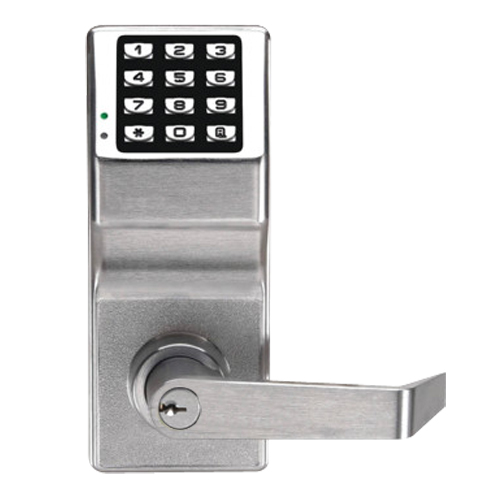
Alarm Lock DL2700: A Keyless Lock for a Door With No Wiring
Posted by Kent on 20th Aug 2026
Back office, stockroom, or a suite door in a strip center. It is keyed, and copies are out with a former employee and a cleaning crew. No control panel, no network drop, no power at the frame. Rekeying buys a year.
That door wants the DL2700-US26D Alarm Lock Trilogy T2 Series Standalone Digital Cylindrical Keyless Lock Leverset in satin chrome (US26D). Commercial-body lockset, battery powered, user list held at the door.
What the lock is doing, physically
Keypad, user list, clock, and batteries all live in the two halves bolted through the door. Mechanically it is a cylindrical lockset that replaces the lever in that door now. A valid code lets a motor in the chassis couple the outside lever to the latch retractor. A wrong code leaves that lever spinning free, connected to nothing. Hang on that lever and you are loading a part that never touches the latch, which is why a commercial standalone outlives a residential keypad knob.
A hardware-store keypad puts a code on a latch built for a bedroom, and it comes back off a door the public touches all day. Nor is this the keypad-plus-strike-plus-power-supply build covered in the article on standalone IEI keypads and why a keypad is only one third of the purchase. The Trilogy is one part.
A keyless lock for a door with no wiring: what standalone costs you
Standalone means the user list lives in the lock and nowhere else. No server holds a copy, nothing syncs. The internet goes down and the door still opens, because the door never cared.
Here is the bill. Adding a user is a trip to the door. Deleting a fired employee is a trip to the door. So is reading who came in last Tuesday. One door and six people, that is nothing. Six doors and real turnover, that is a morning every time somebody quits.
Price that administration alongside the lock. If the number comes out ugly, buy the transfer path below or a networked lock.
Which Trilogy: the selection logic
PIN only
Codes, no cards, nothing to issue and nothing to lose. It is the default, and right more often than buyers expect. The DL2700-US26D is the T2 version. The DL3200-US26D Trilogy T3 Series Standalone Digital Cylindrical Keyless Lock Straight Leverset is T3 with a straight lever, and the DL4100-US26D Trilogy Digital Cylindrical Keyless Lock Leverset sits in the same cylindrical family. The series step through different feature sets, mainly user handling and reporting. I will not guess capacities. Give us your headcount and say whether you need to know who opened the door.
PIN and prox together
The PDL3000-US26D Trilogy PIN/Prox Digital Cylindrical Keyless Lock Straight Leverset takes a credential as well as a keypad entry. Buy PIN/Prox when people already carry a badge, or when you want something you can collect at termination. A card you can take back. A code you cannot.
Prox only
Alarm Lock builds prox-only versions for sites where nobody should memorize anything, and a reader beats a keypad in gloves. Photograph both faces of a card and we will quote against it, because the credential technology has to match.
Networked
The DL6100-US26D Trilogy Networx Digital Cylindrical Keyless Lock Leverset answers the trip-to-the-door problem. Networx locks talk to software, so users push out and audit comes back without walking the building. It costs more per opening and needs the network side to exist, so ask what that looks like at your site.
Both sides of the door
Some rooms need control leaving as well as entering: a server closet off a shared corridor, a stockroom with two ways in. The DL5300-US26D Trilogy Double-Sided PIN-Code Access Digital Cylindrical Keyless Lock puts a keypad on each side. Read the egress paragraph below first.
Cylindrical, mortise, or narrow stile
Cylindrical
The bored round-hole prep most hollow metal and wood commercial doors carry. Everything above except the narrow-stile pair is cylindrical.
Mortise
A rectangular pocket machined into the edge of the door. Alarm Lock builds Trilogy in a mortise body too, and if a mortise lock is in that door now, you need it. Send us the model coming out.
Narrow stile aluminum storefront
This one gets ordered wrong constantly. An aluminum storefront door has a stile too thin for a cylindrical chassis, so it takes the narrow stile body: the DL1200/26D1 Trilogy Narrow Stile Digital PIN Only Keypad Lock with Straight Leverset, or the PDL1300/26D1 Trilogy Narrow Stile Digital PIN/PROX Keypad Lock with Straight Leverset if you want cards too. Glass in an aluminum frame means narrow stile. Order the DL2700 for that opening and it does not go in.
The key override decides whether it joins your key system
Every one of these is still a lock with a cylinder in it, and that cylinder is what people forget to specify. Our catalog lists these Trilogy locks as shipping with a Schlage C keyway cylinder for key override, with interchangeable-core versions for other keyways. Read that twice if your building is keyed to anything else.
Here is why it matters. Four keypad locks on four doors is four locks your master key does not open. The day the batteries go flat, the maintenance guy is standing there with a ring of keys that are all wrong. Tell us the building's keyway before you order. Sorting it afterward means pulling hardware back off doors you already paid to install.
The real trap: reprogramming forty users by hand
People buy the lock, hang it, and load six users. Two years on there are forty users, three of them left last spring, and somebody wants to know who was in the storeroom on the 14th. Sorting that out at the keypad is the real cost of a standalone lock.
Two parts exist for that. The ALPCI2-U Trilogy Audit Trail Computer Interface Cable ties a lock to a PC over USB, so programming and audit data move through software instead of your thumbs. The AL-DTMIII Trilogy Audit Trail Data Transfer Module is the handheld version: load it at the computer, walk the building, push users in and pull the audit out. More than one door, buy the module.
Confirm this before you order
Start with the door's rating and its egress requirement. On a required exit or a labeled fire door, what the lock does on the inside is a code question, and a keypad on the side people have to get out through is where installs fail inspection. Put it to the authority having jurisdiction first.
Then measure: door thickness, backset, existing prep, handing. Photograph the lock coming out and the edge of the door, and send it with any model number on the faceplate.
One more fork. If the door is remote, unheated, or nobody will ever change a battery, buy a mechanical pushbutton lock instead, laid out in the article on the no-battery mechanical pushbutton alternative. One code, no power, no audit.
Rest of the line is on the Alarm Lock hub and the wider keyless locks category.
Common questions
Does the Alarm Lock DL2700 need power or wiring at the door?
No. It runs on batteries and is fully standalone, which is the reason to pick it over a keypad-and-strike system. Nothing gets pulled to the frame. For battery type and expected life, check the cut sheet or call us.
How do I get the audit trail out of the lock?
With the ALPCI2-U USB interface cable or the AL-DTMIII data transfer module. The cable ties one lock to a PC. The module is portable: load it once and walk the building. Without either, you read the audit at the keypad.
Can I put a DL2700 on an aluminum storefront door?
No. An aluminum storefront door has a narrow stile that will not take a cylindrical chassis, so order the DL1200/26D1 for PIN only or the PDL1300/26D1 for PIN and prox.
Is a keypad lock allowed on a fire door or a required exit?
That depends on the door's rating and its egress requirement, and your authority having jurisdiction settles it. Confirm the rating and the egress path before ordering, especially for a double-sided lock like the DL5300-US26D.
Is PIN/Prox worth the step up over PIN only?
It is worth it when people already carry a badge, or when turnover is high enough that you want a credential you can take back. A code leaves inside somebody's head, and the only fix is changing it for everyone. For a small, stable group, PIN only is simpler.