
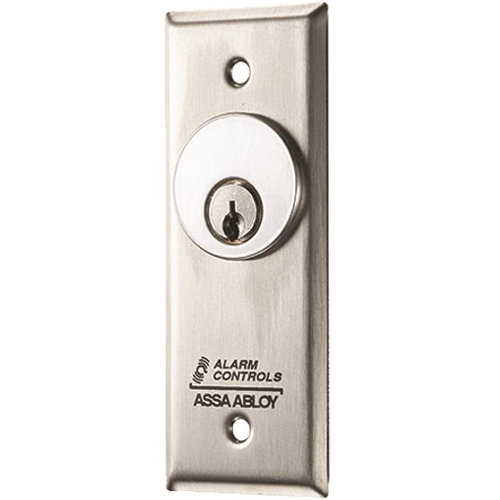
ASP SW-1 vs SW-2 vs SW-3: Wiring a Keyswitch Station
Posted by Kent on 13th Sep 2026
A mortise-cylinder keyswitch looks like a simple part on the door schedule until the wiring diagram shows up and someone asks whether it needs to shunt the alarm too, or just fire the strike. ASP Alarm Control sells three keyswitch stations that look almost identical on the plate and behave completely differently behind it, and the wrong one either leaves a relay doing nothing or leaves an alarm zone unshunted when it should have tripped.
SW-1: one circuit, momentary, the default pick
The ASP-SW-1 is a single-pole double-throw (S.P.D.T.) switch in momentary action, meaning it fires while the key is turned and releases the instant the key returns to center. That's the right behavior for a straightforward "turn the key, unlock the door" application feeding one relay input on an access control panel or power supply. It's rated 4A at 28VDC, the LEDs run on 12 or 24 volts AC or DC, and the stainless steel plate accepts a standard 1-1/8" mortise cylinder that isn't included — you supply the cylinder to match the building's existing keyway.
SW-2: same body, but it stays switched until you turn it back
The ASP-SW-2 is also S.P.D.T., same 4A at 28VDC rating, same 1-1/8" cylinder plate, but it's built alternate action instead of momentary: turn the key and the switch holds that state until the key is turned back. That's the one to specify when the application needs a maintained condition, not a pulse — holding a door unlocked for a shift, or holding an alarm zone shunted for as long as a maintenance crew is working, rather than firing once per turn.
SW-3: two circuits from one key turn
Two independent circuits from one key turn is what the ASP-SW-3 adds, stepping up to double-pole double-throw (D.P.D.T.) in momentary action, same physical plate and cylinder mount as the other two, still rated 4A at 28VDC. The second pole is what changes the job it does: one key turn can fire the door relay and, on a separate circuit, shunt an alarm zone or trigger a door-position monitor at the same time. That's the part to spec when a single keyswitch has to do two jobs on the same turn instead of running a second station beside it for the second circuit.
Matching the switch to the panel, not the other way around
A common punch-list mistake is picking the switch first and figuring out the wiring after. Before ordering, confirm what the access control panel or power supply actually expects on its keyswitch input: a momentary pulse (SW-1 or SW-3) or a maintained state (SW-2). A momentary switch wired into an input built for a maintained signal will unlock for an instant and immediately re-lock, which reads on a service call as "the keyswitch doesn't work" when the part is functioning exactly as built. All three stations are tamper-proof with slotted-head screws and terminate in colored leads, so the wiring itself is straightforward once the switch type is right.
The cylinder is on you, and that's not a flaw
None of the three ASP stations include the mortise cylinder. That's deliberate: a keyswitch is only useful if it takes the same key as the rest of the building, so the plate is designed to accept any standard 1-1/8" mortise cylinder in whatever keyway the facility already uses. Order the cylinder separately, keyed to match, and confirm the 1.25" depth behind the plate clears whatever is mounted on the other side of the wall or door frame before cutting the opening. A cylinder that's too long for the available depth is a return, not a wiring problem.
Keyswitch or panic pushbutton: they're not interchangeable
A keyed station and a pushbutton station solve different access problems, and it's worth being clear on which one a given opening actually needs. ASP's ASP-PBL-1 Latching Pushbutton Panic Station is a mushroom-head button, not a keyed cylinder: press it and it latches, with one normally-open and one normally-closed contact rated 10A at 35VDC or 120VAC, mounted on its own single-gang stainless plate. That's the right part for an emergency-release or panic application where anyone should be able to trigger it without a key. The SW-series keyswitches are the opposite case on purpose: they require a key specifically so an unlock or shunt only happens for someone authorized to turn it. Don't spec a keyswitch where the job calls for a panic button, or vice versa, because the whole point of each is who is allowed to trigger it.
Installation details that keep a punch list clean
All three keyswitch stations mount on the same stainless steel single-gang plate, so a station swapped later for a different action type (say, an SW-1 upgraded to an SW-3 for a second circuit) drops into the same cutout without a new box or plate. Confirm the LED indicator wiring matches the panel's expectation before final closeout: some panels want the LED to confirm "door unlocked," others want it wired to confirm "system armed," and a station wired backward reads correctly on the bench and confusingly on the wall. Test every keyswitch station through a full cycle, both directions on the alternate-action SW-2 and both poles on the dual-circuit SW-3, before the drywall closes up around the box.
Common questions
What's the practical difference between SW-1 and SW-2?
SW-1 is momentary: it fires while the key is turned and releases the instant the key returns to center. SW-2 is alternate action: it holds whatever state you turned it to until you turn it back. Pick based on whether the application needs a pulse or a maintained signal.
Why would I need the SW-3 instead of just using an SW-1?
The SW-3 gives you two independent circuits from a single key turn, useful when one key turn needs to both fire a door relay and shunt an alarm zone or trip a door-position monitor at the same time. An SW-1 only gives you the one circuit.
Does the mortise cylinder come with the keyswitch station?
No. All three ASP stations accept a standard 1-1/8" mortise cylinder that you supply separately, keyed to match the building's existing keyway.
What voltage do the LEDs run on?
12 or 24 volts, AC or DC, on all three stations. The switch contacts themselves are rated 4A at 28VDC.
Can I use one of these to unlock a door without touching the alarm system at all?
Yes. The SW-1 (momentary, single circuit) is the standard choice for a keyswitch that only needs to fire a door relay with no alarm interaction.
For the power side of the same access-controlled door, sizing the supply that actually runs the lock these switches feed, see Altronix LPS3C24X: Power Supply for a Maglock Door. The full ASP Alarm Control line is on the ASP hub.