
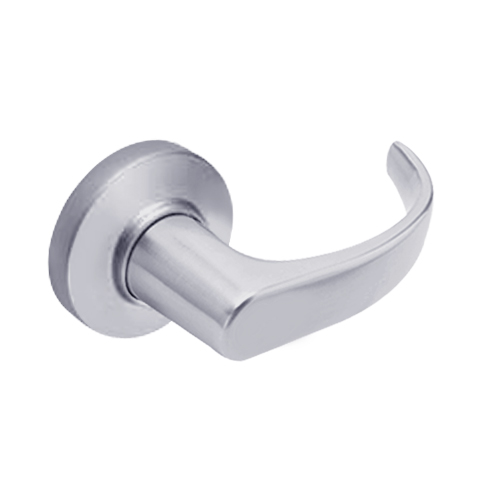
BEST 9K30 vs 9K37: Privacy or Entrance for a Dorm Suite Door
Posted by Kent on 29th Sep 2026
Same 9K body, two completely different jobs
A university housing office fitting out a new suite-style dorm floor has two locking problems that look alike on a punch list and are not alike at all. The door from the corridor into the suite needs to answer to the building's master key system, because facilities and an RA both need a way in. The door from the shared common room into each bedroom needs to do the opposite: lock for the resident, and lock out everyone else, RA included. Both doors can use the same BEST 9K Series cylindrical chassis, and both use lever handles, so they clear ADA operable-parts requirements without any extra spec work. What changes is the function code sitting in the middle of the SKU, and ordering the wrong one is the kind of mistake that doesn't show up until a resident calls facilities asking why a master key opens their bedroom.
BEST 9K30: privacy function, no keyway anywhere
The BEST 9K30L14CSTK626 is a non-keyed privacy function lock. Either lever rotates the latch. The outside lever locks when someone pushes the inside button, and it unlocks the moment either lever turns again from either side — there is no cylinder anywhere on the unit. That is exactly what a bedroom or bathroom door needs: the occupant controls the lock, and nobody, not a master key, not a control key, not a facilities pass, gets in without the occupant letting them in or the door being forced.
Spec-wise, the 9K series is BHMA A156.2 Series 4000, Grade 1 certified, with a 2-3/4" backset, a 9/16" solid brass latch throw, and it's built for standard 1-3/4" to 2-1/4" door thickness, the commercial slab range, not a thin residential door. It's also non-handed, so the same box works on a left-hand or right-hand bedroom door and nobody has to sort stock by swing before the install crew shows up. It's a cylindrical bored-in lock, not a mortise unit, so it drops into a standard ANSI prep without cutting a pocket.
BEST 9K37: entrance function, keyed and core-ready
The BEST 9K37AB14CSTK626 is the entrance function: the inside lever always turns free for exit, but the outside lever only turns when someone pushes the inside button out, or when someone turns a key in the outside lever from the corridor. Push the inside button and the outside lever locks again without touching a key, which is useful for a quick lockdown without fumbling for the right key on a ring of forty.
Note that the entrance function ships less cylinder. It's built with a 7-pin housing that accepts a BEST-format SFIC core, so a campus locksmith drops in the same control-keyed core running every other door on the property. That's the whole reason a school or a hospital specs BEST in the first place: rekeying a door is a core swap, not a locksmith visit. Order the core separately, matched to your existing keying program, not off the lock's own SKU. The lockset also ships with a standard STK strike, 2-3/4" x 1-1/8" with a curved lip, which matters if the frame prep on an older building was cut for a different strike style. Check the jamb before the crew shows up with a box of the wrong plates.
Reading the function code out of the SKU before you order
Both SKUs break down the same way: 9K is the series, the two digits right after it are the function code (30 for privacy, 37 for entrance), the letters after that describe the lever design and rose, STK is the strike, and the last three digits are the finish (626 satin chrome on both of these). Don't guess a function code off a part number you half-remember from another job. We traced both of these off the live product description before writing this piece, not off memory, and that habit is worth keeping: BEST runs a long list of function codes across the 9K line, and a wrong guess means a return shipment and a door that sat unlocked or over-locked for a week.
Don't let these two ship on the same truck by accident
Here's where it actually goes wrong on a job: a GC orders a pallet of 9K locks for a dorm renovation, the suite doors and the bedroom doors get boxed together because the SKUs look close on a quick scan, and installers hang whichever box is closest to the door they're standing at. A 9K37 on a bedroom door means the master key opens a resident's room. That's a housing-policy problem, and the kind of call facilities does not want to field from a parent. A 9K30 on the suite entrance means nobody but the people already inside can ever unlock it from the hall, which is its own headache the first time a resident forgets their key and the RA can't override it either. Sort the boxes by function code before the install crew touches a door, not after the walkthrough finds the mix-up.
Common questions
Can I put a 9K37 on a bedroom door instead of the 9K30?
You can order it, but you'd be handing every keyholder on that master system a way into a resident's private room. On student housing, medical, or any occupant-privacy door, stick with the 9K30 privacy function. The whole point is that nothing outside the room overrides the occupant.
Do I need to order a cylinder separately for the 9K37?
Yes. The entrance function ships less cylinder with a 7-pin housing that accepts a BEST-format SFIC core. Order your control-keyed core from your existing keying program so the new door matches everything else on the property.
What door thickness does the 9K series fit?
1-3/4" to 2-1/4", standard commercial slab range. It's a bored-in cylindrical lock on a 2-3/4" backset, not a mortise unit, so it won't need a pocket cut into the door.
Is the 9K series rated for heavy traffic?
Yes. It's BHMA A156.2 Series 4000, Grade 1 — the same durability class as the rest of BEST's commercial cylindrical line, built for the cycle count a dorm corridor or a school hallway puts on a lock.