
Buying Commercial Door Hardware Online: A Locksmith's Field Guide
Posted by Kent on 6th Jul 2026
The hardware is not the hard part. Commercial door hardware from the majors. Schlage, Von Duprin, LCN, Sargent, Corbin Russwin. Is as good as it has ever been. The hard part is the spec. Nearly every returned order I have seen in thirty years came down to the same thing: somebody bought the picture instead of the part number. Buy commercial hardware online the way a locksmith orders it over the counter and you will get the right part the first time. Here is how.
Start with grade, because the internet will not
Commercial door hardware is graded under ANSI/BHMA standards, and Grade 1 is the commercial benchmark. The lever sets and deadbolts stacked at a big-box store are mostly residential grades wearing commercial-looking finishes. On a door that gets used forty times a day, that difference is invisible. On a door that gets used four hundred times a day. A storefront, a school corridor, a warehouse man-door. The residential-grade lock is a service call waiting on the calendar.
If a listing does not state the grade, assume it is not Grade 1. A supplier who sells to the trade will say it plainly, because the trade asks.
Learn to read the SKU. It tells you everything the photo cannot
A real commercial hardware SKU is a specification in one line. Take a workhorse Schlage lever: ND53PD-RHO-626. That string reads: ND series (Schlage's Grade 1 cylindrical line), 53 function (entrance. Key outside, push-button inside), Rhodes lever style, 626 finish (satin chrome). Change one element and you have a different lock. ND80PD is the same lever in storeroom function: always locked outside, no way to leave it unlocked. Hang an entrance-function lock on a stockroom door and every employee who hits the button has just unlocked your inventory.
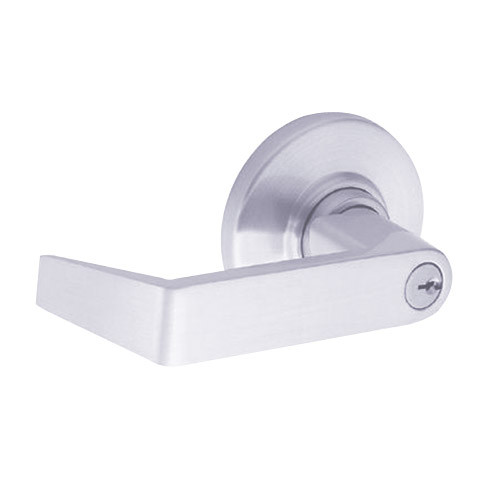
Same lever, same finish. The function code buried in the SKU is the only thing that says what this lock actually does. The photo will never tell you.
The photo cannot show a function code. It cannot show handing. It usually cannot even show finish accurately, because satin chrome and satin nickel photograph the same under studio lights. The SKU is the truth; the photo is decoration. Order from the SKU.
Fire-rated openings buy different hardware. No exceptions
If the door carries a fire label, everything on it must carry a rating too. On exit devices the giveaway is the suffix: a Von Duprin 99EO-F is the fire-rated version of the 99, and it has no dogging. No way to hold the latch retracted. Because a fire door must latch every single time it closes. A non-rated device on a rated door is not a bargain. It is a violation an inspector will tag, and it voids the opening. Before you shop, look at the label on the door edge. It decides half your order for you.
Deadbolts: the number after the letter matters
The single-cylinder Grade 1 deadbolt that belongs on a commercial or exterior apartment door is a Schlage B660P, not the look-alike sold in blister packs. Same brand on the box, different lock inside it. If you are choosing between deadbolt functions, we wrote a full guide: Which Schlage Deadbolt for an Exterior Apartment Door.
Closers are sized and configured, not picked by photo
A door closer is bought against the door: width, weight, interior or exterior, and, the one everybody misses. Which side of the door it mounts on and what arm that mounting needs. An LCN 4040XP with a regular arm is the heavy-duty standard for a reason, but the same closer body ships with different arms for parallel-arm and top-jamb mounts, and the arms do not interchange across LCN series without adapters. Order the closer and arm as one decision, not two.
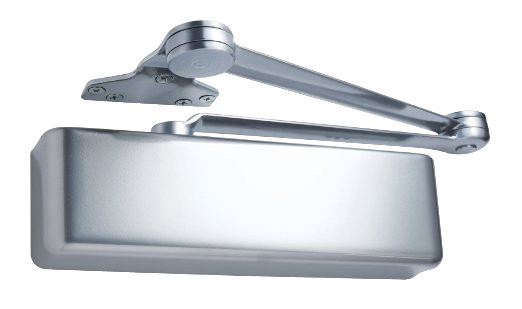
The 4040XP with a regular arm. The body is the easy part. The arm has to match how and where the closer mounts, and that is decided by your door, not the catalog.
Handing and finish: the two return generators
Handing. Stand outside the door. Hinges on the left and the door swings away from you: left hand. Hinges on the right: right hand. Swings toward you: it is a reverse. LHR or RHR. And reverse handing is exactly where lever trims and mortise locks get ordered wrong. If a SKU carries LHR or RHR, the part is handed and you must get it right.
Finish. Commercial hardware uses numeric finish codes, and the same finish wears two names depending on the line: 626 and US26D are both satin chrome. The default on commercial steel doors. 605/US3 is bright brass, 613/US10B is oil-rubbed bronze. Match the code, not your memory of the color.
The five checks before you click buy
2. Function. Entrance, storeroom, classroom, passage. The function code in the SKU, not the product photo, tells you.
3. Fire label. Rated door = rated hardware, with the rating in the model number.
4. Handing. If the SKU carries LH/RH/LHR/RHR, confirm it against the door, from the outside.
5. Finish code. 626/US26D satin chrome is the commercial default. Match the number to the rest of the opening.
Where to actually buy
Buy from a supplier that sells by full SKU, lists the commercial lines deep enough that you can pick function and finish instead of settling for what is on the shelf, and puts a human on the phone who has stood in front of a door. Lock Depot stocks the commercial lines this guide is built on, browse Schlage, Von Duprin, and LCN door closers, or call 877-365-5625 and describe the door. No automated phone trees. If you can send those three photos, we can spec the opening with you on the first call.