
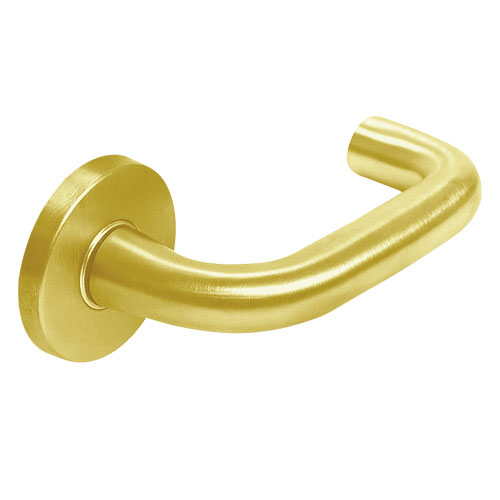
Corbin Russwin ML2010 vs ML2050: Passage or Dummy Trim
Posted by Kent on 24th Sep 2026
Two mortise trims that both do nothing, kind of
Neither the Corbin Russwin ML2010 nor the ML2050 locks anything. That's the point of both, and it's exactly why people order the wrong one. One has a working latch. The other doesn't have a latch at all. Get them backwards and you find out on install day, not before.
Function-code confusion is the single biggest source of return shipments on mortise hardware, and these two are near the top of the list. Nobody spends real time thinking about the leaf that doesn't lock. All the attention goes to the active leaf's security function, and the inactive leaf's trim gets picked in the last five minutes before the order ships. That's backwards. Get the active leaf wrong and you notice immediately. Get the inactive leaf wrong and you might not find out until the flush bolts wear out and someone discovers the "backup" lockset was never functional to begin with.
ML2010: Passage function, a real latch, no lock
The ML2010 is Passage function. Both levers always retract the latch. There's no locking mechanism to bypass, nothing to key, nothing to keep out anyone. What it does have is a working latchbolt, so the door stays shut against a normal push or a draft down the hallway, and it swings free the second someone turns either lever. That's the right lockset for a corridor door, a closet that just needs to stay closed, or any opening where "keep it latched" is the entire requirement and "keep people out" isn't part of the job.
ML2050: Half Dummy, a grip and nothing behind it
The ML2050 is Half Dummy trim. Fixed lever, no working latch mechanism behind it. It's a pull, meant for the inactive leaf of a pair of doors where the real latching and security is already handled by flush bolts top and bottom, or for anywhere someone just needs a grip to swing a door that has no functional reason to latch on its own. Order this for the inactive leaf, not the ML2010. A passage lockset on an inactive leaf is a working latch fighting against flush bolts that already hold that leaf shut, and that's a maintenance call waiting to happen.
Same lever design, same case front, different job entirely
Both come on the ML2000 Series mortise case, prepped to match the door cutout, so a pair of doors with one active ML2000 lockset and one dummy leaf still looks and preps identically from the hallway. Order the same lever design across both, Princeton or Lustra or whatever the spec calls for, and the pair reads as one matched set even though one side's doing real work and the other's just along for the ride.
The question that actually decides it
Does this leaf need to open and close on its own, without another leaf swinging first? If yes, and it just needs to latch without locking anyone out, that's the ML2010. If this leaf stays closed by other hardware and only needs a handle for the rare time someone actually opens it, that's the ML2050. I've had this exact mix-up called in as a warranty complaint, "the latch doesn't work," when the door was a dummy leaf that was never supposed to have one. It wasn't broken. It was ordered wrong.
Neither one replaces a real function lockset
Don't reach for either of these on a door that needs actual security. Passage has no lock. Dummy has no latch. If the opening needs to keep someone out, even casually, you want Privacy, Storeroom, or Classroom function instead, not a workaround built from passage or dummy trim because it happened to be on the shelf.
Where I actually see these ordered right
Double doors into a conference room, a cafeteria, or a gym are the usual home for this pair. One leaf carries real traffic and gets the ML2010 or a locking function depending on the room. The other leaf stays bolted top and bottom nearly all year and only swings open for a delivery or a big event, and that's the ML2050. Closets are the other common spot for the ML2010 specifically, anywhere a door needs to latch against drafts or a gentle bump but nobody's ever going to lock it.
Skip both if the building's maintenance team has a habit of "temporarily" pinning flush bolts open on the inactive leaf, which happens more than anyone likes to admit. A dummy lockset on a leaf where the bolts don't actually stay engaged just means an unlocked door with a handle on it. Fix the bolts, or fix the function code. Don't leave both broken and call it good.
For how Corbin Russwin's ML2000 function codes break down room by room, our ML2000 function guide covers the full lineup. And for the heavier-duty CL3300 cylindrical line on a campus-style building, see our CL3300 guide.
Common questions
What's the difference between Corbin Russwin ML2010 and ML2050?
The ML2010 is Passage function with a working latch and no lock. The ML2050 is Half Dummy trim with a fixed lever and no latch mechanism at all.
Which one goes on the inactive leaf of a pair of doors?
The ML2050 half dummy. The inactive leaf is normally held by flush bolts, so it needs a grip, not a working latch fighting against hardware that's already securing the door.
Can the ML2010 lock at all?
No. Passage function has no locking mechanism. Both levers always retract the latch. If the opening needs any locking capability, look at Privacy, Storeroom, or Classroom function instead.
Do the ML2010 and ML2050 use the same mortise case prep?
Yes, both are built on the ML2000 Series mortise case, so a pair with one active and one dummy leaf preps and installs consistently.
Why would a door need a dummy lockset instead of just a pull handle?
Matching appearance mostly. The ML2050 keeps the same lever design and mortise-case look as the active leaf's real lockset, so the pair reads as one matched set instead of mismatched hardware.