
Corbin Russwin ML2057 vs ML2059: Does Your Storeroom Need the Add-On Deadbolt
Posted by Kent on 26th Sep 2026
Both are called storeroom function. Only one has a deadbolt in the case.
Storeroom function is the default answer for a supply closet, a utility room, a stockroom, anywhere the door needs to lock itself every time and the outside lever should never work without a key. Corbin Russwin sells two versions of that answer in the ML2000 line, and the difference between them is a single mechanism most buyers don't think to ask about until the room behind the door holds something worth a second lock.
ML2057: storeroom function, one lock, one latch
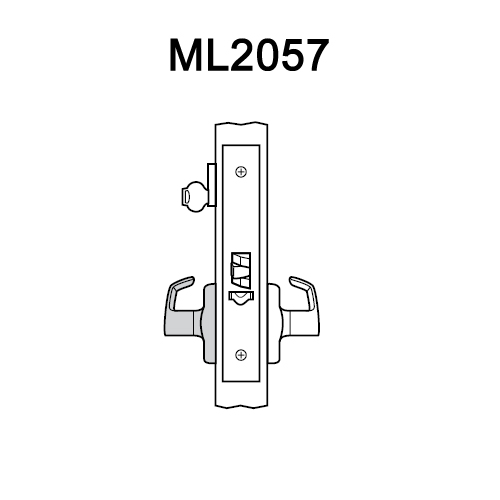
The ML2057 is a standard Grade 1 mortise storeroom lockset. The outside lever is always locked and retracts only by key, the inside lever always exits free, no exceptions, so anyone inside can leave without needing a key regardless of the outside lock state. That's the whole function, and it's the correct, sufficient lock for the overwhelming majority of rooms that just need to stay secured between visits, a supply closet, a janitorial room, general storage. The mortise case is a full mechanical lock body set into the door, not a bored cylindrical lock, which is why it holds up on heavy commercial and institutional doors that see years of hard use.
ML2059: the same function, plus a deadbolt in the same case
Corbin Russwin labels the ML2059 Security Storeroom, and the difference is exactly what the name says: the same locked-outside, free-inside lever behavior, with a deadbolt built into the same mortise case as a second, independent locking point. Corbin Russwin builds this function for high-traffic commercial, institutional, industrial, and government applications where a single latch, however well-built, isn't considered enough for what's behind the door. It's still one lock, one prep, one strike, the deadbolt shares the case rather than requiring a second bore and a second lock the way an auxiliary deadbolt would on a lighter-duty door.
When the extra deadbolt is worth specifying
Reach for the ML2059 when the room holds something that justifies a second locking point beyond the standard latch: a narcotics or medication storage room, a server or telecom closet, an evidence room, a cash or valuables room, a tool crib with expensive equipment, anywhere a facility's insurance carrier, compliance auditor, or internal security policy specifically calls for a deadbolt in addition to the primary lock. If nobody has raised that requirement and the room is ordinary storage, the ML2057 is the right call and the deadbolt is an unnecessary extra step at lock time for staff who already have to juggle enough keys.
Corbin Russwin also points buyers who need to go further than the ML2059 toward the ML2000HS high-security and ML2000VR vandal-resistant variants, which add stainless steel escutcheons with tapered edges and tamper-resistant Torx screws for doors that see attempted forced entry or vandalism on top of the security requirement. That's a step up from what either lock covered here is built for. If the ML2059's deadbolt still feels light for the threat the room faces, that's the direction to look, not a heavier lever trim on the same case.
What installing the deadbolt version actually changes for staff
The ML2059's deadbolt is a separate throw from the latch, which means locking the room fully after hours is a second action, not automatic the way the latch locking behind you is. That's the tradeoff for the extra security: someone has to remember to throw the deadbolt, and a room that relies on the deadbolt for its real security but where staff routinely skip that step isn't actually getting the benefit the lock was specified for. If the room's security plan depends on the deadbolt being engaged every night, that has to be a real, enforced habit, written into someone's closing checklist, not a line item on the hardware schedule.
Same trim, same finish, one mechanism apart
Both locks here ship with the Lustra lever in bright brass (605), and both are also available with the Regis lever for buildings standardizing on that trim instead. The mortise case dimensions and door prep are consistent across the ML2000 line, so switching a room from ML2057 to ML2059 later, if the use of the space changes, is a lock swap against an existing prep, not a new door bore.
Confirm door thickness and backset against the mortise pocket before ordering either function, the ML2000 case is a standard mortise prep, but a door that's already been bored for a different manufacturer's mortise lock can have a pocket that doesn't quite match Corbin Russwin's template without some fitting. That's a five-minute check against the door in front of you, and it's cheaper to catch before the lock arrives than after.
Both are in stock and ship from the Corbin Russwin hub. For the broader restroom-versus-office function decision on the same ML2000 case, see the ML2000 function piece, and for a heavier-duty cylindrical option on a campus-traffic door, the CL3300 piece covers that alternative.
Common questions
Does the ML2059's deadbolt lock automatically when the door closes?
No. The storeroom latch locks itself on close the same as the ML2057. The deadbolt is a separate, manual throw and has to be engaged on purpose for the room to get the extra security it's there for.
Can the inside lever always open the door on the ML2059, deadbolt included?
The lever function matches the ML2057, free exit from inside regardless of the outside lock state. Confirm with your local code official whether the deadbolt is permitted on an egress door in your jurisdiction before specifying it there.
Is the ML2059 the same as a high-security or vandal-resistant mortise lock?
No. Corbin Russwin's ML2000HS and ML2000VR variants go further, with stainless steel escutcheons and tamper-resistant screws for doors facing forced entry or vandalism. The ML2059 adds a deadbolt to standard storeroom function, it isn't hardened hardware.
What's the actual difference in the door prep between the two?
None. Both use the same ML2000 mortise case and strike, so a door prepped for one accepts the other without a new bore.
Which lever styles are available on both functions?
Lustra and Regis lever trims are both available on the ML2057 and ML2059, in the finishes Corbin Russwin offers across the ML2000 line.