
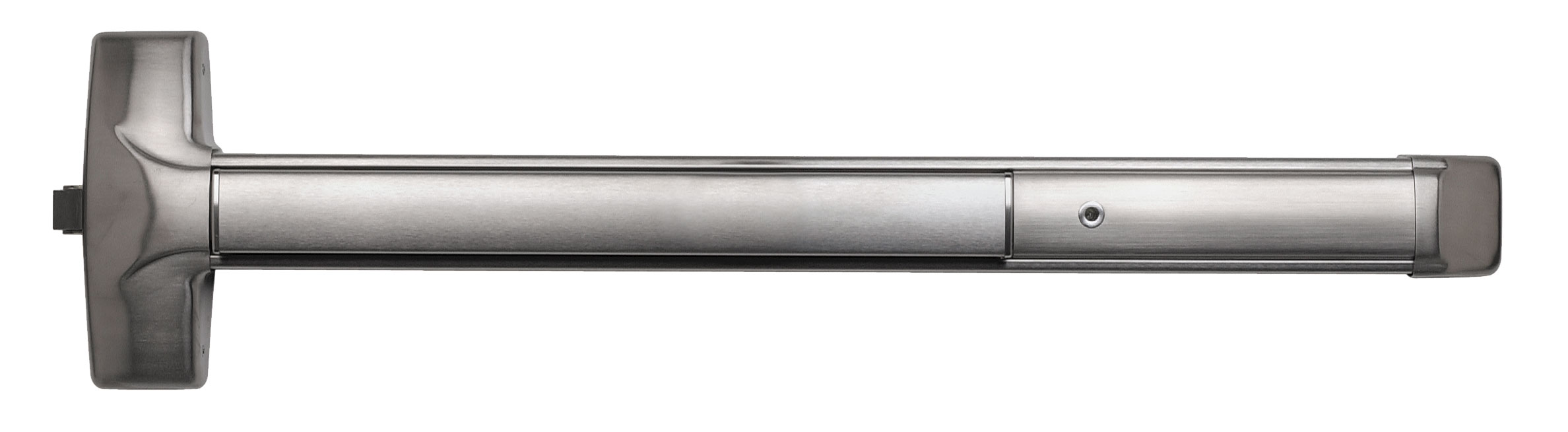
Detex Advantex 10: The Exit Device for a Door That Gets Abused
Posted by Kent on 21st Aug 2026
Every facilities director has one. The gym door, the arena concourse door, the man-door on the shipping side of the warehouse. The bar is loose in its mounts, the latch is chewed, and the device has been replaced twice since the building opened. That is office-grade hardware on a door taking thousands of hard cycles a week. Detex built the Advantex line for that opening. Buying the right one is six decisions.
Why an abused door eats exit devices
Exit devices fail in predictable places. The touchpad wears from cycle count alone. The latch stops lining up because people hit the door at a run and the frame takes that beating. Screws walk loose from the door slamming the stop all day. You want the heavy duty build, not the economy one, and the simplest latching arrangement the door allows. No device fixes a bent frame, the part people skip.
Which Detex Advantex exit device for a door that gets abused
1. Wide stile or narrow stile
This fork decides whether the device fits. The 10 series is wide stile, for hollow metal and wood doors. The 40 series is narrow stile, for aluminum storefront, where the vertical stile leaves almost no width to land hardware on. A wide stile device will not sit flat there.
Hollow metal gym or corridor door: Detex Advantex 10 Wide Stile Heavy Duty Rim 36" (10 HD 630 99 36) in satin stainless steel, also listed as the Detex Advantex Wide Stile Rim Exit Device (10W HD 630 99 36). Aluminum: Detex Advantex 40 Narrow Stile Heavy Duty Rim 36" (40 HD 693 99 36) in black painted.
2. Rim, surface vertical rod, or concealed vertical rod
This one sets how much maintenance you sign up for. A rim device latches into a single strike on the frame: one latch, one strike, one thing to adjust. A vertical rod device latches top and bottom, which is what a pair with no mullion needs.
| Latching type | Use it when | Maintenance reality |
|---|---|---|
| Rim | Single door with a frame strike, or a pair with a mullion | Fewest parts, least to adjust |
| Surface vertical rod | Pair with no mullion, rods on the door face | Two latches to adjust, exposed rods take hits |
| Concealed vertical rod | Same job, rods hidden in the door | Best looking, hardest to service |
Honest advice for an abused opening: if a mullion is possible, put a rim device on the mullion and walk away. Rods mean more for a tech to chase every semester. When it will not, both styles are here. Surface: Detex 50 Series Advantex Surface Vertical Rod 48" (50 HD 630 96 48X84). Concealed: Detex Advantex 10 Wide Stile Concealed Vertical Rod Cylinder Dogging 36" (10 EA CD 630 99 36), which also carries a built-in exit alarm.
3. Fire rated or not
If the door carries a fire label, you buy the fire rated device: Detex Fire Rated Advantex Wide Stile Rim Exit Device (F10 EA LD 630 99 36). A fire door has to latch every time it closes, because the latch is what holds it shut. That is why a fire rated device has no mechanical dogging. No hidden setting, no field trick. Defeating that latch is the most common thing I get asked to help with on a school door. The answer is no.
4. Cylinder dogging on the non-rated doors
On a non-rated door, cylinder dogging answers a real behavior problem. During the school day or an event, staff want the door pushing open freely. Deny them that and they solve it with a brick. Cylinder dogging holds the latch back with a key and puts it right with a key. Two devices here do that: the concealed vertical rod above, and the Detex Advantex 40 Narrow Stile Economy Rim Cylinder Dogging 36" (40 EB W CD 630 99 36) for aluminum, which pairs cylinder dogging with a battery-powered exit alarm. Where a door should never be held open at all, you want a different tool: the Detex ECL-230 for a propped back door.
5. Alarm on the bar, or a separate box
Two of the devices above carry the alarm inside the bar instead of in a box beside it. On an abused opening that is one thing to mount, one thing to power, and one less bracket to pry off. Tell us whether you want the alarm in the device or standing alone. It changes the part number and it changes the install.
6. Device length
Length follows door width, so measure the door. Do not guess off the old device, and do not assume both leaves of a pair match. Wider openings take the Detex Advantex 10 Wide Stile Heavy Duty Rim 48" (10 HD 630 99 48) rather than the 36".
6. Outside trim
Trim is a separate purchase and a separate decision: exit only, a night latch, a lever, or a knob. For a knob, use the Detex 03C Knob Trim for Advantex (03C 630) in satin stainless steel. Settle it before you order, not after somebody asks how the custodian gets in.
The traps
Ordering the device without the trim. The bar goes on, the door works from inside, and then staff need to key in from outside.
Ignoring the frame and the strike. On an abused opening the frame is beat up already, and a new device on a bent frame will not latch reliably. Real money spent, door still not catching.
Assuming the old prep carries over. Confirm the door hand, the existing prep, and whether the door is rated. A device handed wrong is a return and a second trip. And if you buy fire rated, buy it knowing you cannot dog it down.
What to measure and confirm before you order
- Door width, measured. Not the old device length from memory.
- Door material: hollow metal, wood, or aluminum. This picks the stile width.
- Single door or a pair, and whether there is a mullion.
- Fire label present or not. Look at the door edge.
- The existing prep and the door hand.
- Frame and strike condition.
Send us those six plus the finish and we will confirm the full part number, option string included. That string is where wrong orders come from, so let us build it with you. The rest of the line sits on the Detex hub. On a quiet side exit the Advantex is more device than the door needs, the case I made in the Falcon 25 write-up. Match the device to the abuse.
Common questions
Can you dog down a fire rated exit device?
No. A fire rated device has no mechanical dogging by design, because a fire door has to latch every time it closes. No setting and no accessory changes that. If the door must push open freely all day, you need an electrified arrangement reviewed with your AHJ.
What is the difference between a wide stile and a narrow stile exit device?
Wide stile fits hollow metal and wood doors; narrow stile fits aluminum storefront, where the stile is too slim to carry a full-width device. In the Advantex line the 10 series is wide stile and the 40 series is narrow stile.
Do I need vertical rods, or will a rim device work?
A rim device works whenever the door has a frame strike to latch into, which covers most single doors and any pair with a mullion. Vertical rods are for a pair with no mullion. On a heavily used door, rim on a mullion is the lower-maintenance answer.
Does the Detex Advantex come with outside trim?
No, outside trim is ordered separately. Decide up front whether the door is exit only or needs a night latch, lever, or knob. For a knob, the 03C 630 trim is the match. Skipping it is why an install needs a second visit.
What length exit device do I need?
Length follows door width, so measure before ordering. These come in 36" and 48". Measure each leaf of a pair separately rather than assuming they match, then send us the width and we will confirm the size.