
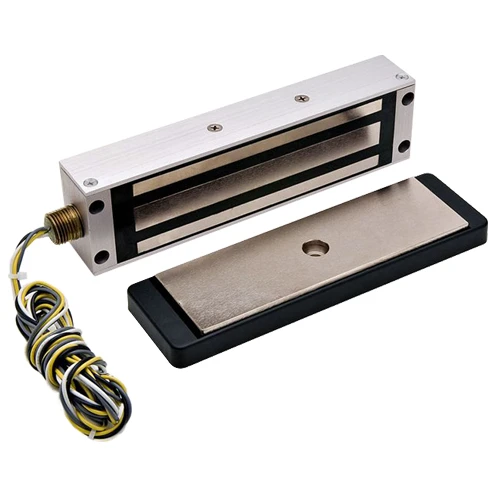
DynaLock 2013: Maglock for an Outdoor Swing or Slide Gate
Posted by Kent on 12th Sep 2026
Most maglocks are built for a door in a conditioned building, mounted to a frame that doesn't move and wired through a header nobody has to weatherproof. A pedestrian or vehicle gate is a different animal. It sits outside year-round, it flexes on its hinge or track in a way a door never does, and the post or frame it mounts to usually has no clean path to run wire through the way a door header does. The DynaLock 2013 series exists specifically for that opening, and picking the right variant comes down to how you're going to get wire into it.
Why a door maglock doesn't just bolt onto a gate
The 2013 is built and sealed for exposure: DynaLock rates it for sliding and swinging gates and any opening subjected to the elements, with a 1/2" threaded conduit nipple as the standard wiring entry from the side of the housing. The coil and housing assembly mounts rigidly to the post or frame, while the armature mounts to the gate itself in a way that lets it pivot slightly, which matters because a gate settles, sags, and shifts on its hardware over a season in a way an interior door frame doesn't. A standard indoor maglock has none of this built in, and mounting one outdoors on a gate post is how you end up chasing a corroded coil or a misaligned armature within a year.
Like any electromagnetic lock, the 2013 is fail-safe: it holds only while powered, at a rated 1200 lb holding force, and runs on field-selectable 12 or 24VDC input. Housing dimensions are 1-1/2" deep by 2-1/2" high by 9-1/4" long. That's the same basic recipe across the whole 2013 line; the variants below change how you get power to it and how much false-alarm tolerance you want out of the holding force.
Standard, rear wire exit, or Dynastat: picking by wiring path
The base 2013-US28 and the 2013-US28-RWE are the same lock with one difference that matters entirely on where the wire has to travel. The standard model exits wiring from the side, through that conduit nipple, which works fine when the post has a side channel or surface conduit run to feed it. The RWE version exits the wiring from the back of the housing instead, which is the variant to spec when the mounting surface itself is where the wire comes from, drilled straight through a post or a solid pier rather than routed around the side. Get this backwards on an order and you're either drilling a new entry point in the field or running conduit across a finished gate post that was never meant to carry it.
A third option, the 2013-US28-DYN, adds a Dynastat force sensor on top of the same body. Where the standard and RWE units simply hold at their rated force, the Dynastat variant senses the actual holding condition and is the one to spec where wind load, gate vibration, or someone leaning on the gate has been triggering false door-forced alarms on a monitored opening. If the gate isn't tied into a monitored access system that cares about that signal, the plain 2013-US28 or RWE does the same locking job for less.
Wiring and mounting notes that save a return trip
Every 2013 ships with 6-foot, 18-gauge flying leads, long enough to reach a nearby junction box but not a full conduit run, so plan the wire path length before the lock arrives rather than after. The all-plated coil and armature resist corrosion, which is the whole point on an outdoor install, but that protection doesn't extend to a wiring entry point that was left exposed or a strain relief that was skipped at the post. Low power draw also matters more here than on an interior door: a gate maglock is a common candidate for solar or battery-backed power at a remote entrance with no nearby AC run, and the 2013's low consumption extends how long that backup actually holds.
Where a gate maglock still needs mechanical backup
An electromagnetic lock, fail-safe by design, means the gate is unlocked the moment power drops, whether that's a planned outage or someone cutting the feed on purpose. On an interior door that tradeoff is usually acceptable because the building envelope is still secure. On a perimeter gate protecting a yard, a pool, or a utility enclosure, a power failure that drops the gate open is a real vulnerability and not a minor inconvenience. Pair the 2013 with a battery backup sized to the lock's actual draw, and where the gate also needs to hold when nobody expects a power interruption, keep a mechanical padlock hasp or slide bolt as a manual backup rather than relying on the maglock alone.
Common questions
Can the 2013 be used on a sliding gate as well as a swing gate?
Yes. DynaLock rates the 2013 for both sliding and swinging gate installations, and the pivoting armature mount is designed to compensate for the misalignment either gate type develops over time.
Do I need the Dynastat version if my gate isn't monitored by an alarm panel?
No. The Dynastat force sensor earns its cost on a monitored opening where false door-forced signals from wind or gate flex are a real problem. On an unmonitored gate, the standard or RWE unit locks exactly the same way for less.
What's the actual difference between the standard 2013-US28 and the RWE version?
Only where the wiring exits the housing: the standard unit exits from the side through a threaded conduit nipple, and the RWE exits from the back. Pick based on which direction the wire is actually going to travel from your power source to the lock.
Is 1200 lb holding force enough for a gate?
That's the rated force for the whole 2013 line, and it's sized for pedestrian and light vehicle gate applications rather than a heavy vehicle barrier arm. For a gate carrying more mass or more wind load, confirm the specific opening's requirements against this rating before ordering.
Does the 2013 need a separate weatherproof enclosure?
No. The housing itself is sealed and finished for outdoor exposure, which is the reason to spec a gate-rated maglock like the 2013 in the first place rather than an indoor door unit in a field-built enclosure.
For sizing a maglock by raw holding force on a standard door rather than a gate, see DynaLock 2500 vs 2000 vs 3000: Sizing a Maglock by Holding Force. The full DynaLock line, including strikes and the higher-force door series, is on the DynaLock hub.