
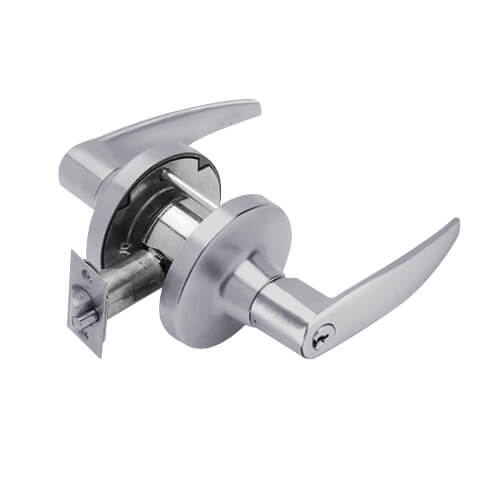
Falcon T561 vs T581: Classroom or Storeroom Lock for a School Door
Posted by Kent on 15th Sep 2026
The mix-up that costs a service call
I get calls from school maintenance staff who ordered "classroom function" and got a box of locks that lock the wrong way for the job. On paper, classroom and storeroom function locks look like cousins: same chassis, same lever, same cylinder, and to a maintenance director skimming a spec sheet they read the same. On the door, they behave completely differently, and you find out the hard way, during the first fire drill or the first time a teacher needs to step into the hall and grab something.
The Falcon T Series covers both functions on the same chassis. The T561PD-A-626 is classroom function, the T581PD-A-626 is storeroom function, and they ship in the same satin chrome finish with the same Avalon lever. Nothing on the box tells you which one locks down harder. You have to know the function code.
Classroom function: the teacher's lock
The T561 is built around one habit: a teacher needs to lock the door from the hallway side without stepping back inside the room. Classroom function keeps the inside lever free at all times, so nobody in the room ever has to think about a key to get out. The outside lever locks and unlocks with a key, and it stays in whatever state the last key turn left it in. Lock it before first period and it stays locked until someone with a key turns it back, no matter how many people cycle through from the inside.
That last part is what makes it a lockdown lock. During a drill or a real event, a teacher standing in the hallway can lock the door in seconds without going back inside to flip a thumb-turn or hunt for an interior control. The T561 is rated ANSI/BHMA A156.2 Series 4000 Grade 1, the top durability tier for a cylindrical chassis, which matters on a door that gets slammed, kicked, and cycled hundreds of times a day for nine months a year.
Storeroom function: no button to leave set
The T581 solves a different problem. On a storeroom, supply closet, or equipment room, you don't want anyone able to leave the door unlocked by accident, and you don't want a thumb-turn or a push-button that a kid, a contractor, or a distracted staffer can leave in the wrong position. Storeroom function fixes the outside lever solid all the time. A key retracts the latch to get in, and the door relocks itself the moment it swings shut behind you. There's no way to prop it unlocked from either side.
That's the wrong lock for a classroom, because a teacher who needs to step into the hall and back can't pull the door shut and expect it to still act like a passage door. It's also the wrong lock anywhere staff cycle through all day needing it to stay open, because every pass means unlocking it again with a key. Put the T581 on rooms that should always come back to locked on their own: the AV closet, the boiler room, the chemical storage room, the server closet.
Two more functions on the same chassis
The T Series line runs wider than these two. The T501PD-A-626 is entry function: keyed outside with a turn-button inside that holds the outside lever locked, while the inside lever always allows free egress. That's the front-office or single-occupant lock, not the classroom lock, because whoever's inside can leave the button engaged and there's no requirement to cycle a key to reset it.
The T101S-A-626 is passage function, no lock at all: both levers always retract the latch. That's for closets, storage rooms with nothing worth securing, and interior halls where the door only needs to close and latch, not lock. Every function in the line runs the same 6-pin cylinder pinned to 5 chambers and the same 2-3/4" backset cylindrical prep, so a facility running a mix of functions across a building can standardize on one keyway and one installer template.
If the same corridor also carries panic hardware on a rated stairwell or exit door, that's a different Falcon line entirely. I covered picking a budget-grade exit device for that job in the Falcon 25 Series piece.
Ordering the right one the first time
When a purchase order says "classroom function" or "storeroom function" with no model number attached, don't assume the supplier's default matches what you meant. I've seen a change order get filled with storeroom-function locks on a wing of classrooms because whoever wrote the PO used "secure function" as a loose description, and the distributor's default for that phrase was storeroom. The fix cost a re-order and a return trip to swap out forty-some cylinders. Put the model number on the order, T561PD-A for classroom or T581PD-A for storeroom, and that removes the guesswork on both ends.
Common questions
Can I convert a T581 storeroom lock to classroom function later?
No, not as a field adjustment. Classroom and storeroom function are built into the lock's internal cam, not set with a switch or a screw. Changing function means ordering the correct chassis, not reworking the one you already have.
Is classroom function less secure than storeroom function?
They're both Grade 1 chassis with the same cylinder and the same throw. The difference is behavior, not strength. Classroom function stays locked until a key turns it back; storeroom function relocks itself automatically. Neither is weaker than the other, they're built for different habits at the door.
What's the difference between classroom and entry function?
Entry function (T501) locks the outside lever with an inside turn-button that anyone inside can set or release, with no requirement to use a key to reset it. Classroom function (T561) only locks and unlocks from the outside with a key, with no inside control at all. A classroom door should never have a turn-button a student or visitor could reach.
Where can I see the rest of the Falcon lineup?
The Falcon hub carries the full T Series along with Falcon's exit devices and mortise locks, if you're speccing more than one function for the same building.