
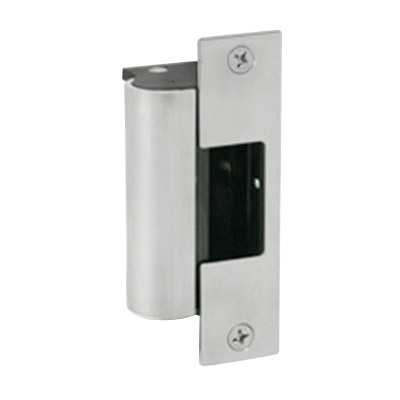
HES Electric Strike or Von Duprin 6300: When a Maglock Makes More Sense
Posted by Kent on 27th Sep 2026
HES Electric Strike or Von Duprin 6300: When a Maglock Makes More Sense
I get this question from integrators more than almost any other on an access-control job: strike or mag? Both will lock the door and both will talk to a card reader. They are not interchangeable, and picking on price or on whatever the last job used is how you end up back on site explaining to the fire marshal why the exit doesn't work right. Here's the honest call, not the sales pitch.
The one question that decides it: what happens to the lock function on power loss
A maglock has no mechanical lock function at all. It's a slab of steel held to an armature plate by an electromagnet. Kill the power and the door is open, full stop, which is why every maglock installation needs a fire-alarm interconnect and usually a request-to-exit device or a breakglass to satisfy code for free egress. An electric strike is different: the door still has a real mechanical lockset or exit device doing the locking, and the strike only controls whether the keeper releases. Cut power to most electric strikes and the mechanical lock or panic bar still lets people out from the inside, strike or no strike. That single difference is why I lean strike first on most commercial doors and reach for a maglock only when the opening genuinely calls for one.
When a strike is the right call
Pick an electric strike when the door already carries a mechanical lockset, a mortise lock, or a rim exit device, and the job is adding access control on top of hardware that's already there. The HES 1006CLB is the standard pick for a cylindrical or mortise lock behind an ANSI 4-7/8" prep, and it ships as a complete kit with the faceplates a retrofit needs. Where the door takes real abuse, an exterior entry the public pulls and kicks all day, step up to the HES 1500, rated for 1,500 lbs static and 70 ft-lbs dynamic. Where the door runs a rim exit device instead of a lockset, and especially where the frame is fire rated, the Von Duprin 6300 does the job without cutting the frame: it surface-mounts on a few holes, carries a UL10C fire rating to 3 hours, and ships fail-secure only, which is exactly what a fire-rated opening needs. All three keep the door's own mechanical egress hardware doing the actual unlocking from the inside; the strike only ever governs entry from the outside.
When a maglock is actually the better tool
A maglock earns its place where there's no mechanical lock to electrify, or where holding force matters more than a mechanical latch can deliver. Glass doors with no stile to mortise a lock into, a lobby turnstile, a gate, a pair of doors that need serious holding force against people leaning on them, these are maglock territory. Maglocks also mount without touching the door's existing hardware at all, which is useful when the client won't let you modify a historic frame or an aluminum storefront system. The tradeoff is the one above: no power, no lock, so the fire-alarm tie-in and the request-to-exit hardware are not optional, they're the code requirement that makes a maglock legal to install at all.
Fail-safe and fail-secure mean something different on each
On a strike, fail-secure keeps the door locked when power drops, and the mechanical lock or panic bar still lets people out from the inside. That's the right default for almost every perimeter door. Fail-safe unlocks the strike on power loss, and you only want that where a life-safety code specifically requires the opening to free on power failure. A maglock doesn't have a fail-secure mode in the same sense, it's inherently fail-safe by design, unlocked the instant power drops, which is exactly why code treats a mag differently from a strike and demands the extra monitored hardware around it.
Installation and the frame
A strike needs a cutout, either the one already there from an older strike or a fresh one cut to template, unless you pick a surface-mount design like the 6300 that skips the cutting entirely. A maglock needs a flat mounting surface on the frame head and a matching armature plate on the door, with careful attention to gap and alignment since holding force drops fast if the plate doesn't sit flush. Neither is harder to install than the other; they're different jobs. If the frame can't be modified at all, a surface-mount strike or a maglock are your two real options, and the maglock's code overhead is the price of skipping the mechanical lockset entirely.
Common questions
Electric strike or maglock, which is more secure?
Holding force numbers favor the maglock on paper, but a strike backed by a real mechanical lock or panic bar gives you secure egress without a fire-alarm interconnect. Security on a commercial door is about the whole opening, not just one number, and for most doors that already carry a lockset, a strike behind it is the more defensible install.
Does a maglock need a fire alarm connection?
In almost every jurisdiction, yes. Because a maglock has no mechanical lock function, code requires it to release automatically on a fire-alarm signal along with a request-to-exit device or push-to-exit button for normal egress. Skipping this is a code violation, not a shortcut.
Can I put an electric strike on a fire-rated door?
Yes, if the strike itself carries a fire rating for that application. The Von Duprin 6300 is UL10C listed to 3 hours and ships fail-secure only for exactly this reason. Confirm the strike's own listing, not just the door's, before you order.
Which one costs less to install?
A strike retrofit onto existing lockset hardware is usually cheaper since you're adding one component to a system that's already there. A maglock install often costs more once you price in the required fire-alarm interconnect, request-to-exit hardware, and door-position monitoring that code demands around it.
Lock Depot stocks HES electric strikes and Von Duprin strikes and exit devices, all in stock and ready to ship. Start at the HES electric strikes hub or the Von Duprin hub, or if the door genuinely needs a maglock instead, see Securitron M680 Maglock for a Door You Can't Mortise and DynaLock 2500 vs 2000 vs 3000: Sizing a Maglock by Holding Force. Or call 877-365-5625 and tell us what's on the door now. We'll tell you straight whether it needs a strike or a mag.