
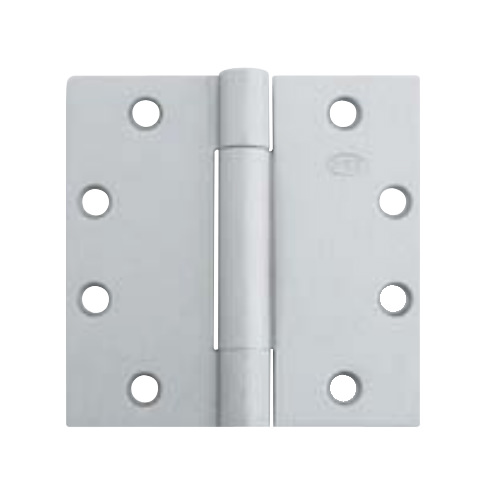
Ives 3CB1 vs 3PB1: Ball Bearing or Plain Bearing Hinge
Posted by Kent on 16th Sep 2026
The question: does this door need a bearing hinge at all?
Not every door swings enough to justify a ball-bearing hinge, and not every hinge on a commercial job needs to be the heaviest option on the price list. Ives sells its standard 3-knuckle full-mortise butt hinge in two bearing types built for two different duty cycles: the 3CB1 concealed bearing hinge and the 3PB1 plain bearing hinge. Same footprint, same mortise, same mounting. The difference lives entirely inside the knuckle.
3CB1: concealed bearings for a door that swings all day
The Ives 3CB1 hides its bearings inside the knuckles, smoothing the swing and cutting wear on medium-frequency doors. It mortises into the door edge and the frame rabbet exactly like a standard butt hinge. It carries standard swinging-door duty for interior and exterior openings, and it is certified to ANSI/BHMA A156.1, the baseline hinge standard most commercial specs call out.
Concealed bearings matter most on a door that gets opened and closed constantly through the day: an office suite entrance, a classroom door, a break room. The bearing reduces the metal-on-metal friction at the knuckle that would otherwise wear a plain hinge's pin and barrel over years of cycling, and it keeps the door from developing that low, dragging squeal that plain hinges pick up once they wear.
3PB1: plain bearing for lower-frequency doors
The Ives 3PB1 uses the same 3-knuckle full-mortise body without the internal bearing, built for lower-frequency residential and light-commercial doors where heavy cycling is not expected. It is the same ANSI/BHMA A156.1-certified hinge, sized and mortised the same way as the 3CB1. The tradeoff is straightforward: less internal hardware, lower cost, and a duty rating that assumes the door is not swinging hundreds of times a day.
A closet door, a storage room, an interior residential door, or a light-commercial office that sees normal foot traffic rather than constant transit are all reasonable homes for a plain bearing hinge. Putting a 3CB1 on a door like that is not wrong, but it is spending bearing hardware on a door that will never wear one out either way.
Sizing: 3-1/2" or 4-1/2"
Both the 3CB1 and 3PB1 are stocked in 3-1/2" x 3-1/2" and 4-1/2" x 4-1/2". The 3-1/2" size is standard for lighter residential and interior commercial doors; the 4-1/2" size is the common call for heavier commercial doors, thicker stiles, or wider doors that put more leverage on the hinge knuckle. Match hinge size to the door manufacturer's spec sheet where you have one. When you do not, a heavier or wider door is the signal to size up rather than assume the smaller hinge will hold.
Both lines are also available with a non-removable pin (NRP) option, which pins the hinge barrel so the pin cannot be driven out from the hinge side while the door is closed. Specify NRP on any out-swinging door where the hinge side is exposed to the outside, since a removable pin on an outswing exterior door is a known bypass a plain hinge does nothing to stop.
Finish and quantity
Both series stock in a wide finish range, including primed for paint, bright brass (632), satin brass (633), satin bronze (612), satin nickel (619/652), and bright chrome (651). Order three hinges per standard door, four for an oversized 7' to 8' door, the same convention that applies across full-mortise butt hinges generally.
When neither is the right hinge
Both the 3CB1 and 3PB1 assume standard-weight, standard-frequency service. A door that gets slammed constantly, carries closer-driven force on every cycle, or sees institutional-grade abuse is a candidate for a heavy-weight ball-bearing hinge instead, and a door that tears its hinge screws out of the frame repeatedly is often better served by a continuous hinge that spreads the load along the full height of the door rather than concentrating it on three points.
Common questions
What's the real difference between a concealed bearing and a plain bearing hinge?
A concealed (ball) bearing hinge has a bearing inside the knuckle that reduces friction as the door swings, cutting wear on doors that cycle often. A plain bearing hinge is a straight pin-and-barrel design with no internal bearing, built for lower-frequency doors where that extra wear protection is not needed.
Can I use a 3PB1 on an exterior door?
Yes, both the 3CB1 and 3PB1 are rated for interior and exterior openings. The choice between them is about swing frequency, not indoor versus outdoor placement.
How many hinges do I need per door?
Three hinges for a standard-height door, four for a 7' to 8' door. Taller or heavier doors sometimes call for a fourth hinge even at standard height if the door manufacturer's spec calls for it.
Should I size up to 4-1/2" if I'm not sure which size my door needs?
Check the door manufacturer's hardware schedule first. If none is available, 3-1/2" covers most residential and light-commercial doors and 4-1/2" covers most standard commercial doors; a heavier or wider-than-standard door is the signal to size up.
What does the non-removable pin option protect against?
It keeps the hinge pin from being driven out of the barrel while the door is closed, which matters on an out-swinging exterior door where the hinge barrel is exposed to anyone standing outside. Specify NRP on any outswing exterior opening.
Lock Depot stocks both the Ives 3CB1 and 3PB1 in both sizes and the common commercial finishes. See the full hinge line on the Ives hub, or call 877-365-5625 if you are not sure which bearing type or size your door needs.
Related reading: Ives 700 Continuous Hinge: For a Door That Keeps Tearing Out Hinges, the fix for a door that has already outgrown a three-hinge install.