
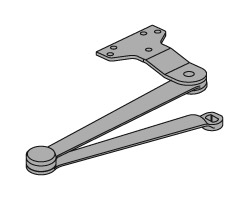
LCN 4110 Series Arm: EDA, CNS, or the Blade-Stop Spacer
Posted by Kent on 2nd Oct 2026
LCN 4110 Series Arm: Matching a Replacement Arm to a Closer That's Still Good
The closer body is fine. It still swings the door shut, still holds pressure, still has years left in it. What's bent, cracked, or just missing is the arm. That's a different repair than most people assume, and ordering the wrong replacement means a second shipment and a second trip.
Door closers fail two predictable ways: the body itself wears out, or a single sub-component, arm, shoe, cover, mounting plate, breaks first while the rest of the closer is nowhere near end of life. If you've already got a working LCN 4110 closer body on the door, replacing just the arm is almost always the right call. It saves the labor of re-templating a fire-rated door, and it keeps the original configuration intact so mounting prep and geometry don't shift.
EDA: Extra Duty Arm, the standard replacement
The 4110-3077EDA is a non-hold-open Extra Duty Arm, and it's the arm most 4110 closers ship with from the factory. If the existing arm just wore out, snapped at a pivot point, or got bent by someone forcing the door past its stop, this is almost always the part number to match. It's a straight functional replacement, not an upgrade or a different arm type, so it drops onto the existing closer body without changing how the door behaves.
Confirm the finish before ordering. LCN part numbers carry the finish code at the end, and a mismatched arm finish next to an otherwise-matched closer body is the kind of detail that gets noticed on a punch list walk.
CNS: Cush-N-Stop, when the arm needs to do double duty as a door stop
The 4110-3077CNS is a different animal. It's a Cush-N-Stop arm, a forearm with a built-in stop in the soffit shoe, meaning the arm itself cushions the door and prevents it from swinging too far into a wall, a piece of equipment, or another door. If the original install never had a wall stop, or the wall stop got removed during a renovation and nobody replaced it, swapping to a CNS arm solves the over-swing problem without adding separate hardware to the wall or floor.
Don't order this as a blind upgrade, though. A CNS arm changes how the door feels at the end of its swing, since it's now doing the stopping instead of a wall or floor stop absorbing that job. Confirm the door actually needs an integrated stop before swapping arm types on a closer that's otherwise working fine.
The blade-stop spacer: a small part that solves a specific clearance problem
The 4110-61 spacer exists for one job: lowering the parallel arm shoe so it clears a 1/2-inch blade stop. If a parallel-arm closer is being installed or serviced on a door with a blade-type wall stop already in place, and the shoe doesn't sit right without interference, this spacer is the fix, not a different arm, not a different closer.
It's an easy part to miss on a parts order because it looks optional, a couple ounces of hardware that doesn't show up on the closer's main spec sheet. But without it, a parallel arm installation on a door with an existing blade stop can bind or refuse to seat cleanly, and the fix afterward costs more labor than ordering the spacer up front would have.
What doesn't change when you swap the arm
Replacing the arm, whichever type, keeps the closer's master configuration intact. The mounting prep on the door and frame doesn't move. The closing force and latching speed the closer body was adjusted to doesn't reset. That's the entire argument for a parts replacement over a full closer swap: less labor, less disruption to a door that was templated once and doesn't need to be touched again.
I've swapped a snapped EDA arm on a 4110 in under twenty minutes on a door that would have taken half a day to re-template for a whole new closer body. Get the part number and finish right, and the arm swap is one of the fastest real repairs in the closer world. Get it wrong, and you're waiting on a second shipment with the door propped open in the meantime.
Common questions
How do I know if I need an EDA or a CNS arm?
If the door already has a separate wall or floor stop and just needs a standard functional arm, order EDA. If the door needs the arm itself to stop the swing, because there's no other stop in place or one was removed, order CNS.
Can I mix an arm from one finish with a closer body in a different finish?
You can, mechanically, but it will look wrong on the door and it's not what a spec calls for. Match the arm finish to the existing closer body finish before ordering.
Do I need the blade-stop spacer on every parallel arm install?
No, only when the door has an existing 1/2-inch blade-type wall stop that the parallel arm shoe would otherwise interfere with. Check the wall stop type before ordering; it's a five-second check that saves a return.
Will a replacement arm work on any LCN closer, or only the 4110?
These specific part numbers are built for the 4110 series. LCN's other closer families use different arm part numbers even when the arm type sounds similar; always match the part number to the closer body's series, not just the arm's function name.
Is swapping the arm a DIY job, or does it need a locksmith?
It's straightforward for anyone comfortable with basic hand tools and the closer already off its adjustment settings correctly. If the closer itself needs readjusting afterward, that's worth having a locksmith check, since closing force on a fire-rated door has code implications.
Not sure which arm type or finish matches an existing 4110 closer? Browse the full LCN line, or send us the part number off the current arm and we'll match it exactly.