
Lockey 2835 vs 2835-DC Pushbutton Lever Lock
Posted by Kent on 11th Oct 2026
A lock with no keys, no batteries and no wiring
Some doors do not need an access control system. A pool equipment enclosure, a storage room, a back gate, a utility closet at a coastal property. What they need is a lock that lets the right people in, does not rely on keys that walk off, and still works in five years without anyone changing a battery. That is the case for a mechanical pushbutton lock, and the Lockey 2835 is the one we stock.
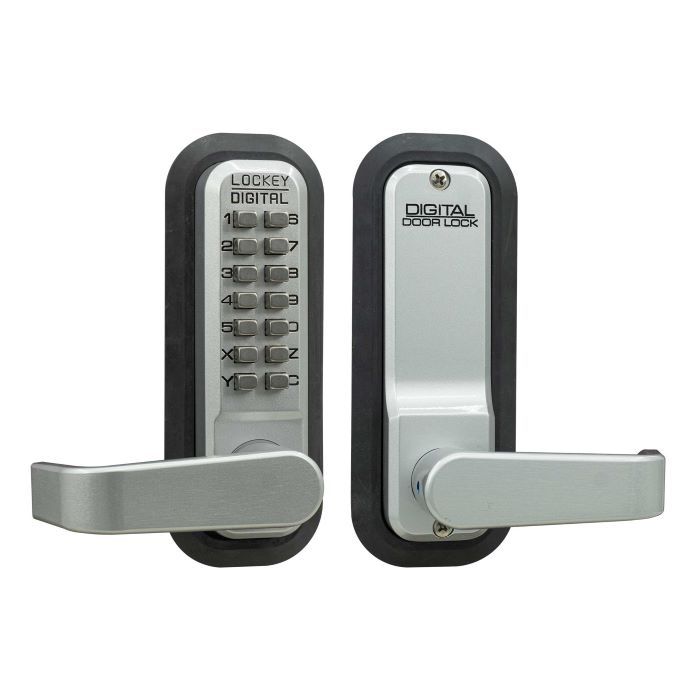
It opens with a memorized code. The catalog says it runs entirely without batteries or wiring, and you reset the code yourself in seconds. No keys to lose, copy or re-issue when staff turns over. The 2835 is listed in a Marine Grade finish, which Lockey builds for salt air, moisture and washdown. We carry two versions, and the difference between them is bigger than the part number suggests.
The two versions
- Lockey 2835 MG: single combination, passage function, Marine Grade.
- Lockey 2835-MG-DC: double combination, passage function, Marine Grade.
Both have a lever and a latch. Both are passage function, which in this case means you enter the code and the latch retracts so you can pass through. The "DC" stands for double combination. Per the catalog, that version puts a keypad on both sides of the door, so you can require a code to enter and a code to exit, and each code can be set separately.
Single or double: the question to ask is egress
Here is the part that decides it. A single combination lock is a code on one side. A double combination lock is a code on both sides, so someone inside the door needs a code to leave.
That is a feature on a fenced equipment yard where you want to control who walks out with the inventory. It is a problem on any door that people rely on to get out of a building in an emergency. Building and fire codes generally require that a person can leave through a required exit without a key, a tool or special knowledge. A door that needs a code to exit does not meet that. Before you put the double combination version on anything that is part of a way out, check with the authority having jurisdiction. Your local fire marshal or building department is the final word, not me and not the catalog.
The simple rule I use: if the door is a required exit, it does not get a code on the inside. If it is a gate, a cage, or a storage room that nobody uses as an exit, the double combination is fair game.
Where this lock earns its keep
- Pool and equipment enclosures. Chemical rooms and pump houses where you want a short list of people in and no key copies out.
- Coastal gates and doors. The Marine Grade finish is aimed at salt air and moisture, which kills ordinary plated hardware fast.
- Storage rooms. Anywhere you hand out a code to a rotating crew and want to change it when someone leaves, without re-keying a thing.
- Outdoor gates. The catalog lists gates among its uses. Check that the gate frame and latch geometry suit a lever lock first.
Changing the code
You reset the code yourself. The catalog says it takes seconds. That is the whole point on a busy site: a code is a one-step swap, where a key means a re-key. If you give out a code to a contractor for a week, you change it when the week is up. Tell whoever opens and closes the property when it changes, and set a recurring reminder to change it on a schedule.
I do not have the manufacturer's installation sheet in the catalog for door prep, backset or door thickness limits. Those dimensions are the next thing to confirm with us before you order for an existing door. Send a photo of the door edge and the measurements and we will check it against the Lockey spec.
When a keyed lock is still the better call
A code lock is good for controlled access without a system. It is not a replacement for audit trail or per-person access. A mechanical code is shared. Anyone who knows it can pass it on, and the lock cannot tell you who came in. If you need that, step up to an electronic lock. If you want the same no-battery idea in a commercial pushbutton lock with a key override, our guide to the Simplex 5010MWL and 5010XKWL covers that route. For outdoor gates where a padlock is the usual answer, look at our guide to the Master Lock 6230.
Common questions
Does the Lockey 2835 need batteries or power?
No. The catalog describes it as mechanical pushbutton entry with no batteries and no wiring.
What does the DC in the 2835-MG-DC mean?
Double combination. It has a keypad on both sides of the door, so a code is required to enter and to exit.
Can I use the double combination version on an exit door?
Do not, unless your local code authority approves it. Required exits generally must open from the inside without a code or a key.
Can I change the code myself?
Yes. The catalog says you can reset the code yourself in seconds.
What does Marine Grade mean?
It is a finish built for salt air, moisture and washdown environments, according to the catalog.
See our full Lockey page. Send us the door type and how the opening is used and we will tell you which version belongs on it.