
Master Lock Security Ratings: Basic, High, Max Explained
Posted by Kent on 29th Oct 2026
Master Lock tells you how to pick one. Here it is in plain words.
A padlock package is crowded with claims. Master Lock's Buying Guide cuts through them with a short framework: pick a protection level, pick a weather class, pick a technology, pick a lock type. This guide walks through what that page actually says, quotes it where the exact words matter, and points out what it leaves unsaid. We only use what Master Lock publishes there.
Step one: the protection rating
The Buying Guide opens its rating section with one sentence: "Every Master Lock product is either rated for basic, high or max protection." There are three tiers. There is no numeric scale on that page and no score out of ten. Here is each tier in Master Lock's own terms.
Basic security
Master Lock says these locks "include basic security features, like a hardened steel shackle to resist cutting and sawing, making them ideal for low-risk, residential areas." Think a tool chest in a locked garage, or a gate latch that only needs to keep honest people honest.
High security
The guide says high security locks "are designed for moderate-risk environments, like outdoor storage sheds, and high-traffic locations, like gyms." This is the middle step, for places where more people pass and the lock is out in the open.
Max security
For "critical security needs" or "protection in a high-risk environment, like a job site or self-storage unit," the guide points you to max security. This is the top tier Master Lock names.
The useful habit is simple. Read the tier on the package and match it to the risk where the lock will hang. A lock rated for a low-risk residential spot is not what the guide recommends for a job site.
Step two: the weather class
The guide says not all locks are created equal in harsh conditions, and splits locks into three classes.
- Indoor locks are "designed for reliable, everyday use in controlled indoor environments," such as the gym, home, school or office.
- Weather resistant locks are "designed to withstand typical outdoor conditions, like moderate heat, cold and rain." They often have a weatherproof vinyl coating and materials that resist rust and corrosion.
- Severe weather locks "can withstand extreme outdoor environments and the harshest weather conditions, like intense heat, heavy rain and freezing temperatures." The guide says to choose them for coastal or humid sites where salt water and heavy rain corrode padlocks.
The protection tier and the weather class are two separate choices. A lock can be strong against attack and still be an indoor lock. Pick both.
Step three: the technologies the guide names
The Buying Guide lists the features Master Lock builds in. Here is what it says about each one, no more.
- CutGuard. An anti-rotation feature that "helps maintain shackle engagement, doubling the time required to compromise the lock."
- Shrouded protection. A design that "limits the exposure of the shackle so it can better resist cutting, prying and bolt cutter attacks."
- Bluetooth. Lets you open smart locks with a phone in range and share access through the Master Lock Vault apps.
- TSA-approved. Lets TSA screeners open, inspect and relock baggage without damaging the lock.
- Push button access. On certain lockboxes, a keypad for entering a combination.
Notice what is claimed and what is not. CutGuard comes with a stated result, doubling the time required. The shrouded design says "better resist," not "stops." Read each claim for the words it actually uses.
Step four: key or combination
The guide says both lock types are available for all security levels. A keyed padlock gives controlled access with a key you carry or store, and you can buy keyed alike multi-packs so one key opens several locks. A combination lock removes the lost-key problem and lets you share access with one combination. Combination locks come with preset combinations or set-your-own combinations, with number or letter dials.
What the guide does not say
It does not publish a numeric scale. It does not list test standards on that page. It does not give a cut-time chart by model. So when you compare a Master Lock to a lock from another maker, you are comparing a named tier against whatever that maker prints. Do not invent a conversion. Ask what each rating is based on, and read the package.
The guide also carries no warranty wording; it only links to a separate warranty page. We did not quote warranty terms here because they are not part of this guide. Read the current terms on Master Lock's own site before you rely on them.
Putting it to work: one example
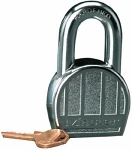
The Master Lock 230 re-keyed padlock is a good lock to read against the guide. The listing describes a 2-1/2in (64mm) wide chrome-plated solid zinc die-cast body that resists corrosion, a hardened boron alloy shackle for cut resistance, a 5-pin cylinder, and a removable cylinder so you can rekey it. The listing says the 5-pin tumbler cylinder gives more than 9,000 key changes.
That is a feature list, not a tier. The listing does not state whether the 230 is basic, high or max. So the guide gives you the next step: check the package for the tier, and match it to the spot. If the lock goes on an outdoor shed, the guide's "high security" description is the one that names that setting.
For gates and outdoor hasps, our outdoor gate padlock guide goes deeper, and the full range is on the Master Lock page.
A buying checklist
- Name the risk: low (home), moderate (shed, gym) or high (job site, self-storage).
- Match the protection tier: basic, high or max.
- Name the weather: indoor, weather resistant or severe.
- Look for a shrouded shackle if bolt cutters are the concern.
- Pick key or combination by who needs access.
- Check what the lock fastens to. The lock is only as good as the hasp.
Common questions
How does Master Lock rate its padlocks?
According to its Buying Guide, every product is rated basic, high or max protection. The guide gives no numeric scale.
What does max security mean on a Master Lock?
The guide says it is for critical security needs or a high-risk environment, such as a job site or self-storage unit.
What is the difference between weather resistant and severe weather?
Weather resistant locks are for typical outdoor conditions like moderate heat, cold and rain. Severe weather locks are for extreme heat, heavy rain and freezing temperatures, and the guide points to them for coastal or humid sites.
What does CutGuard do?
Master Lock describes it as an anti-rotation feature that helps maintain shackle engagement and doubles the time required to compromise the lock.
Can a keyed and a combination lock both be high security?
Yes. The guide says both lock types are available for all security levels.