
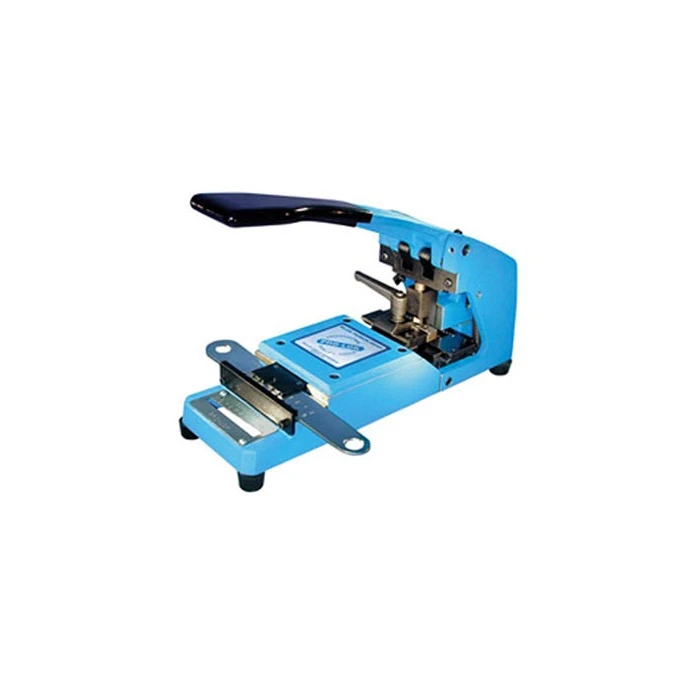
Pro-Lok Blue Punch: Which Key Machine Matches Your Keyway
Posted by Kent on 12th Sep 2026
What a punch machine actually does
A standard key duplicator copies. You clamp an existing key on one side, a blank on the other, and a tracer follows the grooves while the cutter mirrors them onto the blank. It's fast for a single key, but it's only as good as the key you're copying from, and it's slow when you've got a stack of cores to rekey.
A punch machine works differently. Instead of tracing a physical key, you dial in a bitting code, insert the blank, and the machine stamps or punches the cuts straight to that code. No pattern key needed. No tracer arm drifting off a worn original. You're cutting from a number, not from metal.
That distinction matters more than it sounds like on paper. If you've ever handed a customer a duplicate that binds because the original was already worn down, you already know why cutting to code beats copying an old key.
Why a shop would want one over a duplicator
Punch machines earn their keep in two situations: high-volume rekey work and new construction.
On a rekey job, especially interchangeable core work, you're not copying anybody's key. You're building keys to match a combinated core, often a dozen or more at a time. A punch machine cuts every one of those to the same code with the same result, cut after cut. No tracer wear, no operator fatigue changing the depth on key forty of fifty.
On new construction, builders and property managers want keys cut before the locks are even on site, straight from a bitting list the locksmith or the hardware supplier hands over. There's no original key to trace from because the system doesn't exist yet as physical hardware. A punch machine is built for exactly that: code in, key out.
None of this replaces a duplicator on the bench. It sits next to it. A duplicator still earns its keep on walk-in copy-this-key work. A punch machine earns its keep on code-based, repeatable, batch work.
The Blue Punch lineup: one machine, one keyway
Here's the part that trips people up when they're shopping: Pro-Lok doesn't sell one universal punch machine. The Blue Punch line is built as dedicated machines, one model per keyway family. The tooling inside is set up for a specific key system, so the machine you buy has to match the keys you actually cut. Buy the wrong one and it's not a matter of adjusting a setting. It physically won't punch the keyway you need.
BP201-IC for I/Core systems
The BP201-IC is built for I/Core (Interchangeable Core) A2 keys. If interchangeable core rekeying is a regular part of your work, whether for commercial accounts, apartment turnovers, or master key systems, this is the model built around that keyway.
BP201-KW for Kwikset
The BP201-KW is set up for Kwikset keys. Shops that do a lot of residential rekey work, especially move-in and property turnover jobs where Kwikset locks are common, will get the most use out of this one.
BP201-SC for Schlage Classic
The BP201-SC handles Schlage Classic keys, the keyway that's been standard on Schlage residential and light commercial hardware for decades. If Schlage is a big part of your customer base, this is the workhorse.
BP201-SCEB for Schlage Everest B
The BP201-SCEB is built for Schlage Everest B keys, a different keyway generation than Schlage Classic. Schlage introduced Everest as a separate, more restricted keyway system, and it requires its own dedicated tooling. That's also why this model runs higher than the other three. It's a different machine for a different key system, not an upgraded version of the SC.
Matching the machine to your bench
Before you buy, pull up your last few months of invoices and see what you're actually cutting. If most of your rekey tickets are Kwikset residential, the BP201-KW pays for itself faster than any other option. If commercial IC cores are your bread and butter, the BP201-IC is the one that matches your ticket volume. Schlage-heavy shops need to look closer still, since Classic and Everest B are not the same keyway and one machine won't cover both.
Some shops end up owning more than one Blue Punch model because they genuinely service more than one keyway family at volume. That's a legitimate reason to buy a second unit. It's a bad reason to buy the wrong first one and hope it flexes to cover everything.
Pro-Lok also sells a molded carrying case for the Blue Punch line, useful if the machine is going to travel between a shop bench and job sites rather than sitting in one spot permanently.
For the full Pro-Lok catalog, including cutters, pin kits, and other keying equipment, our Pro-Lok product hub is a good starting point. And if your keying program includes swapping SFIC cores as well as cutting keys to them, our piece on rekeying an SFIC core without a locksmith covers the other half of that same job.
Common questions
Is a punch machine better than a standard key duplicator?
It's better for different work, not better across the board. A duplicator is still the right tool for copying an existing key on the spot. A punch machine is the right tool when you're cutting to a bitting code, especially for interchangeable core rekeys and new construction where there's no original key to trace.
Can one Blue Punch machine cut more than one keyway?
No. Each Blue Punch model, the BP201-IC, BP201-KW, BP201-SC, and BP201-SCEB, is dedicated to one keyway family. If your shop services multiple keyway systems at volume, you'll need a separate machine for each one you plan to punch regularly.
Why does the BP201-SCEB cost more than the other three models?
Schlage Everest B is a different keyway generation from Schlage Classic, and the tooling needed to punch it differs from the other models in the lineup. It's priced as its own dedicated machine rather than a variant of the BP201-SC.
Do I still need a standard duplicator if I buy a Blue Punch machine?
Yes, most shops keep both. The Blue Punch handles code-based batch work like rekeys and new construction, while a duplicator still covers everyday walk-in copy requests where a customer just hands you a key.
How do I know which keyway my shop needs most?
Look at your recent rekey and cutting tickets rather than guessing. Whichever keyway shows up most often in your actual job volume, whether that's Kwikset, Schlage, or interchangeable core, is the one that should drive your first Blue Punch purchase.