
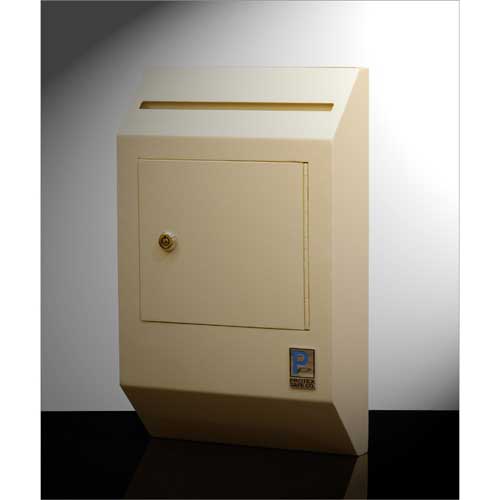
Protex WDB-110 and WDS-150 Drop Boxes: Key Lock or Keypad
Posted by Kent on 18th Nov 2026
Key lock or keypad on a wall drop box
Protex builds two small wall-mount drop boxes that each come in a key version and an electronic version. The WDB-110 is a letter-size drop box, and the WDS-150 is the compact payment and key drop. Each has an "E II" twin with a keypad. The choice between key and keypad sounds trivial and is not. It decides who can open the box, what happens when an employee quits, and how many keys you are chasing a year from now.
I covered the size ladder from the small SDB boxes up in the deposit-size piece. This one is only about key versus keypad on two specific models in the Protex catalog.
The four boxes
| WDB-110 | WDB-110E II | WDS-150 | WDS-150E II | |
|---|---|---|---|---|
| Lock | Key lock | Electronic keypad (II) | Key lock | Electronic keypad (II) |
| Outside (H x W x D) | 16-3/8" x 10" x 4" | 16-3/8" x 10" x 4" | 15" x 10" x 4-1/4" | 15" x 10" x 4-1/4" |
| Material | Steel | Steel | Steel | Steel |
| Mount | Wall | Wall | Wall | Wall |
| Other listed features | Anti-fish deposit slot, pre-drilled mounting holes | Anti-fish deposit, key override | Compact, steel | Key override, updated II electronics |
Weights are where the listings do not agree with themselves. The WDB-110 lists 14 lbs. The WDB-110E II shows both 12 lbs and 15 lbs on one page, with a note correcting an earlier figure. The WDS-150 shows 5 lbs and 15 lbs on one page, and the WDS-150E II shows 15 lbs and 16 lbs. I am not going to pick one. If the weight matters for your wall, call us and we will confirm it before you buy. For any of them, use fasteners suited to your wall type and fasten into framing or masonry, not drywall alone.
WDB-110: the letter-size drop
The WDB-110 is described as a basic wall-mount drop box for offices and lobbies. It has a key lock, a steel body and a deposit slot with anti-fish protection. The listing says to mount it next to a door for after-hours drops of keys, payments or documents. The name carries "tubular keys" in the title, which describes the key style.
WDB-110E II: the keypad version
The WDB-110E II has the same exterior dimensions and swaps the key lock for a keypad. The listing's pitch: program codes, change them, and there are no keys to duplicate. It also keeps a key override, so a forgotten code does not turn into a dead box. That override is a key, which means one key still has to be managed. The point is that it lives with the owner, not with every employee.
WDS-150: the compact payment and key drop
The WDS-150 is described as the smallest wall-mount drop safe Protex makes. The listing suggests a key return in a hotel lobby, tip collection in a break room, or a spare key lockbox in a property management office. At 15" high and 10" wide it fits where the WDB-110 will not, and it is the model I think of for a counter or a hallway wall.
The WDS-150E II is the keypad twin, with a key override and updated II electronics.
Which lock fits which job
One person opens it: the key lock is fine. A small office where the owner empties the box every morning. One key, kept on the owner's ring. Nothing to program, nothing to forget, and no electronics to fail.
More than one person opens it, or people change: the keypad. A property management office, a hotel front desk, a clinic with rotating staff. When someone leaves, you change the code. You do not rekey the box, and you do not wonder which of the copies walked out the door. Keep one code per role, and change it on a schedule.
Keys being dropped: think about the box that hands them out. A key return slot is for dropping. Whoever opens the box takes a bundle of keys out at once, so the keypad's accountability matters more here than for payments.
The one thing a drop box does not do
A drop box takes deposits in and keeps them in. It is not a place to leave cash for days. The steel body and the anti-fish slot slow a casual thief and stop someone fishing a deposit back out with a coat hanger, and that is the job. Empty it on a schedule, daily for a busy counter, and make that part of somebody's routine. A full box on a wall is an invitation, and the lock type matters much less than how often it is emptied.
The same goes for what the box says about you. A wall-mounted drop in a lit lobby, bolted to structure, reads as "this is a managed deposit point." A box on a bare drywall wall in a dark corridor reads as a project. Customers and staff both notice the difference, and so do the people you are trying to deter.
What I tell customers before they mount one
- Decide who opens it and write it down. If you cannot name them, the lock choice is not the real problem.
- Put it where it can be seen. A camera view or a lit lobby does more than the lock does.
- Anchor into structure. A drop box held by two screws into drywall is a drop box someone carries out.
- Test the override. On the keypad models, confirm the key works before you rely on it.
Common questions
Do the keypad models still have a key?
Yes. Both E II listings state a key override.
Are the E II models a different size?
No. The exterior dimensions match their key-lock twins.
Do they come in black?
The listings point to black versions of each model. Ask us for the current part numbers before you order.
How do they ship?
By freight carrier, per the listings, and they do not qualify for free shipping.
Tell us who opens the box and how often, and we will point you to the right lock.