
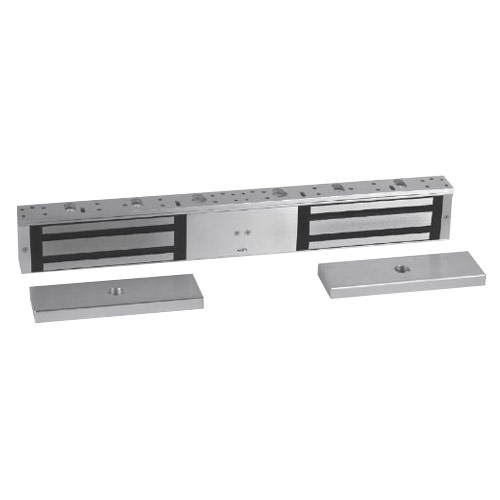
RCI 8320: One Maglock for a Pair of Outswinging Doors
Posted by Kent on 11th Sep 2026
A Pair of Outswinging Doors, One Lock Job
Stairwell exit, double-door retail entrance, mechanical room with two leaves that both swing out. You've got this situation more often than you'd think, and it always raises the same question: how do you maglock it? Some installers grab two single mags off the shelf, mount one on each leaf, and wire them up separately. It works, technically. It's also the wrong way to solve this problem when a purpose-built pair lock exists for exactly this job.
Why Two Single Mags Isn't the Right Call for a Pair
A single electromagnetic lock is designed to hold one leaf against one frame or header plate. Put two of them on a pair of outswinging doors and you're now managing two separate installs that have to behave as one system every single day.
Alignment gets harder, not easier
Two independent mag-and-armature assemblies means two independent chances for misalignment. If one leaf sags or the building settles a little, you're troubleshooting two mounting points instead of one continuous housing built to hold both leaves in the same plane.
You end up running two power feeds instead of one
Two mags means two runs back to the power supply, or a splitter that adds a failure point. A single housing built for the pair takes one feed and distributes it internally.
The access control panel sees one point of control, not two
Fewer output points on the controller means less programming, fewer relay outputs consumed, and fewer things to check when a door doesn't release on schedule.
Sensor and monitoring wiring stays simple
If you want door position or lock status monitoring on both leaves, that wiring is a lot cleaner coming out of one housing than home-running two separate mags back to a panel or fire alarm interface. For life-safety monitoring on both leaves, one housing with a shared point of exit for that wiring is just easier to get right and easier to inspect later.
The RCI 8320 Series: Built for the Pair
This is where the RCI 8320 series earns its name. It's listed as a Double Outswinging Magnetic Lock, meaning it's engineered from the start to secure both leaves of a pair, not stitched together from single-door parts.
8320-28 and 8320-40: same lock, two finishes
The base lock is the RCI 8320-28 in Brushed Anodized Aluminum, and the RCI 8320-40 in Dark Bronze. Same lock body, different finish to match your door and frame hardware. Neither one changes the function, just the look on the header.
8320-2DSS-28: when you need door status on both leaves
If the project calls for confirmation that both leaves are actually closed and secured, look at the RCI 8320-2DSS-28. It's the same lock body with a factory-installed Door Status Sensor on both leaves, in aluminum finish. That "2" in the model number is your tell that you're getting sensing on the pair, not just one side. Expect to pay meaningfully more for the sensor version over the plain lock body, since you're getting two sensor circuits built in and tested at the factory instead of field-added contacts. Weigh that against what a field retrofit of separate door contacts would cost you in labor and troubleshooting down the line.
SCS variants exist too
RCI also lists an 8320-2SCS-28 (Security Condition Sensor on both leaves) and a combined 8320-2DSS-2SCS-28 with both DSS and SCS on both leaves. I'll be straight with you: I'm not going to guess at the exact contact behavior the SCS reports on this series. Pull the spec sheet or call before you spec one into a monitored system, especially if it's feeding a fire alarm panel or a UL-listed egress control scheme. That's not a detail worth guessing on.
Maglocks Are Fail-Safe. That Doesn't Change Here
One thing that's true of every electromagnetic lock, including this series: they're fail-safe by nature. No power, no hold. That's basic maglock physics, not a feature of one brand over another, and it's why maglocks get paired with request-to-exit devices and fire alarm tie-ins on most code-driven installs. Whatever finish or sensor combination you pick from the 8320 line, that fundamental behavior doesn't change.
Sizing and Retrofit Notes
Picking the right lock for the pair is only half the job. You still need to size holding force correctly for the door weight, width, and exposure, and I'd rather send you to the piece I already wrote on that than guess at numbers here. See our maglock holding force sizing guide if you're not sure where to start on that math. And if what you're actually staring at is a door you can't mortise into, not a pair needing a dedicated double mag, the surface-mount approach covered in this piece on maglocks for doors you can't mortise is worth a read too. For the full picture of what RCI makes beyond this series, RCI's full mag lock line is on our site.
Common questions
What's the difference between the 8320 and 8310 series?
The 8310 series is RCI's single-door mag, built for one leaf. The 8320 series is the double, built for a pair of outswinging doors in one housing. Don't use two 8310s where the job calls for one 8320.
Can I mix finishes on a pair of doors?
You could, but there's no reason to. The 8320-28 and 8320-40 are the same lock in Brushed Anodized Aluminum and Dark Bronze, so pick whichever matches your existing hardware and order both leaves in the same finish.
Do I need the DSS version, or is the plain lock enough?
It depends on whether your access control or fire system needs confirmation that both doors are closed and locked. If nobody's monitoring door position on this opening, the plain 8320-28 or 8320-40 is enough. If you need that confirmation, get the 8320-2DSS-28 with the sensor built in rather than trying to add contacts in the field later.
What exactly does the SCS variant report?
I'm not going to guess on that one here. Confirm the exact contact behavior with the spec sheet or give us a call before you order an SCS or combined DSS+SCS variant, especially for a monitored or code-required application.
Will this fit any pair of outswinging doors?
It's built for pairs of outswinging doors, but door width, header depth, and existing hardware all matter for a clean install. Check your opening dimensions against the spec sheet before you order, and call us if anything doesn't line up.