
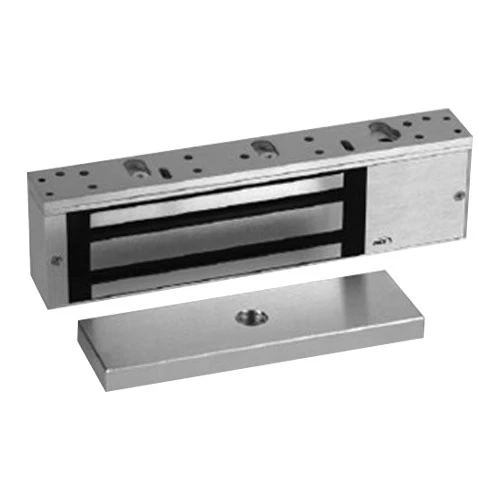
RCI 8371 MiniMag: A Maglock for an Opening Too Small
Posted by Kent on 9th Sep 2026
The mag is fine. The opening is the problem.
You are standing there with a full size mag in one hand and a cabinet stile that measures an inch and a quarter. The mag body is longer than the header. No amount of shimming fixes that. This is the job the RCI small format mag family exists for, and the 8371 MiniMag is the piece most integrators reach for first.
Here is the part that gets people in trouble. Most installers pick holding force first, then go looking for somewhere to bolt it. That is backwards. Pick by the opening and the mounting surface, then check the force number against the actual threat. A drawer holding prescription pads does not need what a stairwell door needs. And a big mag hung off a flexing aluminum header is weaker in practice than a small one bolted to something solid.
Choosing a mini maglock by opening type
RCI splits the small format line by how the opening moves, not by decor. Once you know the swing and the surface, the model number almost picks itself.
Surface mount on a single outswinging door
The RCI 8371-28 Surface MiniMag is the workhorse. Header mounted, armature on the door, done in twenty minutes on a clean frame. If the opening is a standard door and you have header depth, step up to the RCI 8310-28 single outswinging magnetic lock instead. Pairs of doors get the RCI 8320-28 double outswinging mag, which is one long housing with two armatures rather than two separate locks fighting each other for header space.
Enclosures, cabinets, and drawers
When even the mini is too big, the RCI 8375-28 MicroMag goes where nothing else will. Medication carts. Evidence lockers. Server cabinet doors. The trap on these is the door panel itself, not the mag.
Sliding doors
Sliders need the mag out of the travel path, so the RCI 8360-28 Mortise MiniMag buries in the jamb and the armature sits in the leading edge. Measure the pocket twice. I cut a mortise a quarter inch shallow once and spent an afternoon with a router and a very unhappy customer watching me.
Exterior gates
Gates get the RCI 8380-32D GateMag, and the 32D stainless finish is not cosmetic out there. Powder coated aluminum in a coastal parking lot chalks up in two seasons. The rest of the line lives in the full RCI catalog if the opening is stranger than these six.
Mounting surface flex is what actually kills these installs
This is where I want to slow down, because it is the single thing that generates callbacks on small mags.
A maglock does not hold by strength. It holds by contact. The armature and the magnet face have to sit flat against each other with no air gap, and the published holding force assumes exactly that. Introduce a sixteenth of an inch of gap and you lose a large fraction of the rating. Introduce flex and you get an intermittent gap, which is worse than a permanent one, because it passes your test and fails at 2am.
Where does the flex come from? Thin aluminum storefront headers. Hollow core cabinet doors. Vinyl wrapped MDF drawer fronts. Gate posts that are plumb on a calm day and not plumb when the wind comes off the lake.
I had a callback on a pharmacy cabinet where the MicroMag tested clean on the bench and clean on install. Two weeks later it was popping open. The cabinet door was a quarter inch veneer over honeycomb, and every open and slam cycle worked the armature bolt a little looser in that honeycomb until the armature sat proud. The mag never failed. The door failed. We backed the armature with a steel plate spanning to the door edge and it has been quiet ever since.
So the rule I will not bend on. Never bond a maglock to a surface that flexes. If you press on the mounting spot with your thumb and feel any give, you are not mounting there. You are adding backing, spanning to structure, or moving the lock. Sex bolts through the door with a backing plate beat sheet metal screws every single time on a hollow panel.
The glass door bracket problem
Frameless glass gets people creative, and creative is the wrong instinct here. There is nothing to screw into. You cannot drill tempered glass. The armature has to attach to the top rail or to a purpose built bracket that clamps the glass, and for the 8371 that bracket is the RCI GB7112 glass door bracket.
I have seen adhesive mounted armatures on glass. Foam tape, a lot of confidence, and a lock that peeled off in July when the lobby hit ninety degrees. Buy the bracket. It is built for the geometry, it distributes the pull across the glass edge rather than one point, and it puts the armature at the right depth so you are not shimming.
Outswing is the easy case
An outswinging door lets the mag mount on the secure side of the header with the armature on the door face. Everything is accessible, the pull is straight into the magnet, and the geometry is what the lock was designed around. That is why so much of this family is labeled outswinging.
Inswing means you need an L bracket or a Z bracket to reach around the stop, and a bracket adds a lever arm. Longer lever, more twist under load, more chance of that gap opening up. Doable. Just not free. If you have a choice about which leaf gets the lock, take the outswinger.
Fail-safe is the whole point, and also the catch
Every maglock is fail-safe. Cut power and it releases. That is not a flaw, it is the reason an inspector will let you put one on an egress door at all. People get out during a fire.
The catch is that fail-safe means exactly what it says on a gate too. Power blip, gate is open. Squirrel takes out the transformer, gate is open all night. On perimeter gates I run the 8380 on backed up power and tell the customer plainly that a mag is an access control device, not a barrier against someone who wants in. If they want a gate that stays shut when the power dies, they want a fail secure electric strike or a mechanical lock, and they should hear that from you before the invoice, not after the outage.
On the egress side, remember the mag is only half the code conversation. Request to exit, a release device, and whatever your local inspector wants on top. Same argument I made in the piece on the maglock for a door you cannot mortise, and the force sizing logic runs the same way in Dynalock holding force sizing.
Common questions
Will a MiniMag hold a real door?
Yes, on the right door. The 8371 is built for interior openings that see normal traffic, and mounted flat on a solid header it holds far better than an oversized mag on a flexing surface. Exterior doors and anything with a determined attack profile want a full size unit.
Can I mount a maglock on a frameless glass door without a bracket?
No. There is no fastening path into tempered glass and adhesive mounts fail with heat and time. The GB7112 clamps the glass and carries the armature at the right geometry.
What is the difference between the 8371 and the 8375?
Size and application. The 8371 MiniMag is a surface unit for small doors and gates in the light duty range, and the 8375 MicroMag is smaller still, built for cabinets, lockers, and enclosures where the 8371 physically will not fit.
Do I need a different mag for a sliding door?
Usually yes, because a surface mag sits in the travel path. The 8360 Mortise MiniMag recesses into the jamb with the armature in the leading edge of the slider, so nothing protrudes.
What happens to my gate mag in a power outage?
It releases, and the gate is unlocked until power returns. Put the gate mag on battery backup, and if the customer needs the gate held closed through an outage, specify a fail secure device instead.