
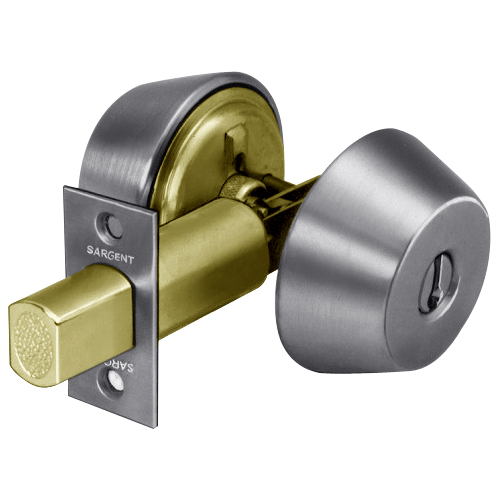
Sargent 484 vs 485 vs 486: Deadbolt Near Glass
Posted by Kent on 25th Sep 2026
Same 480 Series deadbolt, three different interior sides
Sargent's 480 Series auxiliary deadbolt is a straightforward commercial-grade lock, a full 1" hardened steel throw bolt at ANSI/BHMA Grade 1, sold in satin chrome (US26D/626) with a 7-year limited warranty. The body is the same across the line. What changes is what's on the inside of the door, and that decision has a code angle most buyers don't think about until an inspector brings it up.
Double cylinder: 484
The Sargent 484 takes a key on both sides, no thumbturn at all. It's the choice when the door has glass near the lock, either in the door itself or in an adjacent sidelight, close enough that someone could break the glass and reach a thumbturn from outside. A double cylinder deadbolt closes that gap because there's no turnpiece to reach for. The tradeoff is real: on an egress door, a double cylinder deadbolt can mean someone inside needs a key to get out, and many jurisdictions restrict or flatly prohibit that on a required exit route. Check your local AHJ before specifying a 484 on any door that's part of a fire or life-safety egress path. If the door doesn't qualify for a double cylinder, a classroom or storeroom function mortise lock is usually the code-compliant alternative for that same glass-near-lock scenario.
Single cylinder with thumbturn: 485
Keyed from outside with a thumbturn on the inside for free egress without a key, the Sargent 485 is the standard configuration. This is the default for the large majority of commercial doors, an office, a storeroom, a back entrance, anywhere free exit from inside isn't a code conflict and there's no glass close enough to the lock to make a thumbturn a real vulnerability. If you're not sure which of the three to spec, this is the one to default to.
It's also the one most buyers should start from and only move off of for a specific reason. Nobody defaults to a double cylinder because it "sounds more secure," a thumbturn deadbolt paired with a solid door and a decent lockset is plenty of security for the overwhelming majority of commercial openings, and it keeps the door code-clean without a second thought.
Single cylinder with blank plate: 486
The Sargent 486 is keyed from outside like the 485, but the inside gets a blank plate instead of a thumbturn, no interior operating trim at all. That's the right call when the deadbolt is a secondary lock paired with a separate primary lockset that already provides the interior function, so you don't end up with two turnpieces stacked on one door. It's also used where the interior side needs to stay flush and unbroken for aesthetic reasons, with the primary lock doing the actual day-to-day operation.
Picking between the three
Start with whether the door has glass close enough to the lock for someone to break it and reach a thumbturn. If yes, and the door isn't a required egress route, the 484 closes that gap. If the door is an egress route, skip the double cylinder regardless of the glass and look at a mortise lock function instead. If there's no glass exposure and this is the only lock on the door, the 485 is the standard, low-friction choice. If the deadbolt is riding alongside another lockset that already handles the interior side, the 486's blank plate keeps the door from getting a second turnpiece nobody needs.
What's the same regardless of which one you pick
All three share the 1" hardened steel throw bolt, the same Grade 1 rating, the same satin chrome finish, and the same 7-year limited warranty. None of them are fire-door hardware in the deadbolt-only sense, Sargent's own guidance is to verify AHJ requirements before specifying any of the three on a rated or egress opening, and to default to a mortise lockset's built-in function instead when the code question comes up. That's not a knock on the 480 Series, it's just not what an auxiliary deadbolt is rated to solve.
Backset and door thickness are worth confirming before ordering too, an auxiliary deadbolt bores into the same stile as the primary lockset, and a door that's already crowded with a mortise lock or a narrow-stile frame can run out of room for a second bore. Measure the stile width against both locksets before drilling, not after.
All three are in stock and ship from the Sargent hub. For a rated corridor door where the deadbolt question turns into a full mortise lock function question, the Sargent 8200 mortise piece covers storeroom versus classroom function, and Sargent 6500 vs 8200 covers the cylindrical-versus-mortise decision on the same class of door.
Common questions
Can I put a double cylinder deadbolt on an egress door?
Often no. Many jurisdictions restrict or prohibit a double cylinder deadbolt on a required exit route because it can force someone to hunt for a key to get out. Verify with your local AHJ before specifying the 484 on any egress path, and consider a code-compliant mortise lock function instead.
What's the difference between the 485 and the 486?
Both are keyed from outside. The 485 has a thumbturn on the inside for standalone operation. The 486 has a blank plate instead, no interior trim, used when a separate primary lockset already handles the interior side of the door.
Why would I choose a double cylinder deadbolt at all?
When the door has glass close enough to the lock, in the door or an adjacent sidelight, that someone could break it and reach a thumbturn from outside. The 484's double cylinder removes that turnpiece entirely.
What finish does the 480 Series ship in?
Satin chrome, US26D/626, across all three variants covered here.
Is the 480 Series fire-door hardware?
No, it's a commercial auxiliary deadbolt, not rated hardware for a fire door on its own. Verify AHJ requirements on any rated or egress opening before specifying it.