
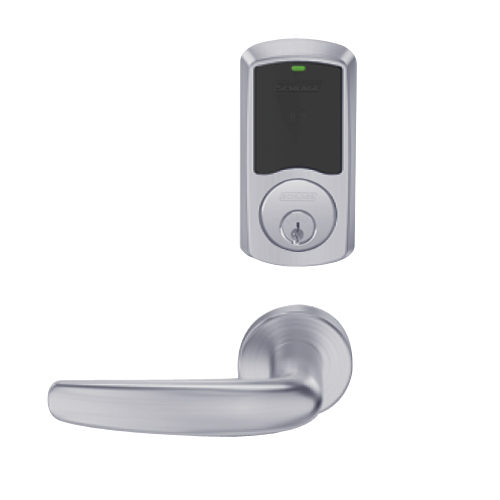
Schlage LE-Series: Wireless Lockdown for a Mortise Door
Posted by Kent on 7th Sep 2026
A security director at a charter school called last spring wanting lockdown control on the front office door. No budget for a wiring pull, no interest in tearing open a plaster wall that had already been patched twice for other reasons, and a hard deadline before the fall semester. The door already had a mortise lock in it. That's the job the Schlage LE-Series wireless mortise lock was built for.
LE isn't another lever or deadbolt cut. It's Schlage's wireless, battery-powered access-control lock: the credential reader, the door position sensor, and the request-to-exit switch all live in one mortise-lock body, with no low-voltage wire run to the door required. We stock it heavy, LEBMB / LEBMD / LEBMS / LEMS / LEMD / LEMB prefixes, thousands of live configurations across functions, lever styles, and finishes.
What "wireless mortise lock" actually means here
The LE-Series is built on the same Grade 1 L-Series mortise chassis as Schlage's mechanical L9000 line. See our L9000 mortise function guide if that's the door you're actually working, because the case and the lock body geometry are the same part. That's why LE fits an existing L-Series mortise prep with no new door modification. Everything that changed sits above the chassis: an electronic credential reader, an integrated door position sensor, and a request-to-exit switch, running on four AA batteries rated up to two years.
Two comms paths, and they do different jobs. Bluetooth handles local setup and config from a phone, which is how you commission the lock standing at the door. WiFi handles the daily grind, pushing automatic schedule and credential-list updates to the lock without a technician making a site visit. That kills the old problem that made networked access control a hard sell on a small campus: somebody driving out to reprogram every reader by hand.
Wireless lockdown for a door you can't rewire, with one honest catch
Here's the part sales copy glosses over and a locksmith won't. WiFi-scheduled updates are not the same thing as real-time lockdown. If the ask is "push a lockdown signal to every door in the building right now," LE needs the ENGAGE Gateway add-on. That's what turns the WiFi link into a live, two-way connection for instant lockdown, immediate credential revocation, and event monitoring as it happens. Without the gateway, LE still updates schedules and credentials automatically over WiFi, just not on a live push. My opinion, after enough lockdown-drill jobs: if lockdown speed is the reason you're buying LE instead of a mechanical L9000, buy the gateway too. Skipping it to save money defeats the reason you picked wireless access control in the first place.
It also changes how you scope the job. A plain WiFi-only LE install is closer to a smart-scheduling upgrade: set the storeroom to unlock at 7 a.m. and lock at 6 p.m. automatically, revoke a badge the moment someone's terminated, and never touch the lock again. Add the gateway and you're buying an actual lockdown system, the kind a school resource officer or a facilities director can trigger from a dashboard the second something goes wrong. Quote the right one. Selling WiFi-only LE into a lockdown-drill requirement is a callback waiting to happen.
Storeroom or privacy/office, pick the function off the door, not the price sheet
Two functions cover most retrofit jobs we quote:
LEMS-GRW storeroom function: outside lever is always locked, credential unlocks it, inside lever always free for egress. This is the one for a supply closet, an IT room, or that front office door, anywhere staff badge in but nobody wants to fumble a thumb-turn on the way out. Satin chrome, Greenwich lever, in stock.
LEMB-GRW privacy/office function: adds a push button and LED indicator so an occupant can lock the room from the inside without a credential. That's the one for a counseling office, a nurse's room, or any space that needs occupant-controlled lockdown stacked on top of credentialed entry. Same lever, same finish, in stock.
Both ship with the credential reader and LED status indicator built into the escutcheon, which is the part buyers new to LE don't picture until they see one installed. It doesn't look bolted-on, and it doesn't need a separate reader plate on the frame the way a lot of retrofit access-control kits do.
Common questions
Does the LE-Series need a wire run to the door?
No. Power comes from four AA batteries in the lock body, and communication runs over Bluetooth for local config and WiFi for daily schedule and credential updates. No low-voltage wire, no conduit, no core drilling through the frame.
Will it fit my existing mortise door prep?
If the door is already prepped for a Schlage L-Series mortise lock, including an existing L9000, yes. LE uses the same Grade 1 mortise case, so it's a swap, not a re-prep.
Do I get real-time lockdown out of the box?
Not without the ENGAGE Gateway. Base LE pushes schedule and credential changes over WiFi on its normal update cycle. The gateway is what adds live, instant lockdown and immediate credential revocation. Ask for it by name when you quote the job if speed-to-lockdown matters.
How long do the batteries actually last?
Schlage rates the four-AA set at up to two years under normal use. Put a battery swap on the same preventive-maintenance schedule as your fire door inspections and it won't catch anyone off guard.
What's the difference between LE-Series and a plain mechanical mortise lock like the L9000?
The L9000 is mechanical: a key turns a cylinder, nothing reports anywhere, nothing schedules itself. LE adds the credential reader, door position sensor, and network link on the identical chassis. Buy the L9000 if all you need is a lock that keys into your existing system. Buy LE when the ask is scheduling, revocation, or lockdown without pulling wire.