
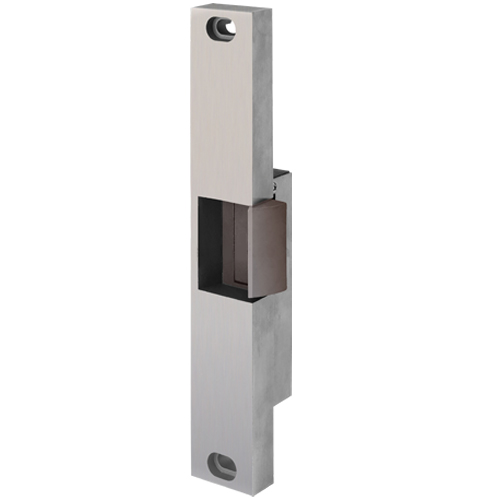
SDC 30 Series: 12VDC or 24VDC Rim Strike Voltage
Posted by Kent on 27th Sep 2026
Same Strike, Two Coils, and It Matters Which One You Order
An integrator wiring a rim exit device retrofit ordered a 24-volt strike because that's what the last three panels on the truck ran. This job's power supply was a leftover 12-volt board from the original installer, still good, still in the electrical closet, never swapped out. The strike he installed drew current the supply was never sized for, ran warm, and started sticking on release within a season. The fix wasn't a different strike. It was the correct voltage version of the exact same part.
The SDC 30 Series is a rim-mount electric strike built specifically for exit devices with a Pullman-type latchbolt, whether that's a dedicated rim exit device or the top Pullman latch on a surface vertical-rod device. Both SKUs covered here share the identical body: 9" H x 1-3/4" W, 1-23/32" D, satin stainless steel, milled ramps to accommodate deadlatches, an integrated shim for quick faceplate-thickness adjustment (3/4" to 1/2"), in-frame horizontal adjustability, and a Pullman keeper. Static strength rates at 1,500 lbs., dynamic strength at 70 ft-lbs. The housing, the keeper, and the mounting hardware never change between them. What changes is the coil the factory winds into it.
30-4-12: Built for a 12VDC Supply
The SDC 30-4-12 is wound for a 12VDC supply, drawing 510 mA at that voltage. Order this one when the power supply feeding the opening is a 12-volt board, which is still the most common output on smaller single-door access-control panels and a lot of retrofit power supplies already sitting in the closet from an earlier installation.
30-4-24: Built for a 24VDC Supply
The SDC 30-4-24 is wound for a 24VDC supply, drawing 250 mA at that voltage instead. Multi-door panels, fire-alarm-interfaced power supplies, and anything feeding several openings off one board more often run 24 volts, both because the wire runs are typically longer and because 24-volt draw is easier on the supply across multiple simultaneous unlocks.
Why Ordering the Wrong One Doesn't Fail Loud
A strike wound for 12 volts will often still pull in on 24 volts, at least at first. That's the trap. It draws roughly double the current it was wound for, runs hotter than it should on every cycle, and the failure shows up weeks or months later as sticking, slow release, or a burned coil, not as a strike that refuses to work on day one. Confirm the actual output of the power supply on the job, not the voltage on the panel spec sheet from a different project, before ordering either SKU.
Failsecure Standard, Failsafe Optional
Both SKUs ship failsecure as the standard configuration: the strike stays locked on power loss, which is the correct default for most rim-exit retrofit work where the panic hardware itself still provides mechanical egress regardless of strike power. A failsafe configuration, unlocking on power loss, is available as an option when the application specifically calls for it, such as certain fire-egress paths where local code requires the strike to release without power. Confirm which fail mode the opening requires before ordering, because a mismatched fail mode is a life-safety and code-compliance issue, not just an inconvenience.
Reading the Rest of the Part Number
The 30-4 prefix identifies the base strike body and keeper configuration shared across the line; the trailing -12 or -24 is the coil voltage. If a spec sheet or an old installed unit shows a different trailing number than these two, it may be a different fail-mode or finish variant of the same 30 Series body. Send us the full stamped part number off the existing hardware before ordering a replacement, rather than matching on voltage alone.
Sizing the Supply, Not Just the Strike
Voltage match is only half the calculation on a multi-door install. Once the voltage is right, add up the rated draw of every strike, maglock, and reader running off the same power supply and compare that total against the supply's rated output, not just its labeled voltage. A supply can be the correct 24 volts and still be undersized if four strikes are pulling current off it simultaneously during a fire-alarm release. This is a job for the person specifying the panel, not something to catch after install, and it's worth confirming before the strikes go in rather than after a supply starts browning out under load.
It's also worth checking the gauge and length of the wire run itself. A long run on thin gauge wire drops voltage before it ever reaches the strike, which can produce the same symptoms as ordering the wrong voltage version in the first place: a strike that pulls in weakly, runs hot, or hesitates on release. If a strike is underperforming on a supply that tests correctly at the panel, check the voltage at the strike leads themselves before assuming the part is defective.
Common questions
Can the 30-4-12 run on a 24-volt supply if that's all I have on the truck?
Don't run it that way as a permanent fix. It may pull in at first, but the coil will draw more current than it's rated for and run hot, which shortens its service life. Order the matching voltage instead of substituting on the job.
How do I check what voltage my existing power supply outputs?
Check the supply's data plate or specification label directly, or measure output voltage at the strike leads with the door unlocked. Don't assume based on what a similar job used.
Does the SDC 30 Series work with any rim exit device, or only SDC's own?
It's built for any rim exit device with a Pullman-type latchbolt, or the top Pullman latch of a surface vertical-rod device, regardless of exit device brand.
Is failsafe available on both voltage versions?
Yes. Failsafe is available as an option on either the 12VDC or 24VDC coil winding. Confirm the fail mode your application requires when ordering.
What's the faceplate thickness range this strike accommodates?
The integrated shim adjusts for faceplate thickness from 3/4" down to 1/2", covering most standard exit device faceplates without a separate shim kit.
Shop the full SDC electric strike and access control line for more configurations, or read how the SDC 45 Series solves a strike question when you can't identify the frame and how the 1091 and 1291 split on fail mode for the rest of the fail-mode decision tree on this line.