
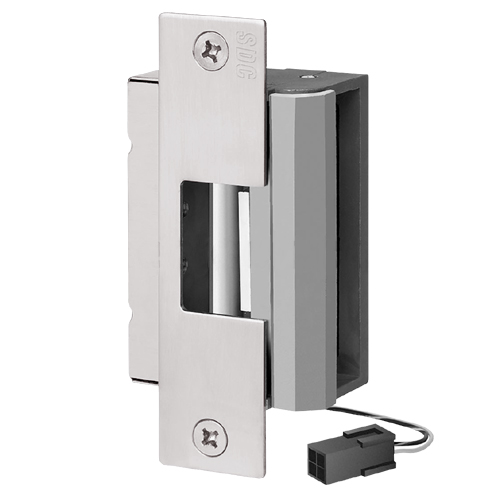
SDC 55 UniFLEX: The Strike for a Rim Exit Device Retrofit
Posted by Kent on 15th Sep 2026
Why the exit device stays and the strike changes
A rim exit device is bolted to the door face, not mortised into the edge, and its latch throws out sideways to catch a keeper mounted on the frame. When a customer wants that door tied into access control, they don't want you pulling a perfectly good panic bar off the door. They want the frame side electrified so a card reader, keypad, or the fire panel can release the latch without anyone touching the crossbar. That means the part that changes is the strike, not the exit device, and the strike has to be built to accept a rim device's latch geometry instead of a standard mortise or cylindrical latch.
I get called on this exact job more than almost any other access control retrofit. Building already has code-required panic hardware on a stair door or an alarmed exit, and now somebody upstairs wants it on the access control schedule too. Swapping the whole exit device is disruptive and usually unnecessary. Re-striking the frame keeps the existing panic hardware in place and skips re-templating the door for new hardware entirely.
What the SDC 55 Series UniFLEX brings to a rim retrofit
SDC's 55 Series, sold as the UniFLEX Heavy Duty Electric Strike, is built for exactly this scenario: a rim exit device already on the door, and a frame that needs an electrified keeper to match it. The 55-AU is that strike in Satin Stainless Steel, and it's the one I reach for on most commercial jobs because satin stainless matches the finish on the vast majority of rim exit devices and door closers you'll find already installed. Order it through the 55-AU listing and you're getting the same UniFLEX body SDC uses across the line, just in the finish that disappears against existing stainless hardware.
One thing I'll say plainly: don't guess on the strike family based on the exit device brand alone. Rim exit devices vary enough in latch profile that a strike built for one manufacturer's case can bind or rattle against another's latch. The 55 Series is built as a rim strike specifically, which is the detail that matters here. If you're not certain the door has a rim device versus a mortise or vertical rod device, stop and check before you order, because the wrong strike family on a rim job is a return trip.
Picking a finish that doesn't stick out
Nothing looks worse on a finished door than a bright strike plate sitting under dull hardware, and nothing tips off a building inspector or a picky property manager faster than mismatched metal on the same frame. The 55-AD gives you the same strike body in Dull Brass, which is the call on older buildings still running brass-finished panic hardware and closers. Find it at the 55-AD page.
Beyond satin stainless and dull brass, the 55 Series is also offered in Dull Bronze (AG), Oil Rubbed Bronze (AH), Bright Chrome (AP), and Dull Chrome (AQ). Before you quote a job, walk the door and note the finish on the exit device, the closer, and the pull side trim. I've had jobs where the exit device was satin chrome but the push bar had been replaced at some point with a slightly different tone, and matching to the newer piece rather than the older one made the whole assembly read as one job instead of two repairs stacked on each other. Ask, don't assume, and if the customer doesn't know, match to whatever's newest on that door.
When you need the latch monitor: 55-AU-LBM
If this strike is going onto a door that reports back to an access control panel, or onto anything tied into a monitored alarm zone, look at the 55-AU-LBM, the same Satin Stainless Steel strike with a Latchbolt Monitor built in. The name tells you what it does: it adds a supervised switch that reports the latch position electrically, so the panel knows whether that door is actually secured rather than just assuming it after a release cycle. You'll find it listed as the 55-AU-LBM.
My recommendation on this one is straightforward: if the door is already going onto an access control panel with reporting capability, spend the extra step and spec the LBM version instead of bolting on a separate door position switch later. A door contact tells you the door is closed. A latch monitor tells you the latch actually seated. Those are not the same piece of information, and on a fire stair or an alarmed exit, the difference matters when someone's reviewing an incident log. SDC also offers a Door Secure Monitor option on this line, listed as LBM or LCM depending on configuration, and it adds its own monitoring function on top of the base strike, so check which one the panel manufacturer wants before you order.
This isn't the 45 Series job
Don't confuse this with the more common situation where you don't know what's in the frame yet. If you're staring at a door with no existing exit device and no clear sense of what hardware will end up there, that's a different strike decision entirely, and I've written about that one separately in the piece on the SDC 45 Series for an unidentified frame. This article is for the job where the rim exit device is already known, already spec'd, or already on the door. If you're not sure which situation you're in, that's the first thing to nail down before you order anything, not after.
Both strikes come out of the same manufacturer, and if you're speccing SDC hardware regularly it's worth keeping the SDC hub bookmarked so you can cross-reference finishes and options across their whole strike and lock line instead of hunting one product page at a time.
Common questions
Does the 55 Series UniFLEX strike require replacing the exit device?
No. That's the entire point of this strike family. It's built to accept a rim exit device's latch at the frame, so the existing panic hardware on the door stays exactly where it is and only the keeper side gets electrified.
What's the difference between the 55-AU and the 55-AU-LBM?
The 55-AU-LBM adds a Latchbolt Monitor to the same Satin Stainless Steel strike body. That monitor reports latch position back to the access control panel, which the standard 55-AU does not do on its own.
Can I match the strike finish to hardware that isn't stainless or brass?
Yes, within the finishes SDC offers on this line. Beyond the 55-AU in Satin Stainless Steel and the 55-AD in Dull Brass, the 55 Series is also available in Dull Bronze, Oil Rubbed Bronze, Bright Chrome, and Dull Chrome, so most existing exit device finishes have a match.
How do I know if my door needs the 45 Series instead of the 55 Series?
If a rim exit device is already on the door or already specified, the 55 Series UniFLEX is built for that latch. If you don't yet know what hardware the frame will end up with, that's a different decision, and it's covered in the separate article on the SDC 45 Series for an unknown frame.