
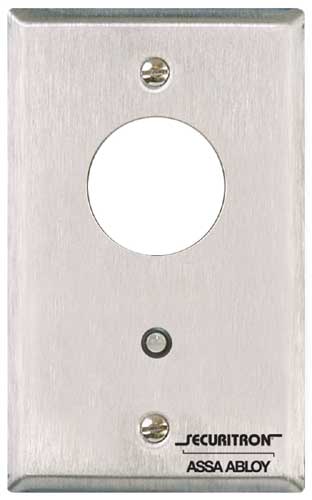
Securitron MK vs MKA: Momentary or Maintained Keyswitch
Posted by Kent on 15th Sep 2026
Why that maglock needs a manual override
If you just set a maglock on a door and wired it into access control, you already know the lock isn't the whole job. Staff need a way to get out from the secure side without waiting on a card reader, and fire and security personnel need a key that works when the power doesn't. I covered the mounting side of this in the piece on the M680 maglock for a door you can't mortise. This one is about what goes next to it: the keyswitch that lets a person with the right key release the lock by hand.
A keyswitch is a switch with a key cylinder instead of a lever. Turn the key, it makes or breaks a low-voltage circuit, and that circuit tells the lock to drop. Simple in concept. The part that trips people up is picking the right action for the job, and then getting it into the door.
Momentary or alternate: what the key actually does
Securitron sells this pair as the MK, a Securitron Single Gang Momentary Mortise Keyswitch, and the MKA, a Securitron Single Gang Alternate Mortise Keyswitch. Same body, same single-gang mortise mount, different action inside.
The MK is Momentary. Turn the key, hold it, and the switch closes. Let go and the key springs back to center on its own, the way a doorbell button returns. You get a brief pulse out of it, not a held state.
The MKA is Alternate, Securitron's term for what most of us call maintained or toggle action. Turn the key to the release position and it stays there. The circuit stays made until someone turns the key back. Nothing springs back on its own.
That difference is the whole decision. It is not about which one is "better." It is about whether you want a blip of a signal or a held one.
Which one I spec, and why
My rule of thumb: if the door only needs to open for someone to walk through and then lock right back up behind them, I put in the MK. A momentary pulse fits that job. Whatever is running the lock logic, whether that's the maglock's own control or a separate access controller, only needs that brief signal to drop the field and let the door swing.
Where I reach for the MKA instead is anywhere the door needs to stay released for a stretch, not just for one person passing through. A loading dock door propped for deliveries, a lobby that goes unlocked during open hours and gets keyed back at close, a mechanical room a contractor needs to move in and out of for an afternoon. You turn the key once, it stays open, you turn it back when the job is done. Nobody has to hold a key in a lock for twenty minutes.
I have walked into service calls where someone put an MK on a door that really needed maintained action. The tech wanted the door to stay unlocked during business hours and wired the momentary switch into a latching relay to fake it, which works until that relay coil fails or someone bumps the wiring during a remodel, and now the door is locked when it's supposed to be open, or worse, unlocked all night. Spec the right action up front and you don't need a relay doing a keyswitch's job.
Get the wiring backward the other direction and the more common headache shows up: door won't release at all when someone turns the key, because the normally-open and normally-closed terminals got swapped on the mortise switch. It's a quick fix once you know to check it, but it costs you a return trip if you don't verify the action at the panel before you close up the wall.
Standard mortise or narrow stile
The MK and MKA are built for a standard single-gang mortise prep, the kind you cut into a wood or hollow metal door or a mullion. That's most of what I run into on office doors, stairwell doors, and mechanical rooms. But a lot of the doors carrying maglocks these days are aluminum storefront, and a standard mortise keyswitch will not fit into a narrow stile.
MK and MKA on a standard door
For a wood or hollow metal door with room for a normal mortise cylinder prep, the MK and MKA drop in without any special sizing considerations. Match the action to the job as above and you're set.
MKN and MKAN on narrow stile aluminum
For a narrow stile storefront door, Securitron makes the MKN, the Securitron Narrow Stile Momentary Mortise Keyswitch, and the MKAN, the Securitron Narrow Stile Alternate Mortise Keyswitch. Same momentary and alternate functions as the MK and MKA, just sized to fit the stile instead of a full mortise prep.
On a storefront job, measure the stile before you order. I've had installers show up with the standard-body switch because it was already on the truck, and it will not go into a stile that narrow no matter how you fight it. Check the door before you cut, not after.
A couple of jobsite habits save you grief on any of these. Anodized aluminum chips at the edges when you rush the cutout, so take it slow and keep the bit sharp. And whichever mortise cylinder you're putting behind the faceplate, key it to match the building's existing system before you set it, not after, or you're pulling the switch back out to swap cores a second time. Mount height matters too. Keep the switch within reach for anyone using it, and if the AHJ has an opinion on where a manual release needs to sit relative to the door, get that settled before the hole is cut, not after.
Common questions
Can I use a momentary keyswitch where a maintained one is called for?
You can make it work with extra relay logic, but I don't recommend it. Adding a latching relay to turn a brief pulse into a held state is one more component that can fail and one more thing a tech unfamiliar with the door has to troubleshoot. If the door needs to stay released, put in the MKA or MKAN and skip the workaround.
Do the MK and MKA fit the same mortise prep?
Yes. Both are single-gang mortise mount switches, so the cutout is the same either way. The difference between them is entirely in the switch action, not the physical mounting.
How do I know if my door needs the narrow stile version?
Measure the stile before you order. A standard single-gang mortise keyswitch is built for a wood or hollow metal door prep and will not fit into the narrow aluminum stile on a storefront door. If you're working an aluminum storefront door, order the MKN or MKAN instead of the MK or MKA.
Where can I see the rest of the Securitron lineup?
The Securitron hub carries the full line, including the maglocks these keyswitches are built to pair with. Worth a look if you're speccing more than one component for the same door.