
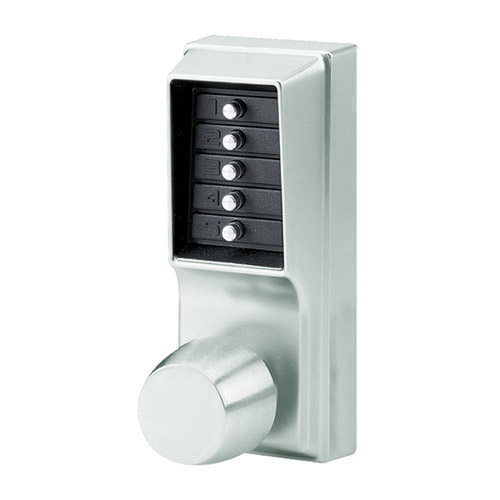
Simplex 1031 vs LL1031 vs LR1031: No Key Override, Knob or Lever
Posted by Kent on 13th Nov 2026
A pushbutton lock with no key at all
Most Simplex pushbutton locks you see on a hardware schedule have a key override: a cylinder on the outside that lets someone with a key bypass the code. The 1031 family does not. The listing is blunt about it: combination entry, passage mode, no key override. The code is the only way in, other than the inside lever or knob. That is a fine setup for the right door and a trap for the wrong one.
Three part numbers share the function: the 1031 with a knob, the LL1031 with a lever for a left hand door and the LR1031 with a lever for a right hand door. Each comes in four finishes, 12 listings in all.
What the three have in common
- All-mechanical, no batteries and no wiring.
- One access combination, with thousands of possible codes. The listing says the code is changed at the keypad without taking the lock off the door.
- Passage mode with an interior thumbturn. Engaged, it lets people in without the code.
- Vandal-resistant solid metal pushbuttons, listed as weather-resistant for indoor or outdoor use.
- ANSI/BHMA Grade 1.
- Backset: 2-3/4 in. (70 mm). Latch throw: 1/2 in. (13 mm).
- Door thickness: 1-3/8 in. to 2-1/4 in.
- Standard cylindrical prep: 2-1/8 in. cross bore, 1 in. edge bore. A template and mounting hardware are included.
- Three year warranty.
Knob or lever
The 1031-026-41 has a knob. The LL1031-026-41 and the LR1031-026-41 have levers, and the listing calls the lever design ADA-compliant. If the door falls under an accessibility requirement, the knob is out. That is the reason most people end up on the L versions. A knob needs a tight grip and a twist, and a lever does not.
Handing
This is where the listings differ in a way that costs money if you ignore it.
- The knob 1031 is listed as factory handed left hand, field reversible. It ships LH and you can flip it for a right hand door.
- The LL1031 is listed as left hand, factory handed.
- The LR1031 is listed as right hand, factory handed.
The lever versions come handed from the factory, and the listing says to confirm the door swing before ordering. The listing does not say whether a lever lock can be reversed in the field, so we do not say it can. Stand on the outside of the door, hinges on the left means a left hand door, and match the number to that. If you cannot decide, send us a photo of the door and we will call it. The same handing trap is explained for the 1021 and 1041 in the factory-handed Simplex piece.
Finishes
The code after the model picks the finish. For all three styles, the catalog lists:
- 026: Bright Chrome, US26 / 625
- 03: Bright Brass, US3 / 605
- 05: Antique Brass, US5 / 609
- 26D: Satin Chrome, US26D / 626
Every number ends in -41. Examples: 1031-03-41 in bright brass, LL1031-05-41 in antique brass, LL1031-26D-41 and LR1031-26D-41 in satin chrome. The -41 is part of every Simplex number on these listings, and the catalog does not decode it, so we leave it alone.
Where the no-override design makes sense
A door with no key slot cannot be picked, bumped or keyed wrong. There is nothing to rekey when somebody quits. For a storage room, equipment room or staff area that is opened by a handful of people who know the code, that is a clean design. When the code changes, you change it at the keypad.
It is the wrong lock where a person who is not on the code list has to get in during an emergency. The listing describes no outside key, no outside release and no override of any kind. A forgotten or garbled code on a door with no cylinder is a service call. Plan for that before it happens: keep the code written down somewhere the right people can reach, and set passage mode with the inside thumbturn when the room has to be open for a shift.
One more habit worth having: write the code on the work order the day you set it, and write the date you changed it. With no key to fall back on, the paperwork is the only backup. A lock that nobody can open is a bigger problem than a lock that is slow to open, and a reversed pair of digits written down wrong has caused plenty of the first kind.
If you want a key override
Pick a different Simplex number. The 5000 series takes a core from a named lock family, and the difference between them is laid out in the 5021, 5031, 5041 and 5051 comparison. The general case for the mechanical pushbutton is in the no-battery Simplex piece. The full line is on the Simplex page.
Before you order
- Decide whether anyone outside the code list will ever need in. If yes, this is the wrong lock.
- Knob only if no accessibility rule applies. Otherwise lever.
- For a lever, work out the door hand first. Stand outside, find the hinges, write down left or right.
- Check the door is 1-3/8 in. to 2-1/4 in. thick with a standard 2-1/8 in. bore.
- Pick the finish last.
Common questions
Can the 1031 be keyed?
No. The listing says no key override, and it shows combination only for the cylinder.
Can I flip the LL1031 to a right hand door?
The listing calls it factory handed and says to confirm the door swing before ordering. It does not say it can be field reversed. Order the hand you need.
What does passage mode do on this lock?
With the interior thumbturn engaged, people can enter without the code.
Does this lock need power or wiring?
No. It is fully mechanical.
Does the catalog list the number of possible codes?
It says thousands of possible codes and gives no exact figure.