
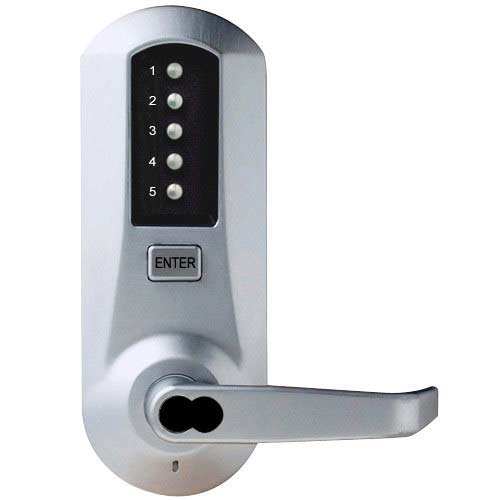
Simplex 5066, 5067, 5068: Mortise Latch, Deadbolt, Passage
Posted by Kent on 17th Oct 2026
Three mortise pushbuttons, one decision
Most of the Simplex 5000 Series is cylindrical, a lock that goes into a round bore through the face of the door. The 5066, 5067 and 5068 are the mortise versions. They go into a pocket cut in the edge of the door, the way a heavy commercial mortise lock does, and they carry the Simplex pushbutton on the face.
The three share a body. What separates them is what comes out of the door edge when you turn the lever, and whether there is a way to hold the door open to the public. That is a decision about how the door is used, so make it by looking at the door.
What the catalog lists
| Part | Function as listed | Latch as listed | Backset |
|---|---|---|---|
| 5066MWL-026-41 | Mortise lock with key override | Mortise latch | 2-3/4 in. (mortise) |
| 5067MWL-026-41 | Mortise lock with key override | Mortise with deadbolt | 2-3/4 in. (mortise) |
| 5068MWL-026-41 | Mortise lock with key override | Mortise with passage | 2-3/4 in. (mortise) |
All three are listed in bright chrome, US26/625, with a lever and a Medeco LFIC key override. The core is sold separately. That table is the whole story at the spec level, and the rest of this article is about what each of those latch descriptions means when you are standing at the door.
5066: the latch
The 5066 is the simple one. A mortise latch, a lever and a keypad. Punch the code and the lever works. Let go and the latch is back out. It is the lock for a door that closes and latches and stays that way.
It is the one I reach for when the door is an interior opening with a real latch requirement and nothing more. A records room, an equipment closet, a maintenance office. There is no deadbolt to throw and no thumbturn to forget. The less a lock offers a staff member to leave in the wrong position, the fewer calls you take.
5067: the deadbolt
The 5067 adds a deadbolt, listed as mortise with deadbolt. A deadbolt is the part that resists someone prying a latch back with a card or a tool, and it is the part that a security-minded customer is looking for.
The catalog does not spell out how the deadbolt is operated on this part number, and I am not going to describe a mechanism the listing does not describe. Ask us how the bolt works on the unit you are buying before you order if that matters to how the door is run. The fact that you can rely on is the listing: this is the member of the three with a deadbolt.
Use it where the door faces a hallway nobody watches, or where an insurance review or an audit has already asked for a deadbolt on the opening. If the door is just an office door in a staffed suite, you are buying more lock than the opening needs.
5068: the passage mode
The 5068 is listed as mortise with passage, and the feature copy describes passage mode with an interior thumbturn that allows free entry without the code when it is engaged. This is the same convenience we describe in our piece on passage mode on the 5021, 5031, 5041 and 5051, built into a mortise body.
That makes it the front office lock. Someone turns the thumbturn in the morning and the door is open to visitors. Someone turns it back at close and the keypad is in charge. The same warning applies as on the cylindrical models: a lock with a thumbturn can be left in the open position. If somebody has to do something to secure the door, somebody will forget. I put the 5068 on doors with staff who open and close the room, and I do not put it on a door with nobody to flip the thumbturn.
Read this before you order: the listing text and the mortise pocket
The installation notes on all three listings repeat the cylindrical prep language, a 2-1/8 in. cross bore and a 1 in. edge bore. That note is shared across the 5000 Series pages. A mortise lock does not mount in a cross bore alone. It needs the mortise pocket cut into the door edge. The backset on these listings is stated as 2-3/4 in. (mortise).
The catalog does not give the mortise body size, the pocket depth or the faceplate dimensions for these three. I do not have them, so I will not hand you a number. Before you order, measure the pocket on the old lock, or send us a photo of the faceplate and the model number. If you are replacing a different brand of mortise lock, assume the pocket will not match until you have checked it. We cover that fork for a very different mortise lock in our Schlage L9000 article, and the same discipline applies here.
What all three have in common
- All-mechanical operation. No batteries, no wiring.
- One access combination, thousands of possible codes, changed at the keypad.
- Solid metal pushbuttons, listed as vandal resistant, and weather resistant for indoor and outdoor.
- ANSI/BHMA Grade 1 and 3-hour UL/ULC fire rated.
- Doors from 1-3/8 in. to 2-1/4 in. thick.
- Non-handed, shipped left-hand, field reversible.
- Three-year warranty.
A short way to choose
- A door that closes and latches, nothing more: 5066.
- A door where a deadbolt is required or expected: 5067.
- A door that stays open for visitors during business hours: 5068.
If the mortise pocket is the wrong shape, or the opening is a standard cylindrical prep, you are probably looking at the wrong family. The 5011, 5015, 5016 and 5017 are the exit trim numbers, split by latch, and they are covered in the 5011 through 5017 article. If you are unsure whether you need a pushbutton at all, our Simplex 1000 piece explains where a mechanical code lock fits and where it does not.
Common questions
What is the difference between the Simplex 5066, 5067 and 5068?
The 5066 has a mortise latch, the 5067 is a mortise with a deadbolt and the 5068 is a mortise with passage mode and an interior thumbturn.
Do these need a mortise pocket?
Yes. They are mortise locks with a 2-3/4 in. backset. The catalog does not give the pocket dimensions, so check the old lock or send us a photo.
Is the Medeco core included?
No. They are prepped for a Medeco LFIC key override and the core is sold separately.
Do they need batteries or wiring?
No. They are all-mechanical.
Are they fire rated?
The listings show 3-hour UL/ULC fire rated and ANSI/BHMA Grade 1.
Can the handing be changed in the field?
Yes. They are listed as non-handed and field reversible.
More from this maker is on our Kaba Ilco and Simplex page. Call us if you need help matching the part number to the door you have in front of you.