
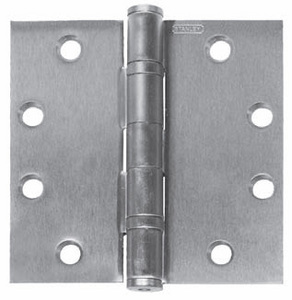
Stanley CEFBB179: Wire a Reader Without the Loop
Posted by Kent on 10th Sep 2026
The Power Transfer Loop Is Always the Ugly Part
You've done this job a hundred times. Card reader on the frame, electric strike or maglock on the door, and now you need 24VDC to cross that gap between the two. The usual fix is a power transfer hinge with a wire loop looping out of the hinge barrel and across the frame-to-door gap in the open position. It works. It also looks like an afterthought, and it's the first thing a kid on a hand truck catches with a cart wheel. On a school, hospital, or retail door that gets hit fifty times a day, that loop is a liability. Vandals pull it. Custodial carts snag it. Eventually someone yanks it hard enough to pop a connector loose behind the frame, and now you're back on site troubleshooting a reader that reads fine but doesn't unlock anything.
The alternative is an electrified hinge that runs the conductors through the hinge itself instead of across open air. That's the CEFBB179, Stanley's electrified version of the FBB179 commercial hinge.
What the CEFBB179 Actually Is
Strip away the "electrified" label and it's a Stanley FBB179 body underneath, Option CE. That's a 5-knuckle, full mortise, ball bearing hinge built for medium-weight doors at average traffic frequency. Standard weight, not heavy-duty. It uses the same template screw hole pattern as the plain version, so it drops into an existing 4.5" x 4.5" hinge prep on either a hollow metal or a wood door and frame without any extra machining. The bearings are permanently lubricated and non-detachable, pins are stainless steel, and there's a hole in the bottom tip for pin removal when you need to pull the door. Tips and pins are reversible, so it's non-handed — order it and it works whether the door swings left or right.
The part that matters for your job: 4 wires run through the hinge barrel itself, frame leaf to door leaf, with no exposed loop. That's enough conductors to run power and, depending on your hardware, a request-to-exit or monitoring signal to whatever's mounted on the door — a strike, a maglock, or the reader itself if it lives on the door side. Finish is US26D satin chrome, and screws are included.
One thing we won't do here is invent a wire gauge or a current rating for those four conductors. Every install is different depending on what you're powering and how far the run is. Call us and we'll help you match it to your strike or lock's actual draw before you order.
Mounting Notes
Because the screw pattern matches the standard FBB179, a locksmith replacing a hinge on an existing opening usually doesn't need to re-mortise anything — pull the old hinge, set the CEFBB179 in the same prep, run your leads. On new construction, template it like any other 4.5x4.5 hinge and coordinate the wire path with whoever's pulling low-voltage cable to the frame. Three hinges per door is standard commercial practice, and on an electrified opening the CEFBB179 typically goes in the middle position so the wire run is shielded by hinges above and below it. Confirm hinge count and placement against the door manufacturer's spec for that specific opening — weight and height change the math.
When You Don't Need the Wire at All
Not every door on the job needs power transferred through the hinge. If you're just hanging a standard door with no electrified hardware, don't pay for electrified capability you'll never use. The FBB179NRP is the same 5-knuckle ball-bearing FBB179 body, same 4.5" x 4.5" size, minus the electrified option, at a fraction of the CEFBB179 price.
Don't confuse what NRP actually does, though. Non-removable pin is a security feature, not a power feature. On an outswinging door, anyone with a screwdriver and a few minutes can drive the hinge pin out from the exposed knuckle and lift the door right off, strike plate be damned. The NRP set screw stops that. It has nothing to do with wiring anything. If a door needs both, power transferred through the hinge and pin security, that's a conversation about whether the frame swing direction even makes NRP necessary, and it's worth having before you order either part.
Speccing the Rest of the Opening
The hinge only solves one link in the chain. If you're also picking the strike itself, our piece on the Von Duprin 6111 covers a fire-rated rim exit strike that pairs well with an electrified hinge feed. And somebody has to power the whole assembly. For that side of the job, see our writeup on the Altronix LPS3C24X power supply, which is a common match for maglock and access-control door sets like this one.
Stanley makes a lot more than this one hinge. If you're stocking a truck or speccing a whole building, the full Stanley Hardware line is worth a look before you check out.
Common questions
Can the CEFBB179 replace a standard hinge one-for-one?
Yes, on doors already prepped for a 4.5" x 4.5" template hinge. It uses the same hole pattern as the standard FBB179, so it fits existing hollow metal or wood door and frame preps without additional machining. You still need to run your low-voltage wiring to and from the hinge location, which is a separate step from the hinge swap itself.
Does the CEFBB179 come with a non-removable pin option?
No. This hinge is built around the electrified (CE) option, not NRP. If you need both power transfer and pin security on the same opening, talk to us about which combination of Stanley hinges fits that door, since they're separate features on separate SKUs.
How many electrified hinges does one door need?
That depends on the door's height, weight, and the manufacturer's hardware schedule, so we won't guess a number here. Three hinges per door is standard commercial practice generally, and most electrified openings only need one electrified hinge, but confirm against the actual door spec before ordering.
What gauge or current rating are the four wires rated for?
We don't publish that spec because it isn't listed on the manufacturer data we have, and guessing on a power-carrying component is a bad idea. Call us with what you're powering, strike, maglock, or reader, and we'll help you confirm it fits before you buy.