
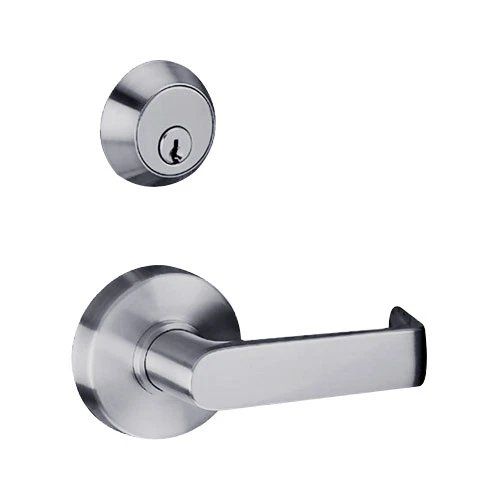
TownSteel MSS: A Heavy-Duty Mortise Lock That Isn't a Big Three Price
Posted by Kent on 18th Aug 2026
Forty doors, a mortise-lock budget written off a big-three quote, and a number that no longer works. That is the call we take most often. In our catalog the answer is the TownSteel MSS Series, and the risk does not sit where most buyers think.
What a value line changes, and what it does not
A mortise lock is a mortise lock. The MSS case drops into a standard pocket, the trim covers the face, the cylinder threads in. Same install as a big-three case, and nobody bills more labor for the brand.
I will not tell you this lock equals a Schlage L9000 or a Sargent 8200. I have not been handed comparative test data and I will not invent it. A value line earns its keep on moderate-traffic commercial openings: an office suite, a church, a classroom.
The highest-abuse door is a different conversation. A main entry that eats a thousand cycles a day, a dorm door, a door with a closer set too heavy. Spec the lock you already know survives there. Put the value line on the thirty-five ordinary openings and the budget into the five that punish hardware. Our Schlage L9000 mortise function guide walks the other side of the fence.
The real cost of switching brands is keying, not hardware
If your building is on an established keyway and a master key system, changing brands is a keying decision before it is a hardware decision. The case is the cheap part. The cylinder, the keyway, the pinning, and whether your masters still work across the building is the expensive part. I have watched a manager save on forty lock bodies and spend it back on keying.
Call us with your keyway before you order: what the building runs on, whether the keyway is restricted or patented, and whether the new openings have to key into the existing master. Sometimes the honest answer is that a mixed-brand system creates a key-control mess, and you want that on the phone, not from your locksmith on installation day.
Spare parts and lead time
A brand your distributor stocks deep gets you a replacement lever, spindle, or case quickly. A value line is a thinner shelf. That matters in year four, when one lock fails and you need the part this week. Order a couple of spares with the original run.
Choosing a heavy duty mortise lock alternative: trim, function, finish
Trim profile: low sectional or sectional
We stock two profiles, both with the Sentinel lever. MSS-L-S is low sectional trim, MSS-R-S is sectional. The difference is how much of the door face the escutcheon covers.
On a full building replacement, pick one and stay consistent. Mismatched trim down a corridor reads as cheap even when every lock is fine, and the building owner walking a tour notices. If you are replacing twelve of forty doors, photograph an existing lock and send it to us before you pick a profile.
Function: 04 entry/office
Everything listed here is the 04 function, entry/office, single cylinder. Leave the lever unlocked for the business day, lock it when you leave. That is what office suites and tenant spaces want.
A storeroom function is a different animal. Outside lever always locked, key every time, no way to leave it unlocked by accident. Storerooms fail as entry/office because somebody flips them unlocked Friday and nobody notices until Monday.
Confirm function per opening, not per building. Write it next to each door number. Our Sargent 8200 function walkthrough covers the full set and the logic transfers.
Finish: two that survive
The finish codes are ANSI/BHMA numbers and mean the same thing across brands.
| Code | Finish | Where it belongs |
|---|---|---|
| 626 | Satin Chrome | The commercial default. Hides fingerprints, tolerates cleaning chemicals, matches almost everything already in the building. |
| 630 | Satin Stainless Steel | The other safe pick. Slightly cooler tone than 626. Holds up in high-humidity and heavy-cleaning areas. |
| 622 | Oil Rubbed Bronze | Dark, architectural. Common in churches and older buildings. Handles wear by darkening rather than spotting. |
| 606 | Satin Brass | Warm tone without the mirror. Use it where existing brass hardware sets the standard. |
| 605 | Bright Brass | Polished. Shows every fingerprint. Lobby and low-touch decorative use. |
| 629 | Bright Stainless Steel | Polished stainless. Same caution as 605 on a busy corridor. |
| 625 | Bright Chrome | Polished chrome. Decorative openings only. |
626 and 630 disappear into a commercial building and keep looking acceptable. Bright finishes show every hand mark and every swipe of a janitor's rag. Pick bright for a boardroom door, not for forty corridor openings.
In-stock MSS locks
Low sectional trim: MSS-L-S-04-626 in Satin Chrome, MSS-L-S-04-630 in Satin Stainless Steel, MSS-L-S-04-622 in Oil Rubbed Bronze, MSS-L-S-04-605 in Bright Brass, and MSS-L-S-04-629 in Bright Stainless Steel.
Sectional trim: MSS-R-S-04-622 in Oil Rubbed Bronze, MSS-R-S-04-606 in Satin Brass, and MSS-R-S-04-605 in Bright Brass. The full line sits on our TownSteel hub.
The trap: your doors may not be prepped for this
A mortise lock is not a drop-in replacement for a cylindrical lock. A bored lock needs a round hole through the door and a small latch bore. A mortise lock needs a rectangular pocket machined into the door edge, plus a face cutout and a strike prep in the frame.
If your doors have cylindrical locks, this is a door-prep project, not a hardware order. On hollow metal, field machining or replacement doors. On wood, a mortising jig, a router, and someone who has done it before. Real labor, and it belongs in the budget before the locks.
Open a door, photograph the edge, and send us the photo. That has saved more than one customer from a pallet of locks that would not fit.
Confirm before you order
- Existing prep. Mortise pocket or bored hole.
- Handing. Per opening, from outside.
- Door thickness. Measure it.
- Function per opening. Entry/office or storeroom, on the door schedule.
- Finish. One finish across the run unless you have a reason.
- Keyway and master system. The one that costs real money if you get it wrong.
Buy one first. Hang it on the worst door in the building and leave it a month. Then order the other thirty-nine. One sample tells you more than any spec sheet.
Common questions
What is the difference between MSS-L-S and MSS-R-S?
Trim profile. MSS-L-S is low sectional, MSS-R-S is sectional. Both use the Sentinel lever and the 04 entry/office function. What changes is how much of the door face the escutcheon covers, which matters when matching existing corridor hardware.
What grade is the MSS Series and what is its cycle rating?
Ask us to confirm both in writing before you order, and get it on the submittal. We do not publish a grade or a cycle number here that we have not verified against current manufacturer documentation. Tell us the application and we will pull the current spec.
Can I use this if my building already has a master key system?
Maybe, and that is the question to settle first. Whether an MSS integrates depends on your keyway, and whether it is restricted or patented. Call us with what the building is keyed to before you order.
My doors have cylindrical locks. Can I just swap in a mortise lock?
No, not without machining the doors. A mortise lock needs a rectangular pocket in the door edge that a bored door does not have, Send us a photo of the door edge and we will tell you what you have.
When should I pick storeroom function instead of the 04 entry/office?
Any door that must never be left unlocked: supply rooms, IT and mechanical closets, exterior openings. Office suites and tenant spaces want the 04 entry/office so staff can leave the lever unlocked through the day.