
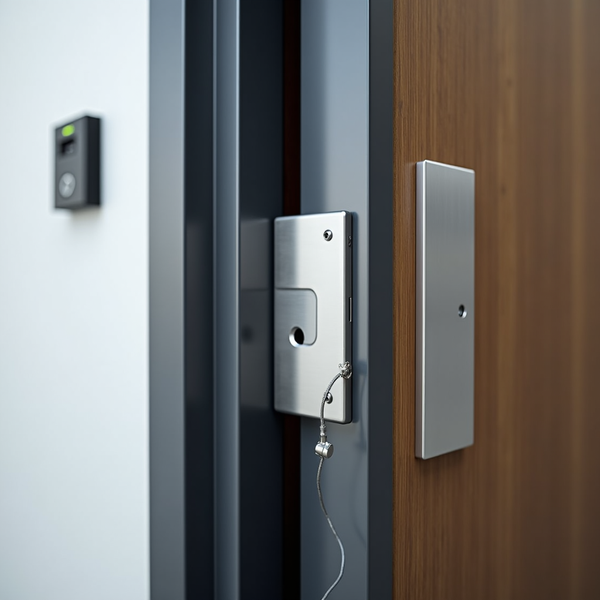
HES 1006 or Von Duprin 6211: Electric Strike for a Card-Reader Metal Frame
Posted by Kent on 21st Jul 2026
Somebody hands you an access-control job on an existing metal-frame door and says "just make the card reader unlock it." The part that actually does the unlocking is the electric strike, and picking the wrong one is how a clean install turns into a frame you have to cut twice. HES makes the strike most integrators reach for on a hollow-metal-frame retrofit. The trick is matching the strike to the lock already on the door and the frame it sits in — and knowing when the job calls for a different strike family entirely.
Start with what the lock throws
An electric strike replaces the fixed strike plate. When the reader energizes it, the strike's keeper releases and the door pushes open, while the lock's own latch or bolt never moves. So the first question is what the lock throws into the frame: a latchbolt, or a deadbolt. Get this wrong and the strike physically will not accept what the lock puts in it.
For a cylindrical or mortise lock with a standard latchbolt, the HES 1006CLB is the go-to. The 1006 is the workhorse of the line, built for latchbolt locks in a hollow-metal frame, and it ships as a complete kit with the faceplates you need to fit common frame preps. CLB in the model is the tell: Complete, LatchBolt. If the lock instead throws a deadbolt, you order the deadbolt version. Read the lock first, then the strike.
Fail-safe or fail-secure: get this decision right
This is the one people flip and regret. Fail-secure (also called fail-locked) stays locked when power drops. Cut the power, the door stays secured, and you still get out from the inside because the lock's own lever always retracts the latch for egress. That is what you want on almost every perimeter and office door. Fail-safe unlocks when power drops, which you only want where a fire or life-safety code says the opening must free on power loss. Most HES strikes are field-selectable between the two with a jumper, but confirm it for the exact model before you order. Set it wrong and you either lock people in or leave the building open every time the power blinks.
Heavy-duty or fire-rated: check the lock before you reach for a bigger HES
The 1006 covers ordinary hollow-metal-frame traffic all day. But when the door takes real abuse — a warehouse man-door, a school exterior, an entry the public yanks and kicks — or the spec calls for a fire rating, look at what the lock actually is before grabbing a bigger HES body. If it's a standard cylindrical bored lockset — Schlage ND, Corbin Russwin CL, Sargent's 10-line, Yale AU, Arrow, and the like — the Von Duprin 6211 is the strike we stock and have priced for that job: ANSI/BHMA Grade 1 heavy-duty stainless body, UL 10C fire-rated for three hours, factory-configured fail-secure, and a dual door-position/latch monitor switch built in for anyone running remote monitoring. It's a different strike family from the 1006/1500 hollow-metal complete kits, built for the 1/2" latch throw a standard cylindrical bored lock uses. Got a mortise lock instead, one with a 3/4" or 1" bolt throw? That's not the 6211 — that's Von Duprin's 6221. Measure the throw before you order either one.
Match the frame prep and the finish
The frame prep decides the faceplate. Most hollow-metal frames take one of a handful of standard preps, which is why the HES complete kits carry several faceplates. Measure the existing strike cutout before ordering. For finish, 630 satin stainless is the commercial default and matches most exit and lever hardware; the 6211 ships in satin stainless, satin bronze, dark bronze, satin brass, bright brass, and bright stainless if the opening calls for something else. Finish is cosmetic; the prep, the lock type, and the fail mode are what make or break the install.
Common questions
HES 1006, or step up to the Von Duprin 6211?
1006 for normal commercial hollow-metal-frame doors. Check the lock before you step up: if it's a standard cylindrical bored lockset and the door takes real abuse, needs a fire rating, or you want built-in monitoring, the Von Duprin 6211 is the heavy-duty pick we stock and have priced. Confirm the 1/2" latch throw first — a mortise lock with a 3/4" or 1" bolt needs the 6221 instead, not the 6211.
Fail-safe or fail-secure?
Fail-secure for almost everything: locked on power loss, still free to exit from inside. Fail-safe only where a life-safety code requires the door to unlock on power loss. The 6211 ships factory-configured fail-secure, in 12VDC or 24VDC.
Latchbolt or deadbolt version?
Match the lock. A latchbolt lock takes the HES CLB strike; a deadbolt lock takes the deadbolt version. Read what the lock throws before you order.
What voltage?
Most HES strikes are field-selectable 12/24V, AC or DC, but confirm the exact model against your power supply and reader before ordering. The Von Duprin 6211 is sold as separate 12VDC and 24VDC part numbers rather than field-selectable, so order the voltage you're running.
Lock Depot stocks the HES 1006 in the common finishes, latchbolt and deadbolt versions, complete kits with the faceplates a hollow-metal-frame retrofit needs — and the Von Duprin 6211 for a heavy-duty, fire-rated upgrade on a standard cylindrical bored lockset. If you're weighing the 6211 against its wide-faceplate sibling for a rough old strike cutout, see our 6211 vs 6211WF guide. Start at the HES electric strikes hub, or call 877-365-5625 and tell us the lock on the door, the frame, and whether code makes it fail-safe. No phone tree. We'll read you the exact strike and faceplate.