
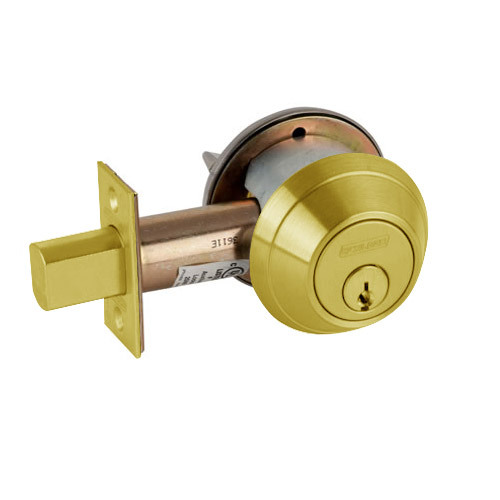
Schlage B660: Which Grade 1 Deadbolt for a Commercial Door
Posted by Kent on 1st Aug 2026
A deadbolt is the one lock people notice only after it fails. On an apartment or a shop back door, the auxiliary deadbolt does the real holding — the latch on the knob is a joke to anyone who has seen a credit card slip one. If you are buying for a commercial or multi-family exterior door, the Schlage B660 is the Grade 1 you want. Here is how to spec it without a second box showing up.
Single cylinder or double, and why it matters more than you think
The B660 is the single-cylinder version: key outside, thumbturn inside. That is the right pick for almost every door with a person behind it. Push the thumbturn, you are out, no key, no fumbling in a fire. The B662 is double cylinder: key on both sides, no thumbturn. People reach for it on a door with glass next to the lock so a burglar can't break the pane and turn the bolt.
Careful there. A double cylinder on an occupied exit is an egress problem, and a lot of jurisdictions won't allow it on a required exit. I have seen inspectors red-tag them. If you have glass and you're worried, the honest fix is usually a better door or laminated glazing, not a lock you can't open from inside without hunting for a key. Buy the B660 unless you have a real reason and the code officer on your side.
Grade 1 is not marketing here
The B600 line is ANSI/BHMA Grade 1, the commercial-duty tier, not the residential B60 you'll see at the big box. Same family name, different animal. The B660 has a hardened, saw-resistant bolt insert and a 1-inch throw. That 1-inch throw is the whole point: it buries deep enough into the strike that a spread-the-frame pry attack has nothing short to grab. I've pulled fifteen-year-old B-series bolts out of rentals still throwing smooth. They earn the price on a door that gets used hard.
Keyway and keying it to what you already run
The B660 takes the Schlage C keyway as standard. If your building already runs Schlage C, most commercial doors around here do, you can have it keyed alike to the existing system or master-keyed into it, so one key runs the whole property. Tell us your keying up front. Rekeying a pile of deadbolts after they ship is a service call nobody needs to pay for.
Backset and finish, the two numbers that cause returns
Two measurements decide whether the lock even mounts. Backset is the distance from the door edge to the center of the bore: 2-3/8" or 2-3/4". Get it wrong and the bolt either won't reach the strike or the cylinder rides off-center. Most commercial doors are 2-3/4". Measure yours before you order; don't guess.
Finish is the easy one. 605 bright brass, 606 satin brass, 626 satin chrome. Satin chrome (626) is the commercial default and hides wear. Match it to the lever or knob already on the door so the opening doesn't look pieced together.
Common questions
Is the B660 the same as the residential B60?
No. Same brand family, different grade. The B60 is residential Grade 2; the B660 is commercial Grade 1 with a hardened bolt and heavier internals. On a commercial or apartment exterior door, buy the B660.
Can I get it keyed to my building's existing keys?
Yes, if you run Schlage C. Tell us keyed-alike or the master-key group at order time and it ships that way.
Should I use a double cylinder?
Usually no. Double cylinder can violate egress code on an occupied door. Use the single-cylinder B660 unless a code official signs off on the double for a specific glass situation.
What backset do I order?
Measure it. Door edge to center of the bolt hole: 2-3/8" or 2-3/4". Most commercial doors are 2-3/4".
Lock Depot stocks the Schlage B660 and B662 in the common finishes, keyed to your system, with box strikes and long screws to match. Start at the Schlage hub, or if you're speccing the lever on the same door, read Which Schlage ND Lever for a High-Traffic Office Door. Or call 877-365-5625 with your backset, your keyway, and single or double, and we'll read you the part number.