
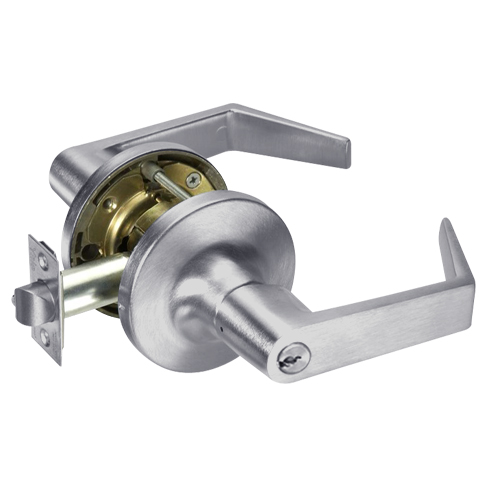
Yale 5400LN: Corridor or Communicating Classroom Function
Posted by Kent on 24th Sep 2026
The 5400LN line has more functions than most people order past
Most Yale 5400LN orders land on Entry, Storeroom, or Classroom because those cover the doors everybody thinks of first: an office, a supply closet, a classroom off the corridor. Two functions further down the list get ordered wrong more than any others on this line, because the names sound close enough to guess: Corridor and Communicating Classroom. They're not interchangeable, and neither one is a substitute for plain old Classroom function.
This is a Grade 1 heavy-duty cylindrical (bored) lockset line built for schools, offices, and healthcare corridors, so the body underneath every function code is the same abuse-rated hardware. Function only changes what the lever does when you turn it. Everything else about the lock, the strength, the cycle rating, the finish options, stays constant across the whole line.
AU5422LN: Corridor function, with an indicator
The AU5422LN is built for exactly what it sounds like: a corridor door, not a room off the corridor. It gives keyed control of the outside lever with an indicator, sized for the kind of high-traffic corridor opening that gets propped, kicked, and left alone by facilities for years at a stretch. The indicator is the detail worth noticing. It's the same idea as the visual indicator on our 4706LN service station lock, a quick look at the lever tells you the lock state without touching the door.
AU5429LN: Communicating Classroom, for two rooms that share a wall
The AU5429LN carries the Communicating Classroom function, and the catalog description is honest but short on it: "used for twin communicating or closet" openings, then it cuts off. I'll say what I know and stop where the documentation stops. This is a function built for a door between two adjoining spaces, not a room-to-corridor door, and it's a different animal from the plain Classroom function that locks and unlocks the corridor-facing lever by key. If your job is a door connecting two classrooms, two offices, or a room and its closet, this is the function to ask about specifically. If you need the exact locking behavior spelled out before you order a school full of them, call us. That's not a dodge, it's the honest answer when the spec sheet stops short of the detail you need.
Both share the same lever mechanism, and that's not nothing
Every function in the 5400LN line, corridor and communicating classroom included, runs the same Free Wheeling lever mechanism. When the outside lever is locked, it spins freely instead of forcing back against a locked mechanism. That's a real durability feature, not marketing copy. A lever that fights back every time someone tries the door on a locked corridor opening is a lever that's going to loosen, then break, well before its rated cycle count. Free Wheeling means someone yanking on a locked door isn't putting stress on the internal parts at all.
Grade 1, same as the rest of the line
Both SKUs are certified to ANSI/BHMA A156.2, Series 4000, Grade 1, the same heavy-duty cylindrical rating that covers the rest of the 5400LN family. Function code changes what the lock does. It doesn't change how tough the lock is built, and that consistency is one of the actual reasons to standardize a whole building on one line instead of mixing brands function by function.
Don't guess on either of these two
Storeroom, Entry, and plain Classroom cover most doors, and most people can spec those from memory. Corridor and Communicating Classroom are the two on this line worth a second look before the order goes in, because the wrong pick means a door that locks the wrong lever, or worse, locks a shared opening in a way that traps someone on one side of it. Cheap mistake to avoid, expensive one to fix after the doors are hung.
Why the Augusta lever specifically
Both SKUs here carry the Augusta lever design. Yale runs several lever styles across the 5400LN line, and the function code is independent of which lever you pick, the same way it is on most cylindrical lock families. Augusta is a return-to-door lever, which matters on a corridor where clothing or a bag strap catching a lever that sticks straight out is a real snag hazard, not a theoretical one. If a different lever style is already standard across the building, confirm it's available in the function you need before ordering rather than settling for Augusta by default.
One more thing worth saying about ordering a whole floor of these: batch the function codes by room type before you place the order, not door by door as rooms get punch-listed. A spreadsheet with room number and function code takes twenty minutes to build and saves a return shipment when half the "classroom" doors turn out to be a connected suite that actually needed communicating classroom function instead.
For the mortise side of the Yale line rather than cylindrical, our 8800 mortise storeroom guide covers that function on the heavier-duty body. And for a pair of doors instead of a single opening, the 7110F/7120F vertical rod guide is the one to check.
Common questions
What's the difference between Yale Corridor and Classroom function?
Corridor function (5422LN) is built for the corridor door itself and includes a lock-state indicator. Classroom function locks the doors off the corridor. They're not the same application and shouldn't be substituted for each other.
What is Communicating Classroom function used for?
Per the catalog, it's used for twin communicating or closet openings, meaning a door between two adjoining rooms rather than a room-to-corridor door. If your exact application needs more detail than that, call before ordering.
Does the Free Wheeling lever apply to every 5400LN function?
Yes. It's a feature of the line, not one specific function, and it protects the internal mechanism when someone tries a locked outside lever.
Are Corridor and Communicating Classroom the same grade as Storeroom or Entry?
Yes. All 5400LN functions are certified to ANSI/BHMA A156.2, Series 4000, Grade 1.
Can I mix Corridor and Communicating Classroom functions on the same job?
Yes, they're separate SKUs for separate door conditions. Spec each opening for what it actually needs rather than standardizing on one function across doors with different jobs to do.