
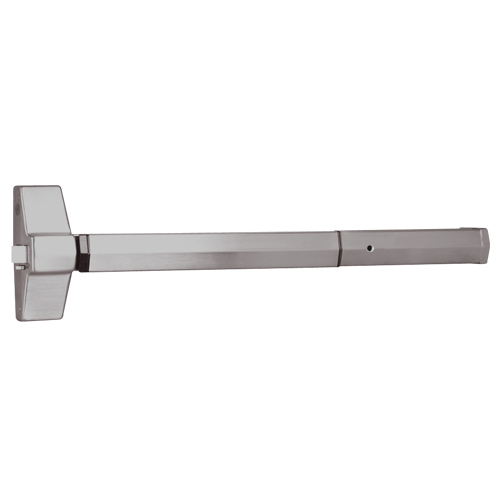
Yale 7100F vs 7100: The Fire-Rated Rim Exit Decision
Posted by Kent on 8th Sep 2026
What the F actually changes
The letter is not a trim option. On a Yale 7000 Series rim device, the F means the device carries a fire label and is built to hold a door closed while the frame is warping and the hinges are pulling. The 7100F and the 7100 look nearly identical hanging on the wall at a supply house. Same push pad, same footprint, same 630 satin stainless. Bolt them side by side and most people could not tell you which is which without reading the stamp.
Three things change. The latch is built to stay engaged when the door is being pushed hard from one side. The device is listed as part of an assembly, so it belongs only on a door and frame that carry their own labels. And the mechanical dogging is gone. Not disabled, not optional. Gone. There is no hex hole and no dogging port.
That last one is where the arguments start, so we will spend most of this article there.
Why a fire rated exit device can never be dogged
Dogging leaves a door that does not latch. That is the whole point of it on a non-rated opening. You push the pad in, hold it with a hex key or a keyed cylinder, and now the door swings free all day. Warehouse aisles, break room doors, a busy back hall between two conditioned spaces. It saves the hardware and it saves everybody's shoulder.
A fire door has one job. Latch. Every single cycle. A closed but unlatched fire door in a real fire is a piece of paper in a wind tunnel. Pressure builds on the fire side, the leaf pushes open a few inches, and the stairwell you were counting on to get people down four floors becomes the chimney that feeds the fire. I pulled the label off a scorched stairwell door on an older commercial building once and the hardware was fine. The door had been chocked with a wood wedge. The frame above it was black. The wall on the far side of the corridor was not.
So the 7100F ships with no dogging. That is deliberate. If you order the non-rated 7100 for a labeled stairwell because a maintenance guy told you he needs to dog it during move-ins, you have bought a device that gets written up on the next inspection, and you will buy it twice.
What people do instead: electric latch retraction
Here is the legitimate answer, and almost nobody at the counter knows it exists until you tell them. Electric latch retraction pulls the latch back electrically and holds it back on a signal. Card reader, time clock, front desk button. The critical part is that it ties into the fire alarm. Alarm drops, power drops, latch springs out, door latches. Instantly.
That gives the facilities crew the free swinging door they wanted during the day and a legal fire door the second the panel goes into alarm. It needs a power supply sized for the inrush, which is the detail that bites people. I have seen two retraction devices run off a supply rated for one, and the second device would chatter and stall halfway. Size the supply for simultaneous retraction of every device on the circuit, not for the average draw.
If retraction is out of budget, the other legal answer is a magnetic hold open tied to the alarm, with a closer that shuts and latches the door on release. What is never the answer is a hex key, a wedge, a zip tie through the pad, or a chunk of angle iron. If a customer asks me to dog a rated door, I say no and I put the no in writing on the work order. That is not being difficult. That is the one call in this trade where being agreeable gets somebody killed.
Read the label before you order anything
Walk to the door. Look at the hinge edge of the leaf, usually up near the top hinge, sometimes on the top rail. A labeled door has a metal or foil tag stamped with a listing agency and a rating in hours or minutes. Twenty minute, forty five minute, ninety minute, three hour. Check the frame too. That label sits on the hinge jamb rabbet.
Label on the door means you order the 7100F. Do not argue with the tag, and do not let a GC talk you into the cheaper part because it is only a back exit. No label anywhere and no rating on the door schedule means the 7100 is fine, and you get dogging as a bonus.
Sizing: 24 in versus 36 in
Device length matches door width, and the pad should run roughly half to three quarters across the leaf. The 36 in device is what you want for a standard 36 in commercial leaf. The 24 in size covers narrower doors, common on older openings and closet width rear exits. Ordering a 36 in device for a 30 in leaf is the mistake I see most, and it does not just look wrong. The end cap overhangs the stile, the mounting holes miss the internal reinforcement, and you end up with a device screwed into the door skin. It will pull out.
Rim, surface vertical rod, or concealed rod
Rim is the default. The latch throws into a strike on the frame stop, one point of latching, easy to install and easy to service. That is the 7100-36-630 and the fire rated 7100F-36-630. If you have a single door in a frame, stop here.
Pairs are different. Two leaves and no center mullion means there is nothing for a rim latch to catch, so you go vertical rod and latch top and bottom into the head and the threshold. Surface vertical rod like the 7110-36-630 mounts on the face of the door. Homely, inexpensive, and you can service every part of it with the door hanging. Concealed vertical rod like the 7120-36-630 hides the rods inside the stiles and needs a door prepped for it from the factory. Beautiful when it works. When a bottom rod goes out of adjustment you are pulling end caps and fishing inside a door on a ladder.
The rest of the line, trims, cylinders, and the mortise family, is over on the Yale hub. If the opening wants a lever instead of a pad, read the 8800 mortise storeroom writeup. For a hollow metal stairwell where you want the heavier Grade 1 conversation, the Von Duprin 99 on a hollow metal fire door covers the same decision from the other side.
Common questions
Can I install a 7100F on a non-rated door?
Yes, and it is perfectly legal, you just lose dogging. Some facilities standardize on the F across every opening so the stock room carries one part number and nobody grabs the wrong device off the shelf. The tradeoff is that no door in the building can be held open mechanically.
Can dogging be added to a 7100F later?
No. There is no field kit and no listed way to add it. Anyone who tells you they can dog a rated device is describing a code violation and voiding the listing on the whole assembly.
How do I know if my door is fire rated?
Check for a metal label on the hinge edge of the door and on the hinge jamb of the frame. It lists the agency and a rating in hours or minutes. If the label is painted over or missing, pull the door schedule from the original submittals before you order hardware.
What size device do I need for a 36 inch door?
The 36 in device, which is what the 36 in the part number means. Measure the actual leaf, not the rough opening or the frame. Narrow doors take the 24 in size, and undersizing is safer than oversizing because an oversized device misses the internal reinforcement.
Do both leaves of a pair need an exit device?
Usually yes, unless one leaf is inactive and held by flush bolts and the opening is not a required exit at that width. On a rated pair the flush bolts have to be the automatic type, and the active leaf carries the device with a coordinator so the two leaves close in the right order.