
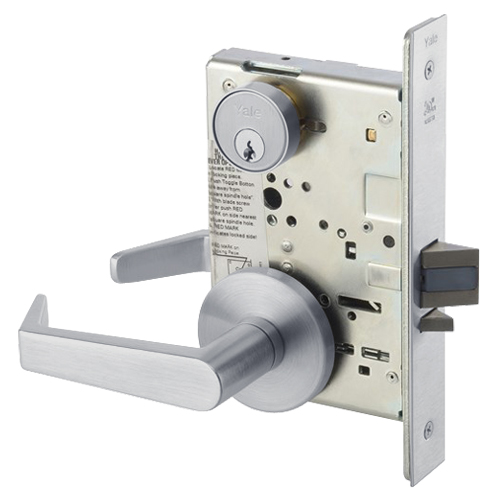
Yale 8800FL 8864 Bathroom vs 8822 Dormitory With Indicator
Posted by Kent on 13th Nov 2026
Two 8800FL locks with an occupancy indicator, and they do different jobs
The Yale 8800FL mortise family has two models that show a locked or unlocked status on the lever side: the 8864, called a bathroom lock with indicator, and the 8822, called a dormitory lock with indicator and a deadbolt. They look alike on a hardware schedule and they are not interchangeable. This is how to tell them apart before you order.
Yale is sold under the Accentra name now. The listings call it the commercial line formerly known as Yale. Both locks carry the Augusta lever and an ANSI/BHMA Grade 1 rating.
Side by side
| 8864 bathroom | 8822 dormitory | |
|---|---|---|
| Deadbolt | No, latchbolt only | Yes, deadbolt added to the latch |
| Outside lever | Rigid at all times | Locked by key |
| Inside | Lever always active; thumbturn works the indicator | Inside lever and deadbolt let the occupant secure the opening |
| Indicator | Yes | Yes |
| Core options in the catalog | Keyed, -LC, -ICLC, -SFICLC | Keyed, -LC |
| Example | AUR8864FL-626 | AUR8822FL-626 |
8864: the bathroom lock
The listing describes this as privacy or bathroom function. It locks from the inside for restroom or bedroom use, and it has an emergency outside release. Here is how the lock works, in the manufacturer's words: the latchbolt is retracted by the key outside or the lever inside. The occupancy indicator is operated by the thumbturn inside or the key outside. When the indicator shows OCC, the key outside will operate the indicator and retract the latchbolt. The outside lever is rigid at all times. The inside lever is always active.
On a single-occupancy restroom, that is the job: the person inside turns the thumbturn, the outside shows occupied, and a key (a manager, a custodian) can still get in. The outside lever never retracts the latch on its own, so nobody walks in because the door "gave."
8822: the dormitory lock
The 8822 is a different animal. The listing says the dormitory function locks the outside lever by key, while the inside lever and the deadbolt let the occupant secure the opening from within. That is the room-with-a-person-living-in-it function: a resident throws the deadbolt for privacy, the key from outside overrides it. A deadbolt adds throw that a latchbolt alone does not give you, which is why this one is the choice for sleeping rooms and offices people close for the day.
A catalog quirk you may hit: the product title on the 8822 reads "Dormitory Lock with Indicator," while the web address on several of the 8822 pages says "bathroom lock with indicator." The function field and the description both say dormitory. We treat the dormitory description as the real one. If you see the odd address, do not take it to mean the lock changes with the page. If the opening is a restroom, you want the 8864.
Which is right for the opening
- Single-user restroom, locker room stall or bedroom with no deadbolt required: 8864.
- Dorm room, resident room or office that needs a deadbolt and a key override from the corridor: 8822.
- Door needs to be keyed from the outside to go in at any time and nothing more: neither one. Look at the entrance and classroom models.
Deadbolt-equipped relatives in the same family, the 8847, 8860, 8861 and 8867, are covered in the deadbolt function piece.
The mix-up that sends the wrong lock
The two numbers sit one apart in the family, the indicator is on both, and the finish codes are identical. A buyer scanning for "indicator" grabs whichever shows first. The check takes ten seconds: look for the word deadbolt in the title. If it is there, you are holding the 8822. If the opening is a restroom and you have a deadbolt-equipped lock in the cart, put it back and find the 8864. A restroom does not need a deadbolt, and a resident's room does need more than a latch.
Cores and finishes
The 8864 comes four ways: plain, -LC (less cylinder), -ICLC (prepped for a large format interchangeable core, less core) and -SFICLC (prepped for a small format interchangeable core, less core). The 8822 in our catalog is listed plain and as -LC only, so a dorm on a core system needs a different 8800FL model or a call to us first.
Both come in ten finishes: 626 Satin Chrome, 625 Bright Chrome, 605 Bright Brass, 606 Satin Brass, 612 Satin Bronze, 613E Dark Satin Bronze, 618 Bright Nickel, 619 Satin Nickel, 629 Bright Stainless Steel and 630 Satin Stainless Steel. One caution: on the 613E, the title says Dark Satin Bronze while the finish field and the description say Oil Rubbed Bronze. The catalog does not settle it. Check the 8864 in 613E or the 8822 in 613E against what is on the door, and ask us if it matters.
What they share
- Backset: 2-3/4 in. only.
- Door thickness: 1-3/4 in. standard.
- Armor front: 8 in. x 1-1/4 in.
- Handing: non-handed.
- Latchbolt: 3/4 in. throw, stainless steel anti-friction.
The catalog does not give the deadbolt throw on the 8822, so we do not quote one. If a spec sheet needs it, ask us and we will not guess.
Before you order
- Decide restroom or sleeping room. That picks the lock.
- Confirm the door is 1-3/4 in. thick and bored for a 2-3/4 in. backset.
- Decide who supplies the cylinder: included, or your own core or cylinder.
- Match the finish to the other hardware on the opening.
The rest of the family lives on the Yale page.
Common questions
Does the 8864 have a deadbolt?
No. It is a latchbolt lock with an occupancy indicator.
Can I get the 8822 for an SFIC system?
Not as a listed number in our catalog. The 8822 shows plain and -LC only.
Is the 8822 a bathroom lock?
No. The function is dormitory. A bathroom has the 8864.
What does OCC mean on the indicator?
Occupied. When the indicator shows OCC on the 8864, the key outside will operate the indicator and retract the latchbolt.
Is it Yale or Accentra?
The same lock. The catalog describes Accentra as the commercial line formerly known as Yale.