
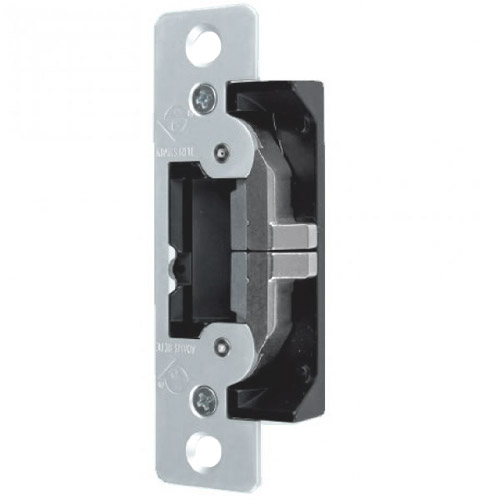
Adams Rite 7400: Electric Strike for a Door Under Preload
Posted by Kent on 15th Aug 2026
Aluminum storefront, reader outside, electric strike in the jamb. At eight in the morning it buzzes and the door swings. At three on a windy Tuesday the reader beeps, the strike buzzes exactly as it always does, and the door does not move. The tenant calls it intermittent and asks what broke. Usually nothing broke. The door is being squeezed against the frame, and a standard strike cannot let go of the latch while that squeeze is on it. The trade word is preload, and it is the number-one reason a buzz-in entry works some hours and not others. The Adams Rite 7400 UltraLine, 628 clear anodized, is the strike we sell to end that call.
What preload actually is
Preload is pressure holding the door against the stop while the strike tries to release. The latch is not resting in the keeper, it is pressed into the face of it. Four things put it there, usually more than one at once.
- Wind. A door on the windward side gets pushed into the frame all afternoon and barely at all in the morning. That is why the failure looks like a schedule.
- The closer. Adjusted heavy on latch speed or backcheck, it keeps pulling after the door is shut and parks the latch under load permanently.
- A warped door or racked frame. Sagging hinges, a bowed stile, a frame that moved when the slab settled.
- Stack pressure. A lobby the HVAC keeps positive leans on that door all day. Tall buildings are worst.
The tell is specific. If the strike buzzes and the door will not open, the panel fired and the strike energized, so the electrical side is fine. Unweight the latch with a small push or pull, then buzz it again. If it opens now, that is preload, not a dead strike. I have watched installers pull a good strike over this, put an identical one back in, and get the same call on the next windy day.
Why a standard electric strike binds under side load
A conventional strike has a keeper, the jaw the latch sits behind, that swings clear when the solenoid releases it. It is built to move with the latch resting in it, not driven sideways into it. Load the door and you add friction between latch face and keeper face, so the solenoid is trying to shift a part that is being clamped. It energizes, buzzes, does nothing, and gets blamed on a bad power supply. Bigger power supply, same failure.
Buying an electric strike for a door under preload
The 7400 is preload capable. Adams Rite built it around the complaint above: it releases even when the door is pushing against the frame. That is why it goes on wind-exposed storefronts and lobby vestibules instead of a cheaper strike I will get called back on. Adams Rite is an ASSA ABLOY brand, and the 7400 is made in the USA and BAA compliant, which matters on federal and school bids.
Two cautions. These are the radius jamb versions, and storefront framing comes both ways, so check the jamb before the truck rolls. And a preload-capable strike is the right part for a door that lives under load, not a license to ignore a cranked-down closer or hinges that are done. Fix those first, then put the 7400 in so the wind does not beat you anyway.
If the door has a panic bar rather than a deadlatch paddle, read our writeup on the Von Duprin 33A exit device for an aluminum storefront door first. The device on the door decides what the strike has to catch.
Fail-safe or fail-secure, and why field-convertible matters
Fail-secure
Fail-secure stays locked on power loss, and it is the default for an exterior storefront entry. A blink in the utility should not unlock your front door to the sidewalk overnight. People still get out from inside through the paddle or the panic bar, so egress does not ride on the strike.
Fail-safe
Fail-safe releases on power loss. You use it where a life-safety or egress requirement says the opening has to free up when power or the fire alarm drops, and you tie it to the alarm.
Do not settle this off a catalog line. Ask the authority having jurisdiction and get the answer on the permit set in writing. Two neighboring fire marshals will rule differently on the same-looking door, and the one who signs your inspection is right. That is where field-convertible earns its keep: you flip the mode on site with the strike already in the jamb. One part number covers both jobs on the truck, and a changed mind at the walkthrough costs a screwdriver instead of a reorder.
When you want the monitored version
Energizing a strike proves you sent voltage. It does not prove the door closed and latched behind whoever walked through. That gap is where after-hours problems live: a mat kicked into the opening, a taped latch, a door that bounced off the stop and never caught. The panel logs a clean grant and the building stands open.
The -M suffix is the monitored version. It signals the strike's actual state back to the panel, so the system alarms on something real instead of an assumption. Spec it on unattended entries, anything armed after hours, anything running door-forced or held-open logic, and anywhere you will be asked to prove a door was secure. We stock the 7400-M in 313 dark bronze. Monitoring runs on its own wiring, so bring the panel model to that conversation too.
Matching the finish on an aluminum storefront
The strike sits in the jamb at eye level. Match the jamb, not the door pull.
- 628 clear anodized aluminum. The default silver storefront frame, and the one that disappears on it.
- 313 dark bronze. Bronze-anodized framing, most of what is out there that is not silver.
- 630 satin stainless. For an opening already trimmed in stainless. It reads heavier than 628 up close, so the two are not interchangeable.
- 606 satin brass. For openings trimmed in brass.
Common questions
Why does my electric strike buzz but the door will not open?
Almost always preload: the door is pressed against the frame and the latch is jammed into the keeper, so the strike cannot swing clear even though it energized. Take the load off the door by hand and buzz it again. If it opens, you need a preload-capable strike like the Adams Rite 7400.
What does preload capable mean on an electric strike?
It means the strike releases while the door is pushing against the frame, not only when the latch is relaxed. That covers wind, a heavy closer, a warped door, and stack pressure in a lobby.
Can the 7400 be switched between fail-safe and fail-secure after it is installed?
Yes. The 7400 is field-convertible, so you change the mode on site without ordering a different part. Confirm it with your AHJ before final inspection, since the rules vary by jurisdiction.
Do I need the monitored version?
Get it whenever you need proof at the panel that the door actually secured, not just that you energized the strike. That is unattended entries, after-hours doors, and anything tied to an alarm.
Lock Depot stocks the 7400 UltraLine for radius jambs in 628, 630, 606, and the monitored -M in 313, all on the shelf. Start at the Adams Rite hub, or call 877-365-5625 with three things: radius jamb or square, what panel and power supply the door is on, and whether the AHJ wants it fail-safe or fail-secure.