
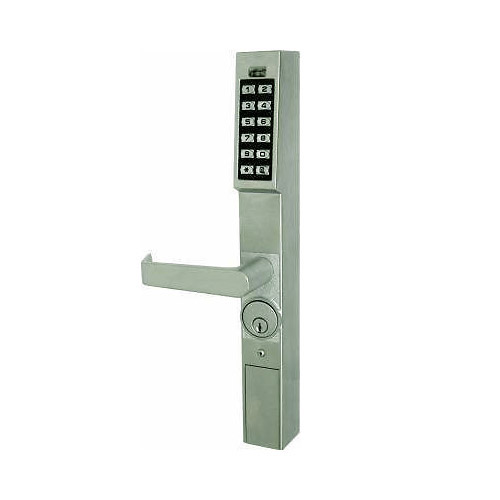
Alarm Lock DL1300 vs PDL1300: PIN Only or Add a Prox Card
Posted by Kent on 18th Sep 2026
A narrow-stile door still needs standalone hardware
We already covered the Alarm Lock DL2700 as the standalone Trilogy answer for a door with no wiring at all. The DL2700 is a cylindrical lock built for a normal-width commercial door. A narrow-stile aluminum storefront door is a different animal: less material in the stile to bore into, and often a different trim profile than a standard corridor door takes. The DL1300 and PDL1300 are the Trilogy narrow-stile answer, and the choice between them comes down to one question: does this door need a card reader, or is a PIN code enough?
DL1300: PIN only, nothing else to manage
The Alarm Lock DL1300 is a Narrow Stile Digital Lock built specifically for cylindrical prep on a narrow aluminum door. Enter a PIN on the keypad and the lock releases: no keys to lose, no cards to issue or deactivate. It supports 100 to 2,000 users, each with an individual PIN, and keeps an internal audit trail of up to 40,000 events so you can pull a record of who came through and when.
It runs on AA batteries, is fully standalone with no wiring, no panel, and no network connection required, and includes a Schlage C keyway cylinder for key override as a backup in case the electronics fail or someone forgets their code. IC (interchangeable core) versions are available in other keyways if your building already standardizes on a different one.
PDL1300: PIN or a prox card, same door, same body
The Alarm Lock PDL1300 is the identical narrow-stile lock body with one feature added: a built-in proximity card and fob reader. A user can enter their PIN on the keypad or present a prox credential, whichever the building issues them. Same 100-2,000 user capacity, same 40,000-event audit trail, same AA battery power, same Schlage C keyway key override as backup, same standalone install with no wiring back to a panel.
This is what Alarm Lock calls dual-credential without a full access control system: you get the convenience of a badge-in door without running wire to a head-end controller or installing a reader, panel, and power supply separately. It costs more than the plain DL1300 for that reader hardware, which is the whole trade-off.
When the PIN-only DL1300 is the wrong call
A shared PIN code has one structural weakness on any door with turnover: once several people know it, it spreads past the people who are supposed to have it, and resetting it means re-issuing the new code to everyone who is still authorized. On a door with individual PIN assignment like the DL1300, that is less of a problem since each user's code is separate. Where prox actually earns its keep is a building that already issues ID badges or fobs for other doors; the PDL1300 lets that same credential open the narrow-stile door too, instead of maintaining a second, separate PIN list nobody remembers to update.
What stays the same either way
Both models are genuinely standalone Trilogy hardware: no wiring, no panel, no network, programmed at the door itself using a programming code rather than software. Both are cylindrical mount, built for the narrow-stile prep specific to aluminum storefront doors, and both include the physical key override so a dead battery or forgotten code does not lock everyone out. If you need a networked version that reports to a central system instead of standalone, Alarm Lock's Networx 6000-series line is the direction to look; call us to confirm narrow-stile compatibility before ordering that line for this application.
A programming note worth planning around
Both locks are programmed at the door with a master programming code, not through software on a computer. Whoever manages the building needs to keep that programming code somewhere more secure than a sticky note on the wall next to the lock, since it is what lets someone add or delete users and change the audit trail settings. Write it down, store it with the building's other master keys and codes, and change it if a manager who knew it leaves. Losing track of the programming code does not lock the door for good, since the mechanical key override still works, but it does mean a service call to reset it before anyone can manage users again.
Which one to order
Order the DL1300 if PIN-only access is enough and you want the lower-cost standalone option. Step up to the PDL1300 if your building already issues prox cards or fobs for other doors and you want this one on the same credential system, or if you specifically want a second, separate access method beyond the shared PIN. See the rest of the Trilogy line on the Alarm Lock hub.
Common questions
Can I upgrade a DL1300 to add a prox reader later?
No. The prox reader is built into the PDL1300's lock body at manufacture, not a field-added module, so adding proximity access later means replacing the lock rather than upgrading it.
Do I need a battery backup or external power for either lock?
No external power is needed. Both run on AA batteries housed in the lock itself, which is what makes them genuinely standalone. Keep spares on hand and expect the batteries to signal low well before they die completely.
What happens if the batteries die with someone stuck outside?
Both models include a mechanical key override with a Schlage C keyway cylinder specifically for this situation, so a dead battery does not mean a locked-out door. Keep the override key accessible to whoever manages the building.
Can the audit trail be pulled remotely, or do I need to be at the door?
These are standalone locks without a network connection, so pulling the audit trail requires connecting at the door with Alarm Lock's data transfer tools. If remote audit trail access matters to you, ask us about the networked Trilogy line instead.
Will either lock fit a door that already has Alarm Lock's older narrow-stile hardware installed?
Likely, since both are built to the same narrow-stile cylindrical prep, but confirm your exact door prep and any trim mismatch before ordering a replacement. Send us the door thickness and existing prep and we will confirm fit.
Narrow-stile prep, keyway options, credential planning: no automated phone trees. Call 877-365-5625.