
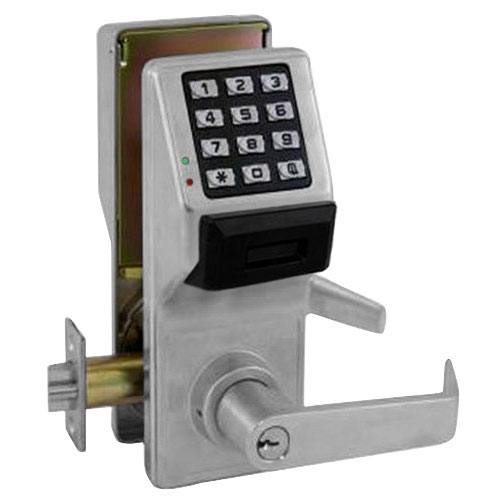
Alarm Lock DL5300 vs PDL5300: Code Required on Both Sides
Posted by Kent on 21st Sep 2026
Alarm Lock DL5300 vs PDL5300: Code Required on Both Sides
Most standalone keypad locks only care about one direction. You badge or punch a code to get in, and the inside lever just opens, because whoever is already inside is assumed to belong there. That assumption falls apart fast in a pharmacy storeroom, a narcotics cage, an evidence room, or any space where the building needs a logged record of who left, not just who entered. That's the specific job the Alarm Lock Trilogy DL5300 and PDL5300 are built for: a keypad on both faces of the door, so entry and exit both require a credential.
Those two part numbers are close enough to type wrong, so start with the part-number breakdown Alarm Lock puts on its own spec sheet. DL means digital lock, PIN only. PDL adds the P, which means proximity card or fob reader alongside the keypad. 5300 is the double-sided cylindrical body common to both. Everything else, the lever style, the satin chrome (US26D) finish, the battery power, is identical between them.
Both units come out of the box ready for a standalone install: no server, no head-end software, no wiring back to a panel. That matters for a pharmacy or a records room retrofit where running conduit to a new door isn't in the budget. The lock does the access-control job by itself, on battery power, and keeps its own audit trail on board rather than depending on a network connection that a storage closet may not even have.
DL5300: PIN only, both sides
The DL5300-US26D is the simpler of the two. Enter a PIN on the outside keypad to get in, enter a PIN on the inside keypad to get out. No cards to issue, no fobs to lose, no reader hardware to wire. It runs on AA batteries, supports 100 to 2,000 users, and logs up to 40,000 events in its built-in audit trail, which is the actual point of a double-sided lock: not just controlling who gets in, but proving who left and when.
PDL5300: PIN or prox, both sides
Step up to the PDL5300-US26D and you get everything the DL5300 does plus a proximity reader on each side. A staff member can badge in with a card or fob, or fall back to the PIN if they left the badge at the desk. Same 100-2,000 user range, same 40,000-event audit trail, same double-sided requirement to leave. The trade is cost: the PDL runs meaningfully more than the DL in the same finish, because you're paying for a reader on both faces of the door instead of one keypad mechanism.
Both units include a Schlage C keyway cylinder for mechanical key override, in case the battery dies or the electronics fault out and someone still needs in. IC (interchangeable core) versions are available if your building runs a different keyway; tell us your core brand before you order so we ship the right cylinder the first time instead of a second shipment two weeks later.
Picking between them
If your staff already carries prox badges for another door in the building, the PDL5300 is the obvious call. Nobody wants to memorize a second credential system for one storage room when they're already tapping a badge at the front door. If this is a standalone room with no existing access system, no badges, no readers anywhere else, the plain PDL keypad hardware is a cost you don't need to carry. Buy the DL5300 and save the difference.
One thing I'd flag before you order either one: a double-sided lock on an egress path can run into fire code trouble. Life safety code generally wants free egress from the inside on an exit route, no credential required to get out in an emergency. That's exactly why these locks exist for storage and inventory-control rooms rather than corridors people are supposed to be able to leave through freely. If there's any question about whether the door you're locking down is on a required means of egress, get your local fire marshal or your life-safety consultant to sign off before you install either unit. That's not a Lock Depot call to make from a product page, and I'd rather tell you to check than have you find out the hard way at an inspection.
Common questions
Do I need the proximity reader, or is PIN enough?
PIN alone is enough for most single-room applications. Add proximity if staff already carry badges elsewhere in the building, or if you want a faster tap-in without typing a code every time someone's hands are full.
What happens if the batteries die?
Both units include a mechanical key override on a Schlage C keyway cylinder, so a physical key still gets you in and out if the electronics fail. Keep a spare set of AA batteries on hand and swap them at the first low-battery warning rather than waiting for a full failure.
Can I put one of these on an exit door people need to leave through freely?
Check with your local fire marshal first. Locking the exit side of a required means of egress behind a credential can violate life safety code. These locks are built for storage and inventory-control rooms, not corridors on an egress path.
How many people can I load onto the system?
Both the DL5300 and PDL5300 support 100 to 2,000 users and store up to 40,000 audit trail events, so you can track exactly who came and went without adding a network connection or a control panel.
What if my building uses a different key system than Schlage C?
Interchangeable core (IC) versions are available for other keyways. Tell us which core brand your building runs before you order so the cylinder matches on the first shipment.
For a lighter-duty single-sided version of the same Trilogy platform, see our write-up on the DL2700, and browse the rest of the lineup on the Alarm Lock hub.