
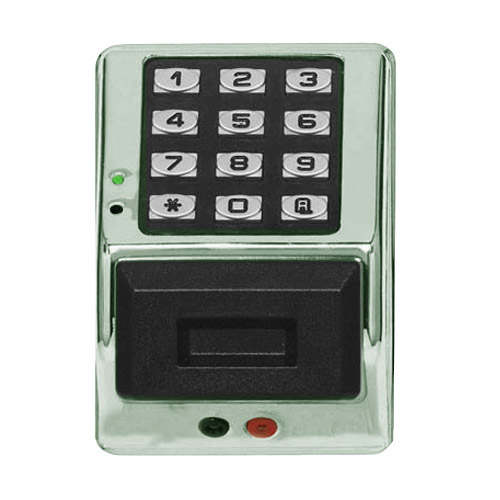
Alarm Lock PDK3000-26D: Keypad Access for a Gate, No Panel
Posted by Kent on 20th Sep 2026
The gate doesn't need a full access system, it needs a lock that thinks for itself
You've got a gate, a gangway door, or a loading-dock man-door that's exposed to weather, and you're done handing out one shared code that every driver, tenant, and half the neighborhood ends up knowing. You also don't want to run low-voltage cable back to a head-end panel in a server room three buildings away just to control one opening. That's the exact spot the Alarm Lock Trilogy PDK3000-26D was built for: a weatherproof keypad and prox reader that sits at the door, controls its own strike or maglock, and doesn't need anything talking to it from across the property.
What the PDK3000-26D actually is
Read the part number and you're reading the spec sheet. On the product page, Alarm Lock breaks it down plainly: P is the proximity card/fob reader, DK is the digital keypad, 3000 is the weatherproof keypad body, and 26D is the satin chrome finish. Put together, that's a weatherproof PIN-and-prox keypad in satin chrome, and that's exactly what ships in the box.
One thing to get straight before you order it: this is a standalone controller, not a lockset. It doesn't have a latch or a bolt built in. It controls a separate electric strike or maglock that you mount on the door itself. If you're picturing something you bolt onto the door and it locks itself, that's a different product. If you're picturing a brain at the door that decides who gets buzzed through and fires a strike or maglock you already have, that's this one.
PIN or prox: dual credential without the overhead
The PDK3000-26D reads two kinds of credentials and either one works: a PIN typed on the keypad, or a prox card or fob held up to the reader. That's real access control without needing a full networked system behind it. You're not stuck choosing between everyone sharing one code and installing a head-end controller with a database to manage.
Why hand out a fob instead of just a code
In practice, most crews run it fob-first. Staff who use the gate daily get a card, it's faster than punching a PIN in the rain, and nobody has to memorize anything. The PIN stays in reserve for the situations a fob doesn't cover well: a lost or forgotten card, a vendor who needs to get in once and shouldn't be issued a credential at all, or a backup path before you've gotten around to programming new fobs. You get the convenience of prox for daily traffic and the flexibility of a PIN for everyone else, on one reader.
12/24V and weatherproof, built to sit outside
This keypad runs on 12/24V, so it matches up with either voltage depending on what the rest of the opening's hardware is wired for, no separate transformer swap needed to make it fit your strike or maglock circuit. And it's rated weatherproof, which is the detail that matters most on this particular product. Alarm Lock's own installation notes for this unit call the weatherproof rating out specifically because it's meant to live on exposed openings: a perimeter gate, an unsheltered dock door, anywhere it's going to take direct weather and still need to read a card in February. A keypad rated for indoor use only doesn't belong on that kind of opening, and this one wasn't built as an indoor unit that happens to tolerate a porch.
The key override matters at 6am
Every electronic lock eventually has a bad day: a dead battery, a board that hangs, a fob nobody thought to reprogram. The PDK3000-26D ships with a Schlage C-keyway cylinder built in for exactly that scenario (IC core versions are available if your site runs a different keyway system). When the electronics quit at the gate before the first truck of the day, whoever's holding the right key gets through with a real mechanical override, not a service call and a crowbar. That's not a nice-to-have on an exterior opening people depend on to get to work. It's the difference between a delayed morning and a locked-out crew standing in a parking lot.
Where this fits next to a full system, or a simpler one
If what you actually need is a whole property on one access database, badge logs pulled from a server, doors that lock down together on a schedule, this keypad isn't that, and it was never meant to be. It's the right call for the one opening, or handful of openings, that doesn't justify that investment: a remote gate, a fenced yard, a detached building where pulling cable back to a head end isn't in the budget or isn't physically practical. Alarm Lock's whole Trilogy lineup is built around that same idea: standalone units that don't need a server to be real access control.
Worth knowing the PDK3000-26D isn't the only shape that idea comes in. If the opening in question is indoor, has its own latch already, and you don't want to deal with a separate strike or maglock at all, the Alarm Lock DL2700 is a standalone keyless lockset that skips wiring entirely. The PDK3000-26D is the one you reach for when the opening is outside, exposed to weather, and needs its own strike or maglock controlled from the door. Match the product to what the door is actually doing before you order either one.
Common questions
Does the PDK3000-26D come with a lock built in?
No. It's a standalone controller that operates a separate electric strike or maglock you mount on the door. Confirm with us before you order if you need help pairing it with the right strike or maglock for your opening.
Can I use a PIN and a prox card on the same unit?
Yes. The PDK3000-26D accepts either credential type, a PIN entered on the keypad or a prox card/fob presented to the reader, so you can issue fobs for daily traffic and keep PIN entry as a backup.
Is this keypad actually rated for outdoor use?
Yes, it's built weatherproof for exterior and exposed mounting, which is why it's the common choice for gates, gangway doors, and loading-dock man-doors instead of an indoor-only keypad.
What happens if the keypad's electronics fail?
You use the mechanical key override. The PDK3000-26D includes a Schlage C-keyway cylinder for exactly that, so a dead board or dead battery doesn't strand everyone on the wrong side of the gate. IC core versions are available for other keyway systems.
Does this need to be wired back to a central access control panel?
No. It's a standalone unit that runs on 12/24V and controls its own opening directly, so you get PIN-or-prox access control without pulling low-voltage cable back to a head-end system.