
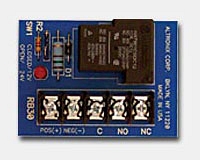
Altronix RB30 vs RB1224: Relay for a No-Contact Panel
Posted by Kent on 23rd Sep 2026
The panel has a low-current output. The maglock needs more than that.
Access control panels and REX inputs often switch a small signal, not enough current to directly drive a maglock, a strike, or an auxiliary device that needs real amperage behind it. An integrator hits this constantly: the panel says "unlock," but its output isn't built to carry the load the door hardware actually draws. A relay module sits in between, using the panel's small signal to switch a separate, properly rated circuit for the lock itself.
Two Altronix relays, two different jobs
Altronix builds two relay modules that come up constantly on this kind of job, and they aren't interchangeable for every application: the RB30 and the RB1224.
RB30: higher current, single pole, double throw
The RB30 runs on 12VDC or 24VDC operation with a 75mA current draw on the coil side, and switches an SPST Form C contact rated for 30 amps at 28VDC, 120VAC, or 277VAC. That's a serious amount of switching capacity for a relay this size, which makes the RB30 the right call when the load on the other side is a maglock, a larger power supply, or anything else pulling meaningful current that a smaller relay isn't rated to carry.
RB1224: lower draw, double pole, snap-track mountable
The RB1224 also runs 12VDC or 24VDC, selectable, but draws less on the coil side at 50mA, and switches DPDT contacts rated 5 amps at 120VAC/28VDC. The DPDT configuration means it can switch two separate circuits off one trigger, which the SPST RB30 can't do. It's also built snap-track mountable, which matters in an enclosure where DIN rail mounting is already the standard and a tech doesn't want to hard-wire a loose relay into a crowded panel.
Picking between them isn't about brand preference
If the job is one high-current load off one trigger, like firing a maglock or a larger power distribution circuit, the RB30's 30-amp SPST contact has the headroom. If the job needs to switch two separate low-current circuits from a single REX or panel output, the RB1224's DPDT contacts do that in one module instead of two, and the snap-track mounting keeps the panel enclosure organized. Neither is a universal answer; match the relay to the amperage and the number of circuits the job actually needs.
Coil draw matters on an already-loaded panel
Both relays run on 12 or 24VDC, but the RB30 draws more on the coil side at 75mA against the RB1224's 50mA. On a panel that's already feeding several accessories off a shared low-voltage supply, that difference adds up. Total the coil draws of everything on the circuit before assuming a power supply sized for the door hardware alone has headroom left for relay coils too.
Reading the spec sheet instead of guessing off the box
Both relays get sold in similar-looking small enclosures, and it's easy to grab whichever one is already in the truck bin without checking the contact configuration printed on the spec sheet. A tech who installs an RB1224 expecting the RB30's 30-amp single-pole capacity is going to find a device that trips or fails to switch the load reliably, because the RB1224 simply wasn't built for that current. Read the amp rating and the pole configuration off the actual spec sheet before wiring either one in, not off memory of which one usually gets used on similar jobs.
Where this actually shows up on a job
A common scenario: an access panel's REX input is rated for a dry-contact signal only, but the customer wants that same signal to also trigger an auxiliary device, like a camera or a door-held-open annunciator, at the same time the door unlocks. One relay, triggered off the panel's REX output, can switch both the lock circuit and the auxiliary device if it's a DPDT unit like the RB1224. Trying to do that off a single-pole relay means adding a second relay to cover the second circuit, when one DPDT module would have handled it.
Pro tip from the counter: label the relay's rated voltage and amperage right on the enclosure when you install it. On a service call years later, a tech who can read the rating off the part without pulling a spec sheet saves real time diagnosing whether the relay itself, or the load on the other side of it, is the actual failure.
Common questions
Can I use the RB30 to switch two separate circuits?
No. The RB30 is SPST, a single-pole single-throw contact, so it switches one circuit per trigger. For two circuits off one trigger, use the DPDT RB1224.
Which relay handles a maglock's full current draw?
The RB30's 30-amp SPST Form C contact has more headroom for a higher-draw load like a maglock than the RB1224's 5-amp DPDT contacts. Match the relay's amp rating to the load, not just the voltage.
Do both relays run on the same voltage?
Yes, both are 12VDC or 24VDC selectable on the coil side. The difference that matters is coil draw (75mA on the RB30 versus 50mA on the RB1224) and contact rating.
Why would I choose the RB1224 over the higher-rated RB30?
When the job needs to switch two separate low-current circuits from one trigger, or needs snap-track mounting in an enclosure already set up for it, the RB1224's DPDT contacts and lower coil draw are the better fit even though its amp rating is lower.
Does a relay module replace a power supply?
No. A relay switches a circuit on and off in response to a trigger signal; it doesn't generate power. The locking hardware still needs its own properly sized power supply, like our Altronix AL600ULACM or LPS3C24X, feeding the load the relay switches.