
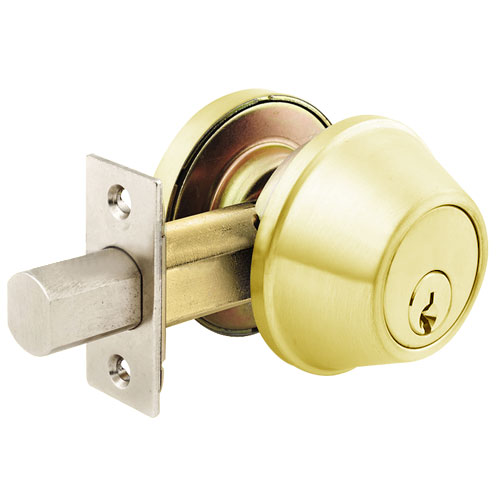
Arrow Lock D61 vs E61: Grade 1 or Grade 2 Deadbolt for a Rental Door
Posted by Kent on 15th Sep 2026
The two decks that look identical on the shelf
Set an Arrow D61 and an Arrow E61 side by side and you won't find much to tell them apart. Same size case, same thumbturn on the inside, same wrench-proof collar around the cylinder, same finish options. A GC comparing line items on two quotes sees "single cylinder deadbolt" twice and picks whichever number is smaller. The difference that actually matters is stamped on the bolt where nobody looks: one is rated Grade 2, the other is Grade 1.
I did a mortise lockset piece a while back on Arrow's BM Series for an institutional door. This is the companion decision for the auxiliary deadbolt that often sits above it, or stands alone on a lighter-duty door.
What Grade 2 buys you: the E61
The Arrow E61 is Arrow's value-grade single cylinder deadbolt, tested and listed to BHMA A156.5 Grade 2. Grade 2 isn't a discount grade in the sense of being flimsy, it's the mid-tier ANSI rating built for standard commercial and heavy residential use: a tenant entry door, an interior office door that still needs to lock, a storage room door that doesn't take daily abuse. It carries the same tamper-resistant wrench-proof collar and steel deadbolt with a hardened pin insert as the rest of the line, so it isn't an easy pry or an easy drill-out. It just isn't rated to survive the cycle count and forced-entry testing that Grade 1 has to pass.
What Grade 1 buys you: the D61
The Arrow D61 is the same deadbolt built to the top ANSI tier, BHMA A156.5 Grade 1. Same collar, same hardened steel bolt, same non-handed installation, same 2-3/8" backset. What changes is what it has to survive to earn the rating: more forced-entry cycles, more strength testing on the bolt and strike. That's the deadbolt I spec for a rental unit's main entry door, a strip-mall storefront's back door, or anywhere a landlord is going to get a call about a kicked-in door and doesn't want the hardware to be the reason it gave way.
Grade 1 and Grade 2 in the Arrow line share a footprint on purpose. Both fit a 1-3/8" to 1-3/4" door thickness and both use a standard 2-3/8" backset, so stepping up from an E61 to a D61 on a re-key or an upgrade job doesn't mean re-boring anything. If a property manager wants to upgrade a whole building's deadbolts one door at a time as units turn over, the hole pattern doesn't change under them.
Picking between them without overspending
My rule: match the grade to who's going to test the door. A Grade 2 E61 is the right call on an interior door, a low-traffic office, or anywhere the deadbolt is backing up a primary lockset that's already doing the security work. Spend the extra for a Grade 1 D61 on any exterior entry that's the only thing standing between the street and the unit: apartment entry doors, retail back doors, anywhere a landlord's insurance carrier or a property's liability exposure actually turns on that door holding.
Both are UL listed and both are non-handed, so finish is the other variable worth checking before you order. Both are stocked in bright brass, and the D61 also ships in satin chrome (626) for a job that needs to match brushed hardware instead of polished. Neither series comes keyed alike out of the box, so if the building runs a master key system, key the cylinders to match before they go on the door, not after.
Installing either one without a callback
The grade of the deadbolt doesn't matter much if the strike side gives way before the bolt does. I've pulled plenty of Grade 1 deadbolts out of doors where the strike plate was still held on with the two half-inch screws that came in the box, sunk into nothing but door jamb trim. On any rental turnover or new install, swap those for 3-inch screws that reach the framing behind the jamb. That single change stops more kick-in break-ins than the jump from Grade 2 to Grade 1 ever will on its own; the grade and the screws are doing two different jobs, and skipping either one leaves the other doing all the work.
Check the bore alignment before you walk away, too. Both the D61 and E61 are non-handed, so there's no wrong-handing to worry about, but a deadbolt that's the least bit misaligned to its strike will bind, and a tenant who has to muscle a key to lock up at night calls that in as a broken lock even when the cylinder is fine. A few minutes with a screwdriver adjusting the strike location fixes it once instead of fielding the complaint every winter when the door swells.
Common questions
Can I mix a Grade 1 deadbolt with a Grade 2 lockset on the same door?
Yes. The deadbolt and the lockset are graded and rated independently, and pairing a D61 with any Arrow BM, BMX, MK, or RL series lockset is a standard combination. Grading them differently doesn't create a compliance problem, it just means the deadbolt is rated to whatever level you chose for it.
Does upgrading from an E61 to a D61 require a new bore?
No. Both use the same 2-3/8" backset and fit the same 1-3/8" to 1-3/4" door thickness range, so a D61 drops into an existing E61 prep without any new drilling.
Is the E61 too light-duty for an exterior door?
It depends on what's exposed to the street. Grade 2 is a legitimate commercial rating, not a residential downgrade, but if that door is the only lock standing between the outside and a unit with no other security layer, spend the difference and put the D61 there instead.
Where can I see the rest of the Arrow lineup?
The Arrow Lock hub carries both deadbolt series along with the BM mortise line and Arrow's cylindrical locksets, if you're speccing the whole door at once.