
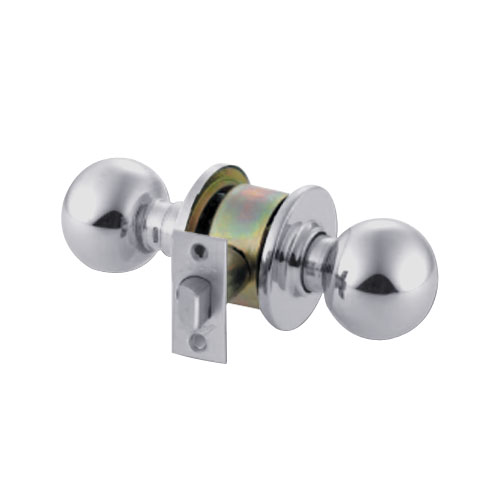
Arrow MK05, MK08, MK11, MK12 and MK31 Knob Functions
Posted by Kent on 28th Nov 2026
Same lock body, five jobs
The Arrow MK is a Grade 2 cylindrical knob lock, BHMA A156.2 Series 4000, UL listed, with a 2-1/8 inch bore and a 2-3/4 inch backset. It fits doors 1-3/8 to 1-3/4 inches thick and it is non-handed, so one box works on a left or right door. Arrow's listings position it for apartment buildings and light commercial projects where Grade 1 is overkill.
We already sorted out the privacy and patio numbers in our Arrow MK02 vs MK04 guide. This one covers the rest of the functions we stock: MK05, MK08, MK11, MK12 and MK31.
Read the part number
Take MK12-BD-26D. MK is the series, 12 is the function, BD is the knob design and 26D is the finish. The knob design comes in three codes on these listings: TA, BD and DD. The finish codes run 03 bright brass, 04 satin brass, 05A antique brass, 10 satin bronze, 10B oil rubbed bronze, 26 bright chromium and 26D satin chromium. The listings do not describe what each knob design looks like beyond its letters, so look at the product image before you pick one for a job with a spec.
The five functions
MK05 Communicating. Both knobs can be locked independently. It goes between rooms that sometimes need optional separation. The TA listing calls it a non-keyed set, so you operate it from the knob and not with a key.
MK08 Single Dummy. A decorative knob that does not operate. No latch, no mechanism, just the trim on the door face. Use it as a pull. If someone orders it thinking it is a passage set, the knob will not open the door.
MK11 Entrance/Office. The outside knob is locked and unlocked by key. The inside knob is always free. Standard office entry.
MK12 Storeroom. The outside knob is always rigid and the key retracts the latchbolt. The inside knob is always free. Supply rooms and storage. This is the one that never gets left unlocked by accident, which is why I like it for utility doors.
MK31 Communicating, double cylinder. The listing title says double cylinder, and the description says both knobs can be locked independently, the same words as MK05. I read that as the keyed version of the MK05. The listing text does not spell that out, so if the difference matters to your job, ask us before you order.
The keyway question on MK12
The MK12 listing is the only one in this group that talks about keying. It ships with the standard Arrow keyway, AR1, which is not a Schlage keyway. The listing says that if you need Schlage C, keyway SC1, to match an existing Schlage system, you contact us before ordering and we will quote the Schlage C variant. Take that seriously. A box of storeroom locks that will not take your existing keys is a return you do not want. For the keying picture on Arrow cores, see our Arrow 6-pin vs 7-pin SFIC core guide.
Knob, not lever
Every MK listing carries the same note: knob hardware does not meet ADA, and for accessibility compliance you use the RL lever series instead. If your door is on an accessible route, such as a public restroom corridor or a workplace that has to comply, that note decides the question for you. Go to the lever line. For a back-of-house closet or a private office that is not on an accessible route, a knob is a reasonable choice.
Check the door before you order
The MK is made for the standard commercial prep, so before you buy a box, check four things on the door:
- Bore. A 2-1/8 inch hole through the door face. Measure it with a tape across the hole, not by eye.
- Backset. 2-3/4 inches from the door edge to the center of that hole. Some older doors are 2-3/8. A 2-3/8 door will not take this lock without a change.
- Thickness. The listings say 1-3/8 to 1-3/4 inches. Hollow metal doors and wood doors both fall in that range.
- Edge prep. A latch hole bored into the edge, in line with the main bore.
On a replacement job, all four are already there and you are mostly checking the backset. On a new door, the shop or the installer cuts them.
Dummy and communicating: the two that get ordered wrong
The MK08 and MK05 sound like they could swap, and they do not. A dummy has no mechanism and does not move a latch. A communicating lock is a working lock that locks from each side on its own. If the door has to open when somebody turns the knob, you want a lock and not a dummy. If you order a dummy and ask the installer to make it work, you will be back on site with a different part. Ask the question on the way in: does this door need to latch?
Quick match by room
- Between two rooms, lock from either side: MK05, or MK31 if you want the keyed version.
- Pull on a fixed or latched door: MK08.
- Office entry: MK11.
- Supply or mechanical room: MK12.
What the listings do not say
The listings give no fire rating. The MK05 and MK31 descriptions are the same, so the keying difference is inferred from the title. The three knob designs are named by letters only. If you want a finish or knob design that is not on the page, tell us and we will check it. For a deadbolt to pair with a knob set, see our Arrow D61 and E61 deadbolt guide. The rest of the line is on the Arrow Lock hardware page.