
ASP Explosion-Proof REX: Momentary or Latching Station
Posted by Kent on 30th Sep 2026
A standard exit button doesn't belong in a classified space
A paint booth, a chemical storage room, a grain elevator, anywhere flammable vapor or dust can build up in the air counts as a classified hazardous location under NFPA 70, and a standard illuminated push-to-exit button is an ignition source waiting to happen the moment its contacts arc. ASP's alarm control line builds a request-to-exit station specifically rated for that environment, and there are two versions that answer two different questions about how the door releases.
ASP-EXP-1: momentary, for a door that should only unlock while pressed
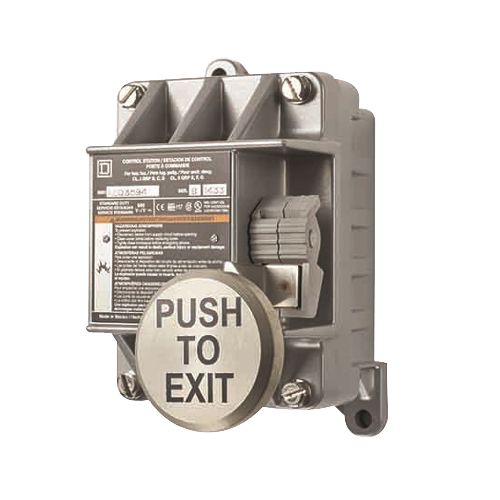
The ASP-EXP-1 is a momentary "push to exit" switch: the door releases while the button is held and the circuit resets the instant it's let go. It ships in a heavy cast NEMA Type 7 enclosure rated for hazardous locations, with a 2-inch push button silkscreened in black epoxy ink and one normally-open plus one normally-closed contact, rated 5A at 35VDC or 120VAC. It mounts on a 1/2-14 NPT pipe thread, the standard conduit fitting for explosion-proof runs, so it ties straight into existing hazardous-area conduit without an adapter. A momentary switch is the right call where the door should only stay unlocked for as long as someone's actively exiting, not linger open after they've walked through.
ASP-EXP-2: latching, for a door that needs to stay released
The ASP-EXP-2 shares the same NEMA 7 enclosure, the same 2-inch silkscreened button, the same 1/2-14 NPT thread, and the same contact rating as the EXP-1, but the switch action is latching instead of momentary. Press it and the circuit stays in that state until it's pressed again, which fits an application where the door needs to stay released for an extended period, an evacuation drill, a maintenance window, or a process that requires the exit to stay clear rather than re-lock behind the first person through.
What "explosion-proof" actually means on the spec sheet
Both EXP models use a NEMA Type 7 enclosure, which is rated to contain an internal arc or spark so it can't ignite the surrounding atmosphere, not to keep the atmosphere out entirely. That's the distinction that matters when specifying for a classified area: a NEMA 4 or 4X enclosure keeps out water and dust, but only a Type 7 (or higher) rating is built to contain ignition inside the housing itself. If the door in question is in Class I, Division 1 or 2 territory, the EXP series is the one to spec; if it's just a wet or dusty non-classified area, the standard ASP-TS-30 illuminated button, UL 294 listed with an SPDT momentary switch, is the lower-cost fit and doesn't need the explosion-proof housing at all.
Wiring and mounting notes before the job goes out
Both EXP models carry one normally-open and one normally-closed contact, so they wire into either a fail-safe or fail-secure locking circuit without needing a relay to invert the logic. The 1/2-14 NPT thread expects rigid conduit; confirm the mounting location has that conduit run already in place or budgeted, since retrofitting explosion-proof conduit into a classified space after the fact is a bigger job than swapping the switch. The push button face can be custom silkscreened, worth flagging to the customer if the facility standardizes on specific wording or icons across its hazardous-area hardware.
Classification of the space itself isn't something a locksmith or integrator should be guessing at on site. A facility with hazardous-location zones has that classification documented, usually by the fire marshal, an industrial hygienist, or the original design engineer, spelling out which class, division, and group apply to each room or zone. Pulling that documentation before quoting the job, rather than eyeballing a paint booth and assuming EXP-rated hardware is needed everywhere nearby, keeps the quote accurate and keeps a facility from paying explosion-proof pricing on a door that's actually outside the classified boundary.
Both EXP models pair naturally with the rest of a hazardous-area access control setup: an explosion-proof strike or maglock rated for the same classification, run through conduit that's already sealed and fitted for the space. Mixing an EXP-rated request-to-exit station with standard, non-rated locking hardware on the same door defeats the purpose of specifying the rated station in the first place. If the door's classified enough to need the EXP-1 or EXP-2, everything else on that door and its wiring path should carry a matching rating. For the access-control side of a job like this, from keyswitches to wiring, the ASP keyswitch station guide covers the same manufacturer's standard-location hardware for comparison.
Ordering the wrong contact configuration is the other mistake worth guarding against on a hazardous-location job, mostly because a return trip into a classified space isn't a quick fix. Confirm with the access control panel or the electrical contractor whether the circuit needs the normally-open contact, the normally-closed contact, or both before the station gets mounted and sealed into its conduit run. Once the fitting is torqued down and sealed per the classified-space requirements, reopening it to rewire a contact is more work than it would have been to double-check the wiring diagram up front.
Documentation matters as much as the hardware on a job like this. Keep the cut sheet and the UL or CSA listing paperwork for whichever EXP model goes in, since a facility operating in a classified area typically has to produce that documentation during an insurance audit or an AHJ inspection. A request-to-exit station with no traceable listing paperwork, even if it's physically the right part, can become a finding on an inspection report that costs more time to resolve than it would have taken to file the paperwork when the part first went in.
Common questions
What's the difference between the ASP-EXP-1 and ASP-EXP-2?
The switch action. The EXP-1 is momentary and releases the door only while pressed; the EXP-2 is latching and holds its state until pressed again. Everything else, the enclosure, contact rating, and mounting thread, is identical.
Do I need an explosion-proof request-to-exit station for every gate or door?
No. Only for doors in a classified hazardous location under NFPA 70, where flammable vapor, gas, or combustible dust can be present. For a non-classified area, the standard ASP-TS-30 covers a request-to-exit function at a lower cost.
What does the NEMA 7 rating actually protect against?
It's built to contain an internal spark or arc so it can't ignite the surrounding atmosphere. It's not primarily a water or dust seal rating; that's what NEMA 4 and 4X cover.
What contact configuration do these use?
Both the EXP-1 and EXP-2 carry one normally-open and one normally-closed contact rated 5A at 35VDC or 120VAC, which wires into either a fail-safe or fail-secure locking circuit.
What thread size do these mount with?
1/2-14 NPT, the standard pipe thread for explosion-proof conduit fittings in a classified installation.