
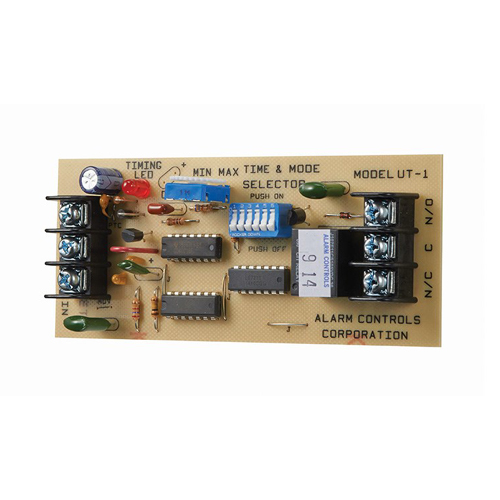
ASP UT-1 vs MT-1: Programmable Timer for a Maglock Door
Posted by Kent on 4th Oct 2026
The Little Box That Fixes "The Door Locks Before I'm Through"
A receptionist buzzes a delivery driver in. The driver has a hand truck, and the maglock drops the second the release pulse ends. The driver is in the doorway with the door half open and the edge catching his elbow. Nothing is broken. The release is just too short for the way people actually use that door.
The fix is a timer in the release circuit, and ASP Alarm Control sells two. The ASP-UT-1 is the flexible one. The ASP-MT-1 is the small, sealed, do-one-thing one. They sit close in price, so the choice comes down to what the circuit needs and what voltage you have.
ASP-UT-1: Four Timing Modes, Sixteen Ranges
The UT-1 is a universal timer with four functions: delay on operate, delay on release, one shot and pulsing. In plain terms:
- Delay on operate: waits, then acts. Useful when something has to happen a few seconds after a trigger.
- Delay on release: keeps the output on after the trigger ends. This is the mode that holds a door unlocked after the button is let go.
- One shot: one fixed pulse per trigger.
- Pulsing: repeats on and off, which is what you want for a strobe or a sounder.
The time range runs from 1 second to 1 hour, split across sixteen ranges, and the listing claims extreme accuracy. The contacts are SPDT, rated 10 amps at 35 volts DC. It draws 37 mA maximum and mounts with adhesive foam tape. Size is 2-1/8 inches by 5-1/4 inches. One limit that matters: the UT-1 is listed at 12 volts DC. There is a 24-volt version, the UT-1-24V, for a system on a 24-volt supply.
ASP-MT-1: One Job, Sealed Against Moisture
The MT-1 does one thing. Its relay mode is one shot, and the time is adjustable from 2 to 45 seconds. That covers a door release, a chime or a short alarm delay. The module is encapsulated for moisture protection, runs on 12 to 24 volts AC or DC, and is rated minus 25 to plus 70 Celsius. Contacts are SPDT, 2 amps at 35 volts DC or 125 volts AC. It is small, 1-3/4 inches square, and also mounts with foam tape.
So the MT-1 works on either voltage, is the one listed as moisture-protected, and fits in a smaller pocket. It gives up three timing modes and a bigger contact rating to get there.
The Contact Rating Is the Part to Check
The gap between 10 amps and 2 amps is the practical difference. Take a 600-pound single-door maglock such as the ASP 600SDURO. Its listing says it pulls 400 mA at 12 volts and 200 mA at 24. Either timer's contacts are well above that, so either can sit in that circuit. Add a second maglock on the same relay, or a strike and a maglock together, and add up the current before you trust the small contact. A coil kicks back when it switches off, and that is harder on relay contacts than a resistive load, so a bigger rating buys margin.
Which Timer for Which Job
- Hold a door open longer after a request-to-exit, 12 volts: UT-1, delay on release.
- Same job on a 24-volt supply: MT-1, or the UT-1-24V.
- A short, fixed release in a damp location: MT-1.
- Something has to pulse or delay before acting: UT-1.
- Time longer than 45 seconds: UT-1. The MT-1 stops at 45.
One caution from the field. A timer sits in the release circuit, so whatever the door is doing must still pass the code for that opening. A timer that keeps a fire exit locked, or delays egress on a door that is not approved for it, is not a timer problem, it is a code problem. Check with the local authority before you stretch any egress delay on a life-safety door.
Three Ways These Go Wrong on the Bench
First, voltage. A UT-1 on a 24-volt supply is a dead timer at best. Read the label on the supply before you open the box. Second, load. Add the current of everything the relay switches, not just the lock. Third, placement. Both timers stick on with foam tape, which is fine inside a clean enclosure and a poor choice on a dusty, vibrating surface. Wipe the spot, press the timer down, and leave slack in the wires so nothing pulls on the tape. Set the time on the bench, not on a ladder, and write the setting on the inside of the enclosure so the next tech does not have to guess.
Common questions
What is the difference between delay on operate and delay on release?
Delay on operate waits after the trigger before switching on. Delay on release keeps the output on after the trigger ends. To hold a door unlocked longer after a button press, you want delay on release.
Does the MT-1 work on 24 volts?
Yes. It is listed for 12 to 24 volts AC or DC. The UT-1 is listed at 12 volts DC, and a separate UT-1-24V exists for 24-volt systems.
How long can each timer run?
The UT-1 spans 1 second to 1 hour. The MT-1 is adjustable from 2 to 45 seconds.
How do the timers mount?
Both mount with adhesive foam tape. The UT-1 is 2-1/8 by 5-1/4 inches and the MT-1 is 1-3/4 inches square, so check the space before choosing.
Is the UT-1 or MT-1 rated for moisture?
The MT-1 listing says it is encapsulated for moisture protection. The UT-1 listing makes no such claim, so keep it inside a dry enclosure.
See the full ASP Alarm Control line for timers, keyswitches and maglocks. For the other half of a release circuit, read how to wire an ASP keyswitch station, and how to size a power supply for a maglock door before you add a timer to it.