
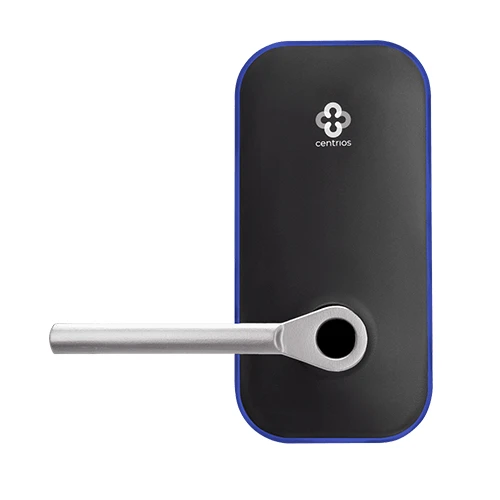
Centrios CEB100: Smart Lock for a Door With No Network
Posted by Kent on 10th Sep 2026
A contractor's door, not a data closet
Say you run a small retail space or manage a handful of rental units. You want to know who came in and when. You want to hand a cleaning crew temporary access without cutting a key and hoping you get it back. And you do not want to call an integrator, run cable to a head-end, or explain PoE switches to your accountant. That's the gap the Centrios CEB100 is built for, a Bluetooth lock that bolts into a standard commercial door prepped for a cylindrical lock, no wiring closet required.
What the CEB100 actually does
This is a Grade 1 lock under ANSI/BHMA A156.2, the commercial durability rating, not a residential lock with a phone app bolted on. It also carries a UL10C three-hour fire rating, so it's fair game for a rated door, not only an interior office. Under the hood it still works like a lock. There's a mechanical key override, so a dead phone or a dead battery doesn't strand you outside your own building. The Bluetooth side lets you open the app, set who gets in and when, hand out one-time or scheduled access to a vendor, and check after the fact who locked up. The app is described as simple to navigate with no training needed, and from what I can tell that's the actual pitch here: an owner who's never touched access control software should be able to run it without a manual.
Bluetooth, not Wi-Fi, and know the tradeoff
Because it runs on Bluetooth instead of hardwired networking, there's no conduit, no data drop, no IT ticket. That's the whole appeal for a single door or a small handful of doors. The tradeoff is the one every locksmith will bring up before you buy: Bluetooth means you need to be in range with the app open to unlock or manage the lock in real time, and the catalog doesn't publish a range figure, so don't take a salesman's word for how far remote really reaches on your building's walls. Ask before you commit if you're planning to manage doors from another floor.
Less Cylinder or Conventional Cylinder, pick one
Both versions are the same lock, same Grade 1 body, same app, same everything. The only difference is the cylinder, and that decision matters more than the finish color.
Less Cylinder: match what's already in the building
If the building already runs an interchangeable-core key system, get the Less Cylinder version, SKU CEB100-TB-626-LC, Satin Chrome. It ships without its own cylinder so your locksmith drops in the same core that's already in every other door in the building. One key still opens everything, the smart lock just happens to be one of the doors on that key system. That's the version I'd point most property managers toward, because it keeps the master key system intact instead of adding a one-off keyway the maintenance guy has to track separately.
Conventional Cylinder: a standalone lock with its own key
If this is the only smart lock going in, and there's no core system to tie into, get the Conventional Cylinder version instead, SKU CEB100-TB-BSP-1803-54L, Black Suede Powder Coat. It comes with its own E1R/Para keyway built in, so it's ready to key on its own the day it's installed. That's the right call for a single storefront door or a standalone office suite that isn't part of a bigger master key plan.
All five finishes, both cylinder options
The CEB100 comes in five finishes, and every finish ships in both cylinder options above. Ten SKUs, one lock:
| Finish | Less Cylinder | Conventional Cylinder |
|---|---|---|
| Black Suede Powder Coat | CEB100-TB-BSP-LC | CEB100-TB-BSP-1803-54L |
| Bright Brass | CEB100-TB-605-LC | CEB100-TB-605-1803-54L |
| Bronze | CEB100-TB-613-LC | CEB100-TB-613-1803-54L |
| Satin Nickel | CEB100-TB-619-LC | CEB100-TB-619-1803-54L |
| Satin Chrome | CEB100-TB-626-LC | CEB100-TB-626-1803-54L |
Fit, weather, and power, the install-day details
Both versions fit doors from 1-3/8 to 2-1/4 inches thick, and the lock adjusts across that whole range tool-free. You're not ordering a spacer kit or measuring twice before it ships. It's non-handed too, so the same lock works on a left or right swing without a special order. It's rated IP57 for weather exposure on both sides of the door, which matters if this is going on an exterior entry that catches rain or snow rather than a dry interior corridor door. Power comes from four AA batteries, rated for about a year of use, and there's a 9-volt emergency power port on the exterior side for when the batteries die before you notice. Press a 9V battery to the contacts and you're back in without pulling the whole lock apart. Worth setting a calendar reminder for battery swaps regardless. A dead lock on a door nobody expects to be locked out of is a bad Monday.
The app and the monthly fee, say it plainly
The features that separate this from a plain mechanical lock, remote access logs, scheduled entry, revoking a key from your phone instead of rekeying a cylinder, run through one flat monthly fee that covers the plan's features, devices, and users. The catalog doesn't list a dollar figure for that fee, and neither will I guess one here. Call Lock Depot for current details before you spec a multi-door job around it, since that recurring monthly commitment is a real ongoing obligation on top of the lock itself, and it belongs in the conversation before you order.
Where this sits against other electronic options
If you're comparing electronic access for a small office rather than a single storefront door, it's worth reading how a keyed lever stacks up against networked options in our piece on Yale NexTouch vs. a keyed lever for a small office. And if the door in question needs to lock down hard in an emergency rather than just log entries, our rundown on the Schlage LE Series wireless mortise for lockdown covers a different job entirely, that's a mortise lock built around lockdown, not everyday Bluetooth convenience. The CEB100 lives in its own lane: cylindrical prep, no wiring, phone-based control. For the full lineup it belongs to, the Centrios line page has the rest of the system.
Common questions
Do I need network wiring or an integrator to install the CEB100?
No. It runs on Bluetooth and standard batteries, and it installs into a door already prepped for a cylindrical lock, the same prep as a standard mechanical lever. No data drop, no head-end panel, no integrator visit required for a single door or a small handful of them.
What's the real difference between Less Cylinder and Conventional Cylinder?
Less Cylinder ships without its own core so a locksmith drops in the building's existing interchangeable core, keeping the smart lock on the same key as everything else. Conventional Cylinder comes with its own keyway built in and stands alone, which is the right pick if there's no core system in the building to match.
What happens when the batteries die?
You're not locked out. The lock still has a mechanical key override, and there's a 9-volt emergency power port on the exterior side to jump-start it if the batteries drain unexpectedly. Four AA batteries run roughly a year under normal use.
How much does the monthly fee cost?
The manufacturer's listing doesn't publish a dollar amount, it's described only as one flat monthly fee covering the plan's features, devices, and users. Call Lock Depot for current details before you plan a job around it.