
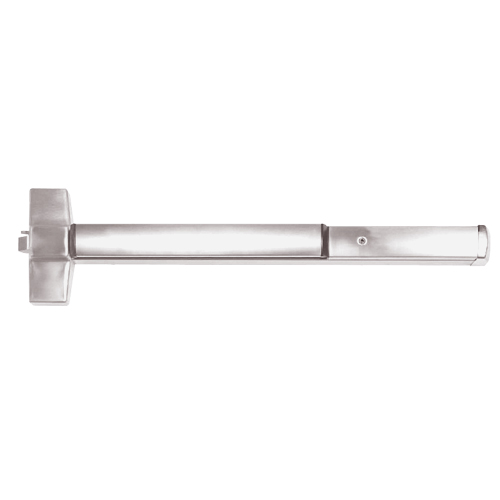
Corbin Russwin ED5200 vs ED5400: Rim or Vertical Rod
Posted by Kent on 16th Sep 2026
The question isn't which device is better, it's which frame you have
A GC calls asking for "a Corbin exit device" and stops there, like the brand settles it. It doesn't. Corbin Russwin builds the ED5200 and the ED5400 off the same touchpad and chassis, and the split between them comes down to one thing: does the top of your frame have room for a strike, or does the door need to throw its own bolts into the head and the floor. Get that wrong and the device you ordered doesn't fit the prep that's already cut.
ED5200: the rim device, no rod, no floor cut
The Corbin Russwin ED5200 is a rim exit device. It mounts to the face of the door and strikes a matching rim strike bolted to the frame head, the way most single doors are already prepped. Push the bar, the latch clears the strike, the door swings. No rod channels to mortise into the door, no floor socket to core out of a slab that might have radiant heat or conduit under it. That's the whole appeal of a rim device: it goes on a door that's already drilled for one, in an afternoon, and it comes back off just as clean if the opening ever changes hands.
It's non-fire-rated, so it belongs on a standard interior or exterior single door where code doesn't require a labeled opening: a break room, a mechanical yard gate, a retail stockroom door. Push the bar, the door opens, free egress every time, no key needed from the inside. That's the code requirement a rim device satisfies as well as any other exit device style, and it does it with the least hardware in the door.
ED5400: the vertical rod device, when the frame can't take a strike
The Corbin Russwin ED5400 is a surface vertical rod exit device. Instead of striking a plate on the frame head, it throws rods up into the header and down into a floor strike, running the rods on the surface of the door rather than mortised inside it. You spec an SVR device for the doors where a rim strike genuinely won't work: a pair of doors with no fixed mullion between them, a frame with a transom or glazing that eats the space a rim strike needs, or a leaf that has to stay flush because a mullion isn't in the budget or the opening.
Same push bar, same non-fire-rated code-compliant free egress on the way out. The difference is entirely in how the door locks to the frame, not in how a person leaves through it. That distinction is the one to get straight before you order, because swapping a rim device for an SVR device later means re-prepping the door and possibly the floor, not just changing the part number.
Single door or a pair, that's the real fork
Here's the shortcut that actually holds up on the job: a single door against a solid frame head almost always wants the ED5200. A pair of doors with no mullion, where each leaf has to lock independently top and bottom, wants the ED5400 on at least the inactive leaf, and often on both if the opening doesn't get a mullion at all. If your frame already has a rim strike cut and you're doing a like-for-like swap, don't second-guess it into an SVR job. Match what the frame is already prepped for unless there's a specific reason (glazing, a missing mullion, a code change) forcing the switch.
Both series ship in Satin Stainless (630), along with Bright Brass, Satin Brass, Satin Bronze, Oil-Rubbed Bronze, Bright Nickel, Satin Nickel, Bright Chrome, and Bright Stainless, so matching an existing set of trim on the same opening isn't a finish-availability problem on either series.
What we stock
We carry both the ED5200 rim exit device and the ED5400 vertical rod exit device across the full finish run, plus the ED5200 in Bright Brass for the jobs matching older brass trim. Both belong on the Corbin Russwin hub alongside the rest of the line, including the CL3300 cylindrical locks we've written up separately for campus doors that see the same kind of daily abuse. If you're weighing a rim device against a vertical rod setup on a Von Duprin opening instead, we've got a companion piece on the 9927 surface vertical rod for a pair of doors that walks the same decision from the other brand.
Measure the frame before you call. A photo of the head condition and whether there's a mullion settles which series you need faster than describing it over the phone, and it keeps you from getting a device back that doesn't match the prep already in the opening.
Common questions
Can I put an ED5400 on a single door instead of the ED5200?
Mechanically, yes, but there's no reason to. The ED5400's rods and floor strike exist to solve a mullion-less pair or a frame that can't take a rim strike. On a single door with a normal head, the ED5200 does the same job with less hardware to maintain and no floor strike to keep clear of debris.
Are the ED5200 and ED5400 fire rated?
No. Both series listed here are the non-fire-rated versions, built for standard openings where code doesn't call for a labeled fire door assembly. If the opening is fire-rated, that's a different device family and a different conversation before you order anything.
Do I need a mullion with the ED5400 on a pair of doors?
Not necessarily; that's the point of the series. A removable or fixed mullion gives each leaf something to strike into and is often the simpler install, but the ED5400's vertical rods let a pair operate without one when the opening can't take a mullion at all.
What's the bolt throw on the vertical rods?
We don't have that dimension confirmed for this specific series, so we won't guess at it here. Send us the opening's height and frame condition and we'll confirm the exact rod length and throw before you order.
Can I get the ED5200 and ED5400 in matching finishes for a mixed opening?
Yes. Both series run the same finish set, from Satin Stainless to Oil-Rubbed Bronze, so a job with a single ED5200 door next to a paired ED5400 opening can match trim across the whole hallway.