
Detex EAX-500 vs EAX-300: An Alarm for a Door That Keeps Getting Propped
Posted by Kent on 1st Oct 2026
Detex EAX-500 vs EAX-300: An Alarm for a Door That Keeps Getting Propped
Somebody wedges the back door open to load in cases of product, takes a smoke break, or just leaves it cracked because the AC feels good in August. An hour later it's still open, unlocked, unwatched. That's not a wiring problem or an access-control problem. It's a door with no alarm on it, and the fix is cheap.
Detex makes two families of standalone exit alarm for exactly this: the EAX-500 and the EAX-300. Both are battery powered, both mount without an electrician, and both are UL Listed and meet NFPA 101 Life Safety Code. The overlap ends there. Pick wrong and you'll either overpay for durability nobody needed, or underbuy on a door that gets kicked around daily.
EAX-300: header mount, lightweight, and cheap to deploy at scale
The EAX-300 is built from high-impact ABS plastic and mounts on the door header, above the frame rather than on it. It runs a 100dB alarm off a single 9V battery, no wiring, no panel. Installation is genuinely a "minutes, not hours" job, which is exactly why it shows up on multi-door retrofits where a facility needs alarms on eight or ten secondary doors by Friday and doesn't have an electrician's budget for any of them.
It's rated for fire-rated doors too. Since it mounts to the header and doesn't modify the door or frame structure, it doesn't interfere with a self-closing mechanism or void a fire rating. That surprises people who assume anything alarm-related on a fire door needs a fire-panel tie-in. It doesn't, not for a standalone local alarm like this one.
Durability and options are the trade-off. No key-reset variant is offered on the base EAX-300; it resets on its own terms, and the housing is plastic, not metal. Fine for a low-traffic back door in an office building. Less fine for a door that gets slammed, kicked, or lives outside exposed to weather and vandalism.
EAX-500: frame mount, die-cast housing, and a rekeyable reset
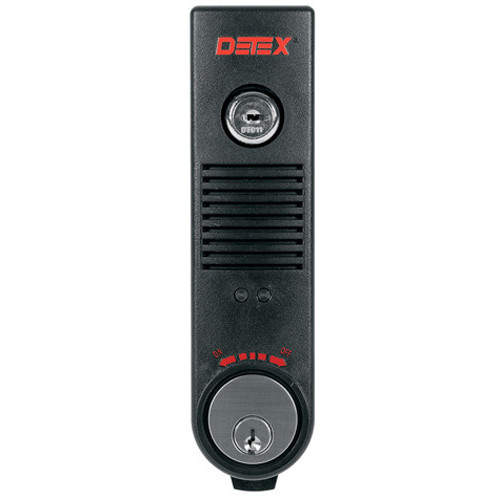
The EAX-500 steps up on two fronts. It's a die-cast housing instead of plastic, mounted to the door frame rather than the header, and it resets with a physical key rather than an internal timer, standard key or, on the IC7 configuration, a Detex interchangeable core cylinder that lets a locksmith rekey the alarm without pulling it off the door.
That IC7 option matters more than it sounds like on paper. A retail back door that turns over managers every year, or a school where key control actually matters, benefits from being able to rekey the alarm reset the same way you'd rekey any other cylinder on the property, instead of ordering a whole new alarm unit because a set of keys walked off with an employee who quit.
Sound output on the EAX-500 runs a 95dB piezo horn, slightly quieter on paper than the EAX-300's 100dB, but the die-cast build and key-reset function are what justify the step up in price. This is the one to spec on a heavier door, a higher-abuse location, or anywhere the alarm itself needs to survive the same conditions as the door hardware around it.
Matching the switch kit to the frame gap
Both families need a switch kit sized to the actual gap between door and frame, and this is where a lot of installs go sideways on measurement alone. Standard surface mount (SK1) covers most hollow metal and wood frames without a second thought. Wide-gap aluminum storefront framing needs SK2. Concealed installation in a wood frame calls for SK3. High-abuse areas, the kind that eat a standard switch kit in a season, get the armor-plated SK4. Uneven gaps get SK5, and overhead mounting situations get SK6.
Measure the door-to-frame gap before ordering, not after the alarm shows up and doesn't seat right. When in doubt, call it in; matching the wrong switch kit to the frame is the single most common return on this product line, and it's entirely avoidable with one measurement.
What these alarms are not
Neither the EAX-300 nor the EAX-500 controls the door. They alarm it. If a business needs a timed exit delay, the kind that lets someone push through after a 15-second countdown while sounding an alarm the whole time, that's a different Detex family entirely, the EAX-2500/EAX-3500 timed-bypass line, and it's a different conversation with different code implications for delayed egress. These two families are simpler: door opens, alarm sounds, full stop.
I've installed the EAX-300 on a strip-mall back door that got propped nightly for a cigarette break, and it stopped within a week once the owner started hearing about it from the alarm company. Cheap fix, exactly matched to a low-stakes door. I wouldn't put the same unit on a warehouse loading door that takes real abuse. That one gets the EAX-500, every time.
Common questions
Can either alarm tie into a central monitoring system?
Both are standalone local alarms out of the box; local sound is the primary function. Integration options exist on some configurations, but confirm with the specific model before assuming a tie-in is included.
How long does the battery last?
A quality alkaline 9V typically runs one to two years under normal use on this product line. Check it during routine fire door inspections rather than waiting for a low-battery chirp to catch anyone off guard.
Do I need an electrician to install either unit?
No. Both are designed for surface mount with basic hand tools, no wiring and no panel. That's the entire appeal over a hardwired exit alarm system.
Which one do I pick for a fire-rated door?
Both are compatible with fire-rated openings since neither modifies the door or frame structure. The EAX-500's frame mount and die-cast body still make more sense on a heavier fire door that also happens to see daily abuse.
What's the real-world difference in how loud they are?
100dB on the EAX-300 versus 95dB piezo on the EAX-500, close enough that neither wins on volume alone. Pick based on mounting location, housing durability, and whether you need a key reset, not decibels.
Not sure which switch kit fits your frame, or whether your door needs the timed-bypass family instead? Browse the full Detex line, or send us a photo of the frame gap and we'll match the kit.