
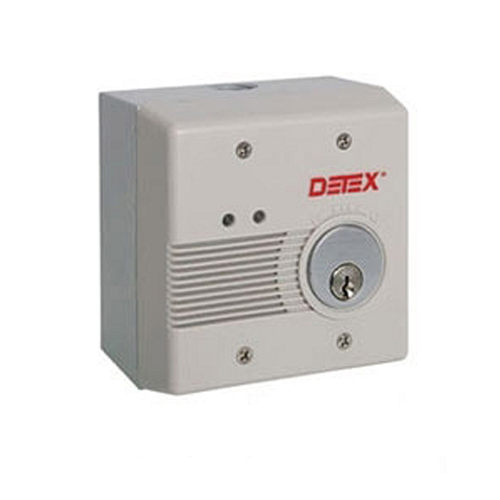
Detex EAX-2500 vs EAX-3500: Prop Alarm or Timed Bypass
Posted by Kent on 17th Sep 2026
Fire door propping is one of the most common life-safety violations an inspector writes up, and it's usually not malicious. It's a guy on a delivery run who doesn't want to badge back in eight times in twenty minutes. Detex builds two different door-prop alarms for two different versions of that problem, and mixing them up means either an alarm that goes off on every legitimate delivery, or a bypass nobody remembers to re-arm.
Detex EAX-2500 vs EAX-3500: catching a prop or managing a legitimate one
Both are door-mounted alarms that watch a magnetic contact and sound when the door stays open too long. Where they split is what happens when someone actually needs the door open for a while:
- EAX-2500: straight prop detection. An adjustable 1-30 second delay lets normal foot traffic pass through silently, and if the door stays open past that window, a 95dB alarm sounds. There's no legitimate way to hold it open longer without the alarm firing, and that's the point. It's built for doors where propping is never supposed to happen at all.
- EAX-3500: timed bypass. Authorized staff key-bypass the alarm for a set window, anywhere from 15 seconds to 4 minutes, and it automatically re-arms when the timer runs out with no one needing to remember to reset it. This is built for doors that get propped legitimately and often: loading docks, smoke-break exits, trash runs.
The failure mode each one is designed against is different. The 2500 assumes propping should never happen and alarms every single time it does. The 3500 assumes propping happens routinely and the real risk is someone bypassing it by hand and forgetting to turn it back on, so the timer handles that automatically instead of relying on a person.
Which one fits your door
If the opening is a true emergency-only exit, a stairwell door, a side exit nobody should be using for deliveries, the EAX-2500S (surface mount) or EAX-2500F (flush mount, cleaner look, recesses into the frame header) is the right call. Surface mount is faster to install and fully visible for a service tech; flush mount takes longer and looks better on a finished opening where appearance matters. Same alarm, same 95dB output, same adjustable delay. The mounting is the only real difference between those two.
If the door in question is a loading dock, a smoke-break door, or anywhere staff have a legitimate, repeated reason to prop it open, the EAX-3500 is built for exactly that. It also runs on a rechargeable NiMH pack instead of a disposable 9V, which matters here specifically because a bypass-heavy door cycles its battery far more than a rarely-used emergency exit ever will.
What both share
Both lines are UL Listed and address NFPA 101 and NFPA 80 fire door propping violations, both are ADA compliant, and both auto-reset when the door closes, with a key-reset option available if the auto-reset doesn't trip on its own for some reason. Neither one locks the door. These are alarms, not locking hardware, and if this opening also needs to control access rather than just alarm on propping, that's a different Detex product line entirely. Don't expect either EAX to double as a lock.
Don't confuse this with an alarmed panic device
If what you actually need is a locking device that alarms when used without authorization, a warehouse or stockroom exit where someone using the door at all is the concern rather than just propping it, that's a different category entirely. Detex's ECL-230D alarmed deadbolt panic device locks the door and sounds on unauthorized use. The EAX line covered here doesn't lock anything; it only alarms on a door being held open too long. Confusing the two means specifying an alarm where you needed a lock, or a lock where all you needed was a simple prop detector.
Installers see this mix-up most often on secondary exits that started life as delivery doors and got repurposed. Before you spec either EAX model, walk the door and confirm what the real failure mode is: people leaving it open, or people using it who shouldn't be there at all. Those are two different problems and Detex sells a different device for each.
Common questions
Can I set the EAX-2500's delay long enough to act like a bypass?
You can push it to 30 seconds, but that's the ceiling. It can't be extended further, and it still alarms every time that window is exceeded, with no automatic re-arm logic built in. If staff regularly need more time than that, you need the EAX-3500's bypass function, not a longer delay on the 2500.
Does the EAX-3500 alarm ever, or just during unauthorized use?
It alarms the same way the 2500 does outside of an active bypass window. The bypass only suspends the alarm for the timed period an authorized user keys in. Once the timer expires, it's back to full prop detection automatically, with nothing for staff to reset.
Which mounting should I pick, surface or flush?
Surface mount installs faster and is easier to service since everything's exposed. Flush mount takes more install time recessing it into the frame header but leaves a cleaner finished look. Pick surface for a utility door, flush for anything client-facing.
Do these need a magnetic contact installed separately?
No. Both the EAX-2500 and EAX-3500 ship with the magnetic contact, mounting hardware, and installation instructions in the box. There's nothing else to source before install.
Deciding between a straight prop alarm and a timed-bypass unit for a door with legitimate traffic: see the full Detex alarm hardware lineup, or if the door needs panic hardware in addition to an alarm, the Detex Advantex 10 crash bar piece covers that case. Call 877-365-5625 and tell us how often that door legitimately gets propped, and we'll point you at the right one.