
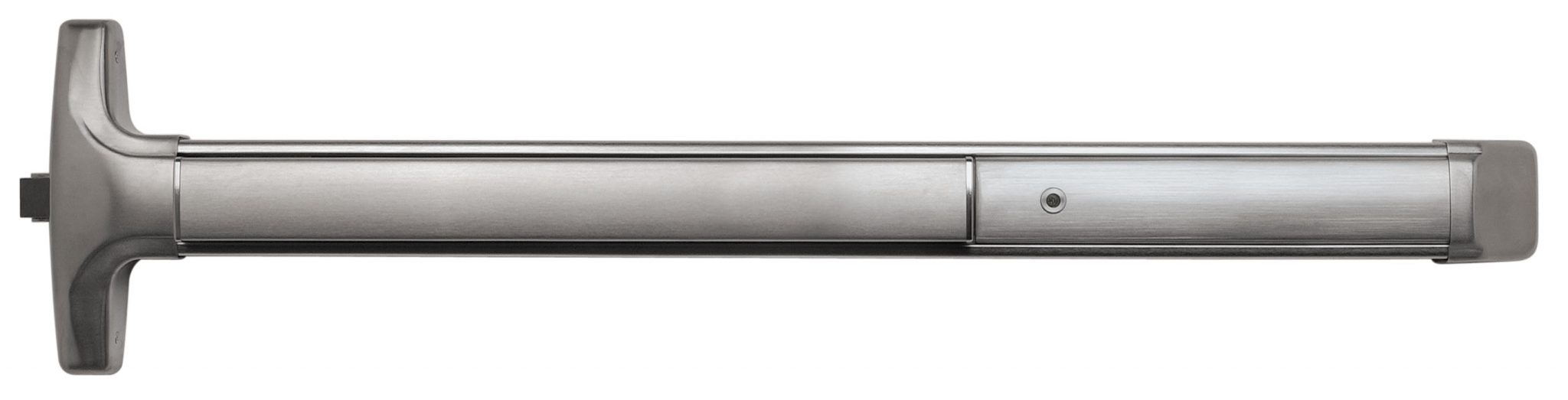
Detex V40: Cylinder Dogging or Less Dogging for a Storefront Exit
Posted by Kent on 20th Sep 2026
A fire-rated door doesn't get a vote on dogging
A retail buildout wants the front exit propped unlocked during business hours so staff aren't fumbling with a key every time a delivery comes through. A stairwell door two floors up needs the exact opposite: it has to latch, every single time, no exceptions, because it's rated for fire. Both doors can wear a Detex V40 exit device. They cannot wear the same configuration.
What the V40 Value Series is
The V40 is Detex's value-tier rim exit device, built to ANSI/BHMA A156.3 Grade 1 and UL 305 listed for panic hardware, tested to 1,000,000 cycles, and ADA compliant at under 15 pounds of operating force. It comes in 36" and 48" widths with a 99 surface strike, and the pushbar can be field-cut for a narrower door as long as you cut from the hinge end and leave the lock stile end at factory length. That last part matters. Cut the wrong end and the strike won't engage right.
Cylinder dogging: hold it open during business hours
The V40 CD holds the latch retracted with a key cylinder, so a store can leave the door functionally propped during the day and re-engage it with a key at close. It needs a standard 1-1/8" mortise cylinder, sold separately, and it's compatible with most major keyways, Schlage, Yale, Sargent, Corbin Russwin, so match it to whatever's already on the building's master key system. This is the right spec for a retail storefront, a warehouse loading door, anywhere staff need the door to function like it's unlocked for hours at a stretch without someone holding it open by hand.
Less dogging: the door that has to latch every time
The FV40 LD drops the dogging mechanism entirely. The door latches on every closure, no exceptions, and that's not a design preference. It's code. Fire-rated openings are listed for up to a 3-hour fire door under UL 10C, and NFPA 80 requires positive latching on every close for a labeled fire assembly. Dogging of any kind voids that rating. If an inspector finds a dogged exit device on a fire door, that's a failed walkthrough, and I've seen it happen on buildings that had the right door and the wrong hardware.
Picking the right one before you order
Ask what the opening is rated for before you ask what's convenient. A non-rated storefront door with heavy foot traffic during business hours wants cylinder dogging. A stairwell, a corridor door tied to a fire separation, or any labeled fire assembly gets less dogging, full stop, no matter how much the tenant wants to prop it open. This isn't a judgment call the building gets to make. It's in the code, and a locksmith who specs dogging on a fire door because the customer asked nicely is the one who eats the callback when it fails inspection.
One more thing worth checking before the device ships: confirm the door width against the 36" or 48" options. A device cut down in the field from 48" to fit a 40" opening still needs that hinge-end trim done correctly, and it's a lot easier to order the right base width than to fix a bad field cut after the fact.
Finish and the strike that comes with it
Both configurations we stock ship in Satin Aluminum, and both come with the 99 surface strike included, so there's no separate strike order to remember on a standard job. The finish matters more on the CD version, since that's the one that ends up on a visible, high-traffic storefront door where scuffs show. The LD version is more likely to end up in a stairwell nobody looks at twice, so cosmetics matter less there than the fire listing does.
What's covered if something fails
Detex backs the mechanical components with a limited lifetime warranty and the electronic components with three years. That warranty covers manufacturing defects, not field damage or a bad install, so a pushbar that's been cut down wrong or a strike mounted crooked isn't a warranty claim, it's a callback on the installer. Keep the installation instructions and mounting template that ship in the box; they're the fastest way to check your work against the factory spec if something's not latching right on day one.
What we stock
We carry the V40 cylinder dogging and the FV40 fire-rated less dogging configurations on our Detex hub. If the opening also needs to alert on a propped door instead of just meeting exit code, our piece on the ECL-230 prop alarm covers that separately. And for a door that takes real physical abuse on top of the exit requirement, we've written up the Advantex 10 as well.
Common questions
Can I add dogging to a fire-rated exit device after it's installed?
No. Fire-rated openings require positive latching on every closure under NFPA 80, and dogging voids that rating. If the door is fire-rated, order less dogging from the start.
What cylinder does the V40 CD need?
A standard 1-1/8" mortise cylinder, sold separately. It's compatible with most major keyways, including Schlage, Yale, Sargent, and Corbin Russwin, so match it to the building's existing key system.
Can the V40 pushbar be cut down for a narrower door?
Yes. Cut from the hinge end only and leave the lock stile end at factory length, or the strike won't engage correctly.
What's the fire rating on the FV40?
UL listed for up to a 3-hour fire door assembly, which covers the vast majority of labeled openings you'll run into on a commercial job.
Is the V40 the same as Detex's Advantex line?
No. The V40 is Detex's value-tier device for standard exit and code compliance. Advantex is built heavier for doors that see real physical abuse. Pick based on how hard the door gets used, not just the exit requirement.