
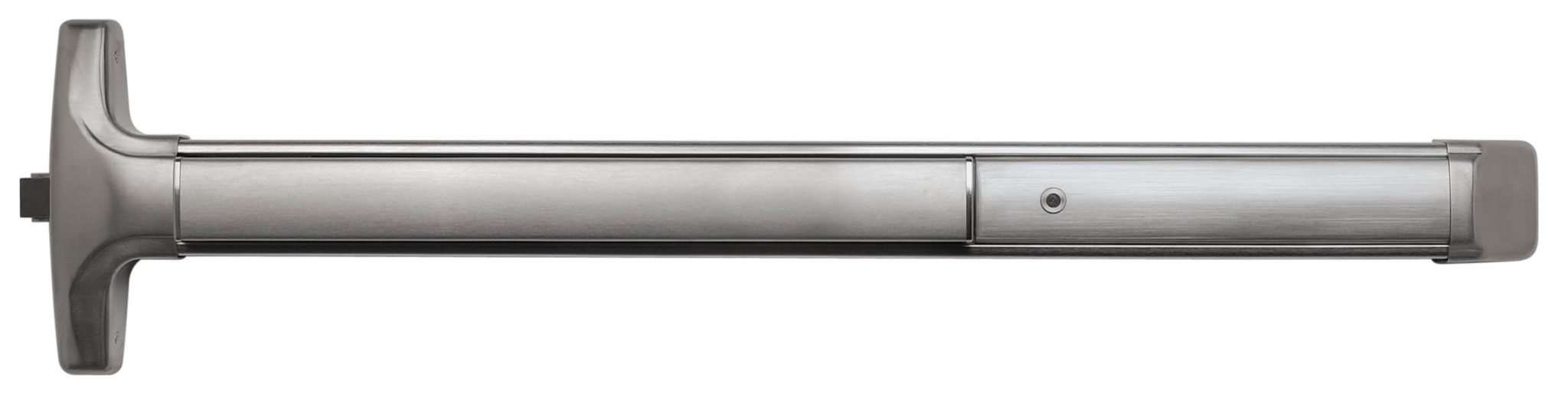
Detex V40 HD, EB, EA, EE and FV40 Compared
Posted by Kent on 13th Oct 2026
One panic bar, five different jobs
Detex V40 is the value rim exit device in the Detex line. It is a Grade 1 bar built to ANSI/BHMA A156.3 and listed to UL 305 as panic hardware. What confuses buyers is the string after "V40". HD, EB, EA, EE and FV40 all ride on the same family of bar, but each one answers a different question. Does the door need an alarm? Where does the alarm get its power? Does anyone have to be held back for a few seconds? Is the door fire rated?
Pick the wrong suffix and you find out on install day, with the bar on the bench and the wrong wires in the wall. This guide lines up the five so you can read a part number like a hardware schedule.
V40 HD: the plain bar with hex dogging
V40 HD 628 99 48 is the one with no electronics. The catalog describes it as hex dogging: a standard hex key holds the pushbar retracted during business hours, and the door latches again when you release it. No cylinder is needed for the hold-open. It is the right bar for a back-of-house door, a warehouse or a stockroom, anywhere you only need a person to be able to push out.
It is satin aluminum, finish 628, with the 99 surface strike, and the one in the catalog is the 48 inch length. The catalog notes the pushbar can be field-cut for narrower doors, from the hinge end only. The lock stile end has to stay factory length so it engages the strike.
V40 EB: battery-powered exit alarm
V40 EB CD 628 99 36 adds a 100 dB exit alarm that runs on a 9V battery, included. The catalog says the battery lasts up to three years in normal use and that no wiring is needed. The alarm sounds when someone pushes the bar. This is the part number for a retail back door, a school side exit or a loading door you want watched but cannot easily run power to.
The "CD" means cylinder dogging. A key in a cylinder holds the bar open during the day for authorized use. The cylinder is not in the box. The catalog says a standard 1-1/8 inch mortise cylinder is required, and it lists Schlage, Yale, Sargent and Corbin Russwin as compatible. Match your existing keyway if you are on a master key system.
V40 EA: hardwired alarm with fire command input
V40 EA FC3 CD 628 99 36 is the hardwired version. It runs on 24 VAC/DC instead of a battery, and the FC3 in the part number marks the fire command input for connection to a building fire alarm panel. The catalog says the device releases on the alarm signal. Cylinder dogging works the same as on the EB.
The power supply is not in the box. The catalog says a 24 VAC/DC supply is required and suggests Altronix or a similar UL listed supply. If you are tying into a fire panel, or you have a monitored exit where a dead battery is not acceptable, this is the one. The cost is a power run and a supply. The benefit is that nobody ever climbs a ladder to change a battery.
V40 EE: delayed egress
V40 EE FC3 CD 628 99 36 is the delayed egress version, for doors where you want a pause before someone can leave. The catalog gives a 15 second hold, field selectable to 30, with an audible and visual warning, then a clean release. It also releases immediately on a fire alarm signal through the FC3 input.
The catalog lists NFPA 101 Section 7.2.1.6 and IBC 1010.1.4.3 for delayed egress. It also states that a 30 second setting needs written approval from the Authority Having Jurisdiction before you install it. Do not skip that. A fire marshal who finds a 30 second delay on a door approved for 15 will make you change it. The box includes the required delayed egress warning sign, and power is 24 VAC/DC with a separate supply, same as the EA.
Typical doors are memory care wings, retail loss prevention exits and secured government areas. It is the most expensive bar of the five, and it should be. It is a life safety device with a timer in it.
FV40: when the door is fire rated
FV40 EB LD 628 99 36 carries the battery alarm from the EB, but it is built for fire doors. The catalog lists UL 10C and UL 10B and says it is UL listed for up to 3 hour fire door assemblies. The LD stands for less dogging. There is no hold-open at all, so the door latches every time it closes.
The catalog is direct about this. Fire-rated openings require positive latching on every closure under NFPA 80, and dogging of any kind voids the rating. A common mistake is ordering a plain V40 with cylinder dogging for a fire door because the dogging looks like a convenience. If the opening is rated, the answer is an FV40.
Side by side
| Part | Alarm | Power | Dogging | Fire rating |
|---|---|---|---|---|
| V40 HD | None | None | Hex key | Not rated |
| V40 EB CD | 100 dB exit alarm | 9V battery | Cylinder | Not rated |
| V40 EA FC3 CD | 100 dB alarm, fire command input | 24 VAC/DC | Cylinder | Listed as fire rated, hours not stated |
| V40 EE FC3 CD | Delayed egress, 15 or 30 sec | 24 VAC/DC | Cylinder | Listed as fire rated, hours not stated |
| FV40 EB LD | 100 dB exit alarm | 9V battery | None | Up to 3 hours |
On the EA and EE, the catalog marks both as fire rated but does not give an hour rating in the text. If you need the rating for a specific opening, ask us before you order. I will not guess at one.
How to choose
Work backward from the door, not the part number. First question: is the door fire rated? If yes, start with the FV40 line and leave dogging out. Second: does the exit need to be watched? If not, the HD does the job. If so, can you get power to the door? No power, take the EB. Power and a fire panel to tie into, take the EA. Third: does the building need people held at the door for a few seconds, as in a memory care unit? That is the EE, and it comes with a conversation with the fire marshal.
Two practical points. Order the cylinder with the bar if you want cylinder dogging, because it ships separately. And check the length against the door width before you cut anything. The catalog covers 36 and 48 inch devices, and a 36 inch bar on a 40 inch leaf is not a field fix.
Common questions
Can I cut a V40 down for a narrow door?
Yes. The catalog says the pushbar can be field-cut, from the hinge end only. The lock stile end stays at factory length.
How loud is the alarm?
The catalog puts it at about 100 dB at 3 feet, comparable to a car horn.
Does the EB need an electrician?
No. It runs on a 9V battery and the catalog says no wiring is needed.
Can I add dogging to the FV40?
No. Dogging of any kind voids the fire rating on a rated opening.
What does the Detex warranty cover?
The catalog lists a limited lifetime warranty on mechanical components and three years on electronic components. It does not cover field damage or improper installation.
Browse the full line on our Detex hardware page. For the dogging choice on the plain bar, see the V40 dogging guide. Send us the door, the width and whether it is rated, and we will line up the part number.