
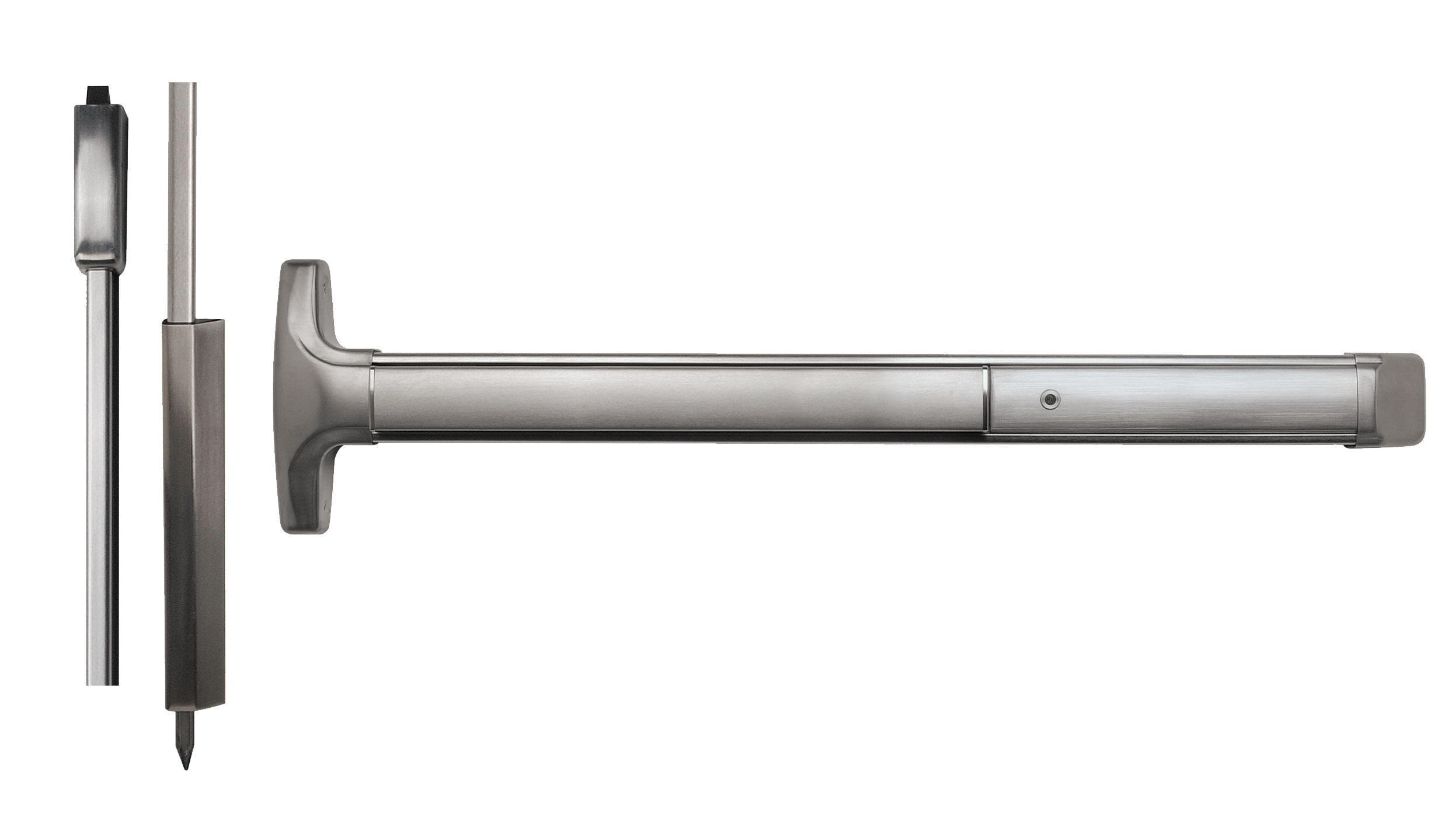
Detex V50: Battery Alarm or Hex Dogging Exit Device
Posted by Kent on 26th Sep 2026
Two Detex V50 Devices, One Body, Two Different Jobs
A distributor rep sold a strip-mall tenant a Detex V50 last year for a back exit that kept getting propped by the overnight crew. It showed up with a 9-volt battery bracket and a piezo horn instead of a hex key. Nobody wired it to anything because there was nothing to wire it to. The tenant called us confused, holding a spec sheet that mentioned an alarm and a door that still needed to close and latch on its own. That is the whole V50 line in one phone call: same Grade 1 surface vertical rod body, two completely different functions bolted onto it, and a buyer who ordered the wrong one because nobody explained the difference before the invoice printed.
The Detex V50 comes in two functions that solve two different problems. V50 EB (Exit Alarm Battery) is a self-contained door alarm. V50 HD (Hex Dogging) is plain mechanical panic hardware with a hold-open key. They share the same wide-stile body, the same ANSI/BHMA Grade 1 rating, and the same 36" x 84" door coverage. What they do not share is the reason you buy one over the other, and that decision has to happen before you order, not after it arrives.
V50 EB: The Alarm Does the Watching, Not You
Retailers lose real inventory every year to unauthorized exits through back doors, whether that is shrinkage walking out the loading door or a fire exit turning into an unsupervised smoke-break entrance nobody is watching. The Detex V50 EB CD (SKU V50 EB CD 628 96 36X84) answers that with a battery-powered exit alarm built into the device housing. Push the bar and it delivers a 100 dB alarm the instant the latch releases. No electrician, no low-voltage run back to a panel, no conduit through a slab you do not want to cut. It runs on its own battery and goes in wherever the door already is.
This is the device for a door that needs a deterrent, not a lockdown. A stockroom exit, a school side door that staff prop for deliveries, a warehouse dock door that security wants to know about the second it opens. Cylinder dogging lets a manager hold the door open on a battery-alarm model during a specific window (a loading dock at 6 a.m., a fire drill) without disabling the alarm function once the key is turned back. The alarm is the point of the purchase. If a device shows up without a battery compartment and a horn, it is not doing this job.
V50 HD: Sometimes You Just Need Panic Hardware
Not every exit needs electronics, and paying for an alarm function on a door that does not need one is money spent on a feature that will just get disabled or ignored. The Detex V50 HD (SKU V50 HD 628 96 36X84) is straight Grade 1 panic hardware with hex dogging: a standard hex key holds the latch retracted for business hours, and turning it back re-engages the latch so the door closes and locks itself after close. No battery to replace, no alarm to false-trigger when a customer leans on the bar, no monitoring to explain to staff who do not want to hear another horn go off.
This is the right call for a door that just needs to open under panic conditions, hold open during operating hours, and self-latch overnight — a warehouse side door with no theft history, an office suite's secondary exit, anywhere the building code requires panic hardware but nobody has asked for an alarm. Buying the HD instead of the EB here is not cutting corners. It is matching the hardware to the actual risk instead of the fear of one.
Reading the Rest of the Part Number
Both SKUs share the tail end of the part number for a reason: 628 is Satin Aluminum Clear Anodized finish, 96 is the surface strike that ships with the device, and 36X84 is the device length ordered for a standard 36" x 84" door. Change the door height or width and the length code changes with it, so measure the actual leaf before ordering rather than assuming every commercial door in the building matches. If a door runs taller or narrower than standard, tell us the exact dimension and we will confirm the correct length code rather than have you guess and cut a device you cannot return.
What Neither Version Gives You
Neither the EB nor the HD reports door position to an access control panel, and neither one is fire-rated out of the box in these SKUs. If the opening is on a fire door, you need a rated device with a documented listing, not a field modification. And if the goal is a signal to a security desk rather than a local alarm, that is a monitored strike or a maglock with a status output, not a V50. Buy the V50 for what it is: a self-contained deterrent or a self-contained panic device, not a networked sensor.
Common questions
Can I convert a V50 HD to an alarmed version later?
No. Exit Alarm Battery and Hex Dogging are built into the device at the factory as different internal mechanisms, not a field-swappable module. If there is any chance the door will need an alarm later, order the EB now rather than replace the whole device in a year.
Does the V50 EB need to be wired to anything?
No. The exit alarm runs on its own battery inside the device housing. That is the entire selling point: full alarm function with zero electrician time and no conduit run.
What happens when the V50 EB's battery dies?
The alarm stops sounding, but the device still functions as panic hardware — the door still opens and latches. Set a maintenance reminder rather than assume a silent door means it is secure.
Is hex dogging less secure than cylinder dogging?
It is different, not less secure. Hex dogging uses a hex key anyone with the tool can turn; cylinder dogging on the EB restricts hold-open to whoever holds the actual key. Pick hex when hold-open access does not need to be restricted, cylinder dogging when it does.
Will either V50 fit a narrow-stile aluminum storefront door?
No. Both of these SKUs are wide-stile devices built for hollow-metal and similar commercial doors. A narrow-stile aluminum storefront needs a narrow-stile rim or vertical-rod device instead — tell us the stile width before ordering.
Shop the full Detex exit alarm and panic hardware line for more configurations, or read how Detex V40 handles dogging on a narrower storefront body and how the ECL-230 stops a back door from getting propped for the retrofit version of this same problem.