
Don-Jo 95-CW vs 75-CW vs 19-CW Wrap-Around Plates for Marks
Posted by Kent on 13th Nov 2026
Three Don-Jo plates for Marks locks
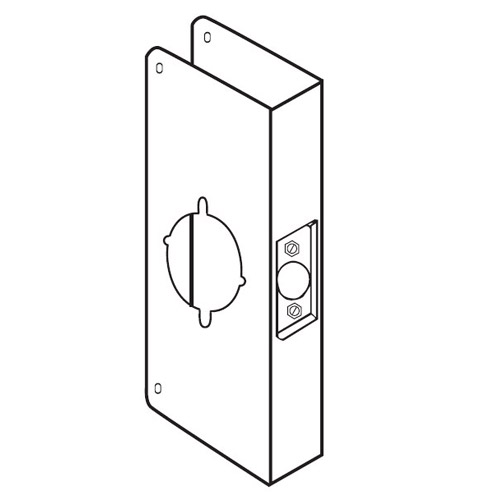
A Marks lock that comes off an old door leaves a bore, a latch mortise and usually a few holes from whatever hung there before it. A wrap-around plate covers the mess and gives the new lock fresh steel to bolt to. Don-Jo cuts three plates for Marks: the 95-CW and 75-CW for Marks levers, and the 19-CW for Marks I-Q locks. The part number picks the size, and the letters before -CW pick the finish.
If you have not used one before, the wrap-around plate lock swap piece explains the idea. This one sorts the three Marks numbers.
Sizes
| Plate | Listed for | Size (W x L) | Finishes listed |
|---|---|---|---|
| 95-CW | Marks levers | 4-3/4 x 9 in. | S, PB, BZ, AB |
| 75-CW | Marks levers | 4-3/4 x 5-1/2 in. | S, PB, BZ, AB |
| 19-CW | Marks I-Q locks | 5 x 15 in. | S, PB |
The listings share the same core specs: a 2-3/4 in. backset, a 1-3/4 in. door, 22 gauge (.032), four #8 x 3/4 in. Phillips truss head trim screws and two #8-32 x 1/4 in. flat head latch screws per latch. Each carries a one-year limited warranty from the maker.
95-CW versus 75-CW: same lock, different footprint
Both are listed for installing Marks levers. Both are 4-3/4 in. wide. What changes is the length: the 95 is 9 in. and the 75 is 5-1/2 in. The 75 covers little more than the lock itself. The 95 reaches up and down the door face almost twice as far.
The catalog does not say which Marks lever models go with which plate, and it does not say why Don-Jo makes both. So the choice comes from the door, not the lock. A 5-1/2 in. plate is enough when the old holes sit tight around the bore. A 9 in. plate is for the door where the last lock was bigger, or where a deadbolt or an escutcheon left holes above or below the new bore. Pull the old lock first, lay a tape on the door face and see how far the damage runs. If it runs past 5-1/2 in., take the 95.
19-CW: the Marks I-Q plate
The 19-CW is listed for Marks I-Q locks, and it is the big one: 5 x 15 in. That is wider and a good deal longer than the lever plates. The listing does not tell us what I-Q stands for or which Marks models fall under it, and we are not going to guess. If your Marks lock does not say Marks I-Q on the body or the box, do not assume the 19 is yours. Send us a photo or the model number. We will match it to the listing before you buy a plate that does not fit.
Two finishes are listed: stainless steel and polished brass.
Finish codes
The finish is in the part number, between the series and -CW. Going by the product names on the site:
- S: stainless steel
- PB: polished brass
- BZ: bronze
- AB: antique brass
The 95 and 75 come in all four, for example the 95-PB-CW, the 95-BZ-CW, the 95-AB-CW and the 75-PB-CW. The 19 comes in stainless and polished brass only. Match the plate to the lock's finish. A bronze lock on a stainless plate reads as a repair, and the plate is the largest piece of metal on the door face.
Reading a part number
Take 95-AB-CW. The 95 is the plate series, the AB is antique brass and the CW is Don-Jo's wrap-around code. Take 19-S-CW: series 19, stainless, wrap-around. Once you can read one, you can read the whole page, and you can see at a glance when a number you were given by phone is missing a finish letter. A number with no finish letter is not a complete order. Ask which finish before you place it.
If your shop services Marks locks across several buildings, the practical stock is the 75 and 95 in stainless, since stainless goes with most door hardware. The brass and bronze versions are the special orders that match a particular building.
What a plate fixes and what it does not
The plate gives the lock fresh steel and hides old holes. It does not rebuild a door that is cracked through, or a wood door with a split along the latch edge, or a hollow metal door with a crushed skin. If the door is not sound, fix the door. Count the holes you need to hide, check the edge where the latch seats, and then choose the plate.
If you are covering more than a lock bore
A longer plate does more than hide holes. It spreads the clamp of the trim screws over a larger area of the door face, which helps on an older door whose skin has gone soft around the bore. That is a reason to lean toward the 95 over the 75 on a tired door, even when the old holes would fit under the shorter one. The listings do not make that claim for the plates, so treat it as the shop's judgment and not a rating. What the listings do give you is the gauge, 22 (.032), and the fastener counts.
Before you order
- Read the model off the Marks lock. Lever or I-Q.
- Confirm a 2-3/4 in. backset and a 1-3/4 in. door.
- Measure how far the old holes run. Under 5-1/2 in. is a 75. Longer is a 95.
- Pick the finish last, and check it exists for the number you chose.
The rest of the maker's line is on the Don-Jo page.
Common questions
What is the difference between the 75-CW and the 95-CW?
Length. Both are 4-3/4 in. wide and listed for Marks levers. The 75 is 5-1/2 in. long and the 95 is 9 in. The catalog gives no other difference.
Which plate is for Marks I-Q locks?
The 19-CW, at 5 x 15 in., in stainless or polished brass.
What door thickness do these plates fit?
All three are listed for a 1-3/4 in. door.
Do the plates come with screws?
The listings give the fastener counts: four trim screws and two latch screws per latch.
Which finishes does the 19-CW come in?
Stainless steel and polished brass.