
DynaLock 1300: What ARSB, DPSM and BPS Mean
Posted by Kent on 12th Oct 2026
A deadbolt that hides inside the door
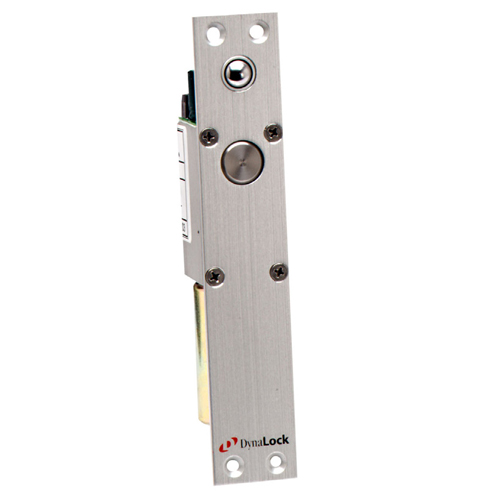
The DynaLock 1300 series is a mortise electric deadbolt built for places where a conventional lock does not fit. The catalog describes it as designed for concealed mounting. It is a narrow aluminum body, 1-1/2 in. wide by 8 in. tall with a 1-5/8 in. backset, and a 3/4 in. diameter bolt with a 3/4 in. throw. It runs on 12 to 24 volts AC or DC, continuous duty, so one model covers whatever supply the opening already has.
It is fail-safe. Power extends the bolt, and losing power lets the bolt spring back. That one fact decides where the 1300 belongs, and I come back to it below.
The reason this lock draws questions is the suffix. A plain 1300-12/24 sits next to six or seven variants that all look the same in the thumbnail. The suffixes add sensors. Here is what each one does, using the catalog's own definitions.
The plain model
1300-12/24 is the base lock: the deadbolt, dual voltage, aluminum strike, satin aluminum finish. No sensors. It tells the controller nothing about whether the bolt is thrown or the door is shut. If your system only needs the door locked and unlocked on command, this is the cheapest correct answer.
What the suffixes mean
- ARSB: auto-relock switch, ball type. See 1300-12/24-ARSB.
- ARSM: auto-relock switch, concealed.
- DPSM: door position switch, concealed. See 1300-12/24-DPSM.
- DPSB: appears in combination numbers such as ARSB-DPSB. By the same pattern as DPSM it is the ball-type door position switch.
- BPS: bolt position switch. See 1300-12/24-BPS.
- MB: appears on a few combination part numbers, such as ARSM-DPSM-MB. The catalog does not spell it out on the pages I checked, so I will not guess. Ask us before ordering one.
Combinations stack the suffixes. 1300-12/24-ARSM-DPSM is a deadbolt with a concealed auto-relock switch and a concealed door position switch.
What each sensor is for
Auto-relock is the one worth understanding. When the door opens and shuts, the bolt should extend again by itself so a person cannot walk away from a propped-looking door that looks locked and is not. An auto-relock switch senses the door and tells the lock to relock. On an opening with a keypad and no reader on the inside, this is what keeps the door honest on a busy day.
The door position switch tells the access control panel if the door is open or closed. Without one, the panel only knows that it asked the lock to unlock. Door position is how you get a door-held-open alarm or a forced-door alarm. If you want either, buy the lock with the switch built in, or you will be adding a separate contact later and drilling a frame that was supposed to stay clean. Our guide to the Securitron DPS-M versus DPS-W explains the separate-contact route.
The bolt position switch reports whether the bolt is extended. It is the proof that the door is actually locked, not just commanded locked. A door that is shut but whose bolt did not throw because of a misaligned strike looks fine at the panel until someone leans on it. If your insurer or your own policy wants confirmation of lock state, BPS is the suffix.
Ball type or concealed
B and M are the two mounting styles of the sensor. B is a ball type and M is a concealed type. The catalog calls the DPSM sensor concealed, which matches the reason this lock exists, a clean door with nothing visible. I do not have a drawing that shows where the ball-type sensor sits or what the door needs to look like for it, so I will not invent a layout. If you are not sure which one fits your frame, send us a photo and the existing prep.
Where the 1300 belongs, and where it does not
The catalog is direct about two exclusions. The lock is not suitable for wood door and frame installations, and not suitable for doors with panic devices. That rules out a surprising number of doors. If the door has an exit device on it, the 1300 is not your lock. If the frame is wood, the 1300 is not your lock.
The fail-safe behavior is the other limit. When power is lost, the bolt retracts and the door is unlocked. That is correct for a door that must open in an emergency, and wrong for a door that must stay secure when the building loses power. A fail-safe deadbolt on a perimeter door means that every power cut is an unlocked building. If the opening is a security door, you want a fail-secure device, and our DynaLock maglock sizing guide covers the other end of the DynaLock line.
Where it fits is a hollow metal or aluminum door with a narrow stile, a door that has no room for a surface lock, and an opening where the owner does not want hardware showing. Interior doors on a controlled corridor, stockrooms behind a reception desk, office suites where the lock should vanish.
Picking one: a short decision path
- Is the door wood, or does it have a panic device? Stop. Pick another lock.
- Must the door stay locked when power fails? Stop. This lock is fail-safe.
- Do you need the panel to know the door is shut? Add DPSM (or DPSB).
- Do you need the door to relock itself after it closes? Add ARSM (or ARSB).
- Do you need proof the bolt actually threw? Add BPS.
- If the answers are all no, buy the plain model and keep the savings.
Wiring notes
I do not have the current draw or the terminal diagram in front of me, so I will not quote them. Get both from the manufacturer's sheet before you pull wire. What I can say from experience is that every sensor suffix means more conductors in the same narrow door loop, so a plain 1300 and a 1300 with auto-relock, door position and bolt position are very different pulls. Check the loop and the transfer hinge before you commit to the sensor-heavy model, or you will be pulling a second cable through a door that was never meant to hold one.
Common questions
What does ARSB mean on a DynaLock 1300?
Auto-relock switch, ball type. The ARSM version is the same switch in the concealed style.
Is the DynaLock 1300 fail-safe or fail-secure?
Fail-safe. The bolt extends when power is applied and retracts by spring when power is lost.
Can I use a DynaLock 1300 on a wood door?
No. The catalog says it is not suitable for wood door and frame installations, or for doors with panic devices.
What voltage does the 1300 run on?
12 to 24 volts, AC or DC, continuous duty.
See the full line on our DynaLock page, or send us the door and frame type and we will pick the model.